程序分析
exec1.c & exect2.c & exect3.c
程序代码 (以exect1.c为例,其他两个结构类似)
#include <stdio.h>
#include <unistd.h>

int main()
{
	char	*arglist[3];

	arglist[0] = "ls";
	arglist[1] = "-l";
	arglist[2] = 0 ;//NULL
	printf("* * * About to exec ls -l
");
	execvp( "ls" , arglist );
	printf("* * * ls is done. bye");

	return 0;
}
运行结果:

结果显示代码“* * * ls is done. bye”没有打印出来。
原因:因为调用execvp,execlp,execv时,内核将新程序载入到当前进程,替代当前进程的代码和数据。
forkdemo1.c
程序代码:
#include	<stdio.h>
#include    <sys/types.h>
#include    <unistd.h>
int main()
{
	int	ret_from_fork, mypid;
	mypid = getpid();
	printf("Before: my pid is %d
", mypid);
	ret_from_fork = fork();
	sleep(1);
	printf("After: my pid is %d, fork() said %d
",
		getpid(), ret_from_fork);

	return 0;
}
运行结果:

分析:fork()在父进程中返回子进程的pid,在子进程中返回0。
forkdemo2.c
程序代码:
#include <stdio.h>
#include <unistd.h>

int main()
{
	printf("before:my pid is %d
", getpid() );
	fork();
	fork();
	printf("aftre:my pid is %d
", getpid() );

	return 0;
}
运行结果:
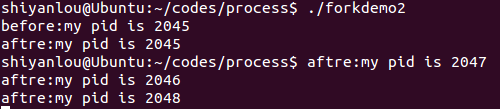
分析:两次fork()共产生3个子进程,加上父进程总共有4个进程。
forkdemo3.c
程序代码:
#include	<stdio.h>
#include    <stdlib.h>
#include    <unistd.h>

int main()
{
	int	fork_rv;

	printf("Before: my pid is %d
", getpid());

	fork_rv = fork();		/* create new process	*/

	if ( fork_rv == -1 )		/* check for error	*/
	perror("fork");
	else if ( fork_rv == 0 ){
		printf("I am the child.  my pid=%d
", getpid());

		exit(0);
	}
	else{
		printf("I am the parent. my child is %d
", fork_rv);
		exit(0);
	}

	return 0;
}
运行效果:

forkdemo4.c
程序代码:
#include	<stdio.h>
#include    <stdlib.h>
#include    <unistd.h>

int main()
{
	int	fork_rv;

	printf("Before: my pid is %d
", getpid());

	fork_rv = fork();		/* create new process	*/

	if ( fork_rv == -1 )		/* check for error	*/
		perror("fork");

	else if ( fork_rv == 0 ){
		printf("I am the child.  my pid=%d
", getpid());
		printf("parent pid= %d, my pid=%d
", getppid(), getpid());
		exit(0);
	}

	else{
		printf("I am the parent. my child is %d
", fork_rv);
		sleep(10);
		exit(0);
	}

	return 0;
}
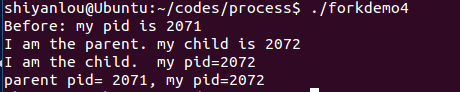
运行结果:
forkgdb.c
程序代码:
#include <stdio.h>
#include <stdlib.h>
#include <unistd.h>

int  gi=0;
int main()
{
	int li=0;
	static int si=0;
	int i=0;

	pid_t pid = fork();
	if(pid == -1){
		exit(-1);
	}
	else if(pid == 0){
		for(i=0; i<5; i++){
			printf("child li:%d
", li++);
			sleep(1);
			printf("child gi:%d
", gi++);
			printf("child si:%d
", si++);
		}
		exit(0);

	}
	else{
		for(i=0; i<5; i++){
			printf("parent li:%d
", li++);
			printf("parent gi:%d
", gi++);
			sleep(1);
			printf("parent si:%d
", si++);
		}
	exit(0);

	}
	return 0;
}
运行效果:
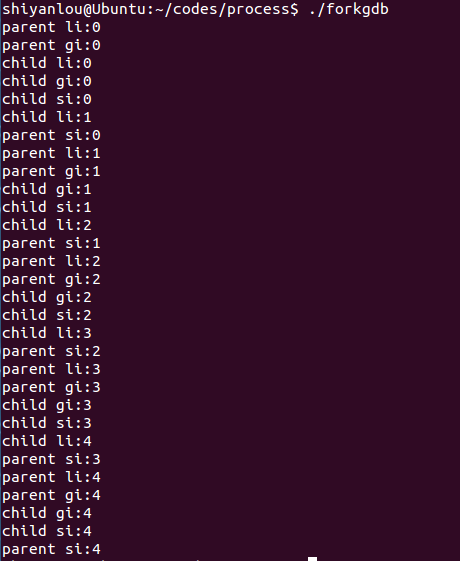
分析:运行结果说明了子进程与父进程并发运行。
psh1.c
#include	<stdio.h>
#include	<stdlib.h>
#include	<string.h>
#include    <unistd.h>

#define	MAXARGS		20
#define	ARGLEN		100

//将字符串内容当做命令来执行。
int execute( char *arglist[] )
{
	execvp(arglist[0], arglist);
	perror("execvp failed");
	exit(1);
}

char * makestring( char *buf )
{
	char	*cp;

	buf[strlen(buf)-1] = '';
	cp = malloc( strlen(buf)+1 );
	if ( cp == NULL ){
		fprintf(stderr,"no memory
");
		exit(1);
	}
	strcpy(cp, buf);
	return cp;
}

int main()
{
	char	*arglist[MAXARGS+1];
	int		numargs;
	char	argbuf[ARGLEN];

	numargs = 0;
	while ( numargs < MAXARGS )
	{
		printf("Arg[%d]? ", numargs);
		if ( fgets(argbuf, ARGLEN, stdin) && *argbuf != '
' )
			arglist[numargs++] = makestring(argbuf);
		else
		{
			if ( numargs > 0 ){
				arglist[numargs]=NULL;
				execute( arglist );	//将arglist中的字符串当做命令来执行。
				numargs = 0;
			}
		}
	}
	return 0;
}
运行结果:
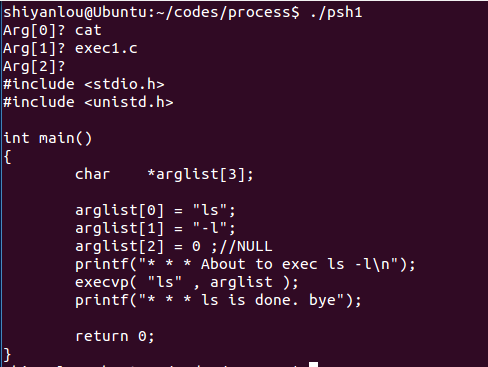
程序功能:输入字符串并将其当做命令执行。
psh2.c
程序代码:
#include	<stdio.h>
#include    <stdlib.h>
#include    <string.h>
#include    <sys/types.h>
#include    <sys/wait.h>
#include    <unistd.h>
#include	<signal.h>

#define	MAXARGS		20
#define	ARGLEN		100

char *makestring( char *buf )
{
	char	*cp;

	buf[strlen(buf)-1] = '';
	cp = malloc( strlen(buf)+1 );
	if ( cp == NULL ){
		fprintf(stderr,"no memory
");
		exit(1);
	}
	strcpy(cp, buf);
	return cp;
}

void execute( char *arglist[] )
{
	int	pid,exitstatus;

	pid = fork();
	switch( pid ){
		case -1:
			perror("fork failed");
			exit(1);
		case 0:
			execvp(arglist[0], arglist);
			perror("execvp failed");
			exit(1);
		default:
			while( wait(&exitstatus) != pid )
				;
			printf("child exited with status %d,%d
",
					exitstatus>>8, exitstatus&0377);
	}
}

int main()
{
	char	*arglist[MAXARGS+1];
	int		numargs;
	char	argbuf[ARGLEN];

	numargs = 0;
	while ( numargs < MAXARGS )
	{
		printf("Arg[%d]? ", numargs);
		if ( fgets(argbuf, ARGLEN, stdin) && *argbuf != '
' )
			arglist[numargs++] = makestring(argbuf);
		else
		{
			if ( numargs > 0 ){
				arglist[numargs]=NULL;
				execute( arglist );
				numargs = 0;
			}
		}
	}
	return 0;
}
运行结果:
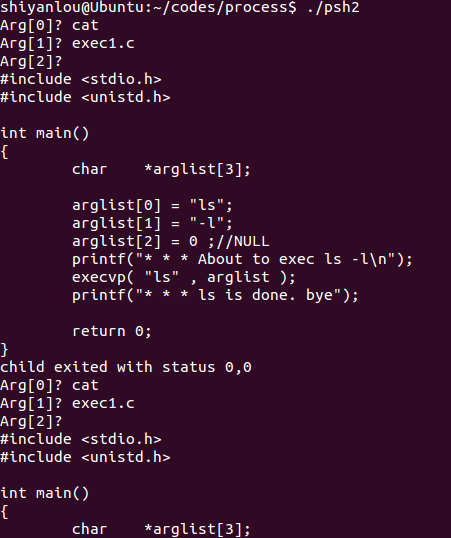
程序功能:不断产生新的子进程输入字符串命令。
testbuf1
程序代码:
#include <stdio.h>
#include <stdlib.h>
int main()
{
	printf("hello");
	fflush(stdout);
	while(1);
}
运行效果:

testbuf2
程序代码:
#include <stdio.h>
int main()
{
	printf("hello
");
	while(1);
}
运行效果:

testbuf3
程序代码:
#include <stdio.h>

int main()
{
	fprintf(stdout, "1234", 5);
	fprintf(stderr, "abcd", 4);
}
运行效果:

分析:在默认情况下,stdout是行缓冲的,他的输出会放在一个buffer里面,只有到换行的时候,才会输出到屏幕。而stderr是无缓冲的,会直接输出。所以输出结果为:abcd1234
testpid.c
程序代码:
#include <stdio.h>
#include <unistd.h>

#include <sys/types.h>

int main()
{
	printf("my pid: %d
", getpid());//获取当前进程pid
	printf("my parent's pid: %d
", getppid());//获取当前进程父进程pid
	return 0;
}
运行效果:

testpp.c
程序代码:
#include <stdio.h>
#include <stdlib.h>
int main()
{
	char **pp;
	pp[0] = malloc(20);

	return 0;
}
运行效果:

testsystem.c
程序代码:
#include	<stdlib.h>

int main ( int argc, char *argv[] )
{

	system(argv[1]);
	system(argv[2]);
	return EXIT_SUCCESS;
}
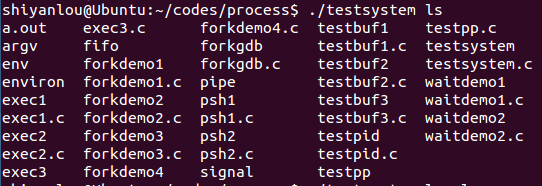
- system函数:
system()会调用fork()产生子进程,由子进程来调用/bin/sh-c string来执行参数string字符串所代表的命令,此命令执行完后随即返回原调用的进程。在调用system()期间SIGCHLD 信号会被暂时搁置,SIGINT和SIGQUIT 信号则会被忽略。 返回值 =-1:出现错误 =0:调用成功但是没有出现子进程 >0:成功退出的子进程的id 如果system()在调用/bin/sh时失败则返回127,其他失败原因返回-1。若参数string为空指针(NULL),则返回非零值>。如果system()调用成功则最后会返回执行shell命令后的返回值,但是此返回值也有可能为 system()调用/bin/sh失败所返回的127,因此最好能再检查errno 来确认执行成功。
运行效果:
waitdemo1.c
程序代码:
#include	<stdio.h>
#include    <stdlib.h>
#include    <sys/types.h>
#include    <sys/wait.h>
#include    <unistd.h>

#define	DELAY	4

void child_code(int delay)
{
	printf("child %d here. will sleep for %d seconds
", getpid(), delay);
	sleep(delay);
	printf("child done. about to exit
");
	exit(17);
}

void parent_code(int childpid)
{
	int wait_rv=0;		/* return value from wait() */
	wait_rv = wait(NULL);//子进程成功结束返回子进程PID,没有子进程则返回-1。
	printf("done waiting for %d. Wait returned: %d
",
			childpid, wait_rv);
}
int main()
{
	int  newpid;
	printf("before: mypid is %d
", getpid());
	if ( (newpid = fork()) == -1 )
		perror("fork");
	else if ( newpid == 0 )
		child_code(DELAY);
	else
		parent_code(newpid);

	return 0;
}
运行效果:

waitdemo2.c
程序代码:
#include <stdio.h>
#include <stdlib.h>
#include <sys/types.h>
#include <sys/wait.h>
#include <unistd.h>
#define	DELAY	10

void child_code(int delay)
{
	printf("child %d here. will sleep for %d seconds
", getpid(), delay);
	sleep(delay);
	printf("child done. about to exit
");
	exit(27);
}

void parent_code(int childpid)
{
	int wait_rv;
	int child_status;
	int high_8, low_7, bit_7;

	wait_rv = wait(&child_status);
	printf("done waiting for %d. Wait returned: %d
", childpid, wait_rv);

	high_8 = child_status >> 8;     /* 1111 1111 0000 0000 */
	low_7  = child_status & 0x7F;   /* 0000 0000 0111 1111 */
	bit_7  = child_status & 0x80;   /* 0000 0000 1000 0000 */
	printf("status: exit=%d, sig=%d, core=%d
", high_8, low_7, bit_7);
}

int main()
{
	int  newpid;

	printf("before: mypid is %d
", getpid());

	if ( (newpid = fork()) == -1 )
		perror("fork");
	else if ( newpid == 0 )
		child_code(DELAY);
	else
		parent_code(newpid);
}
运行结果:
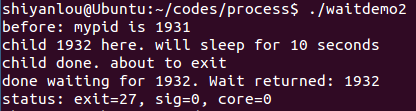
argtest.c
程序代码:
#include <stdio.h>
#include <stdlib.h>
#include "argv.h"

int main(int argc, char *argv[]) {
char delim[] = " 	";
int i;
char **myargv;
   int numtokens;

   if (argc != 2) {
     fprintf(stderr, "Usage: %s string
", argv[0]);
	  return 1;
}
if ((numtokens = makeargv(argv[1], delim, &myargv)) == -1) {
	  fprintf(stderr, "Failed to construct an argument array for %s
", argv[1]);
 	 return 1;
}
printf("The argument array contains:
");
for (i = 0; i < numtokens; i++)
	  printf("%d:%s
", i, myargv[i]);

   execvp(myargv[0], myargv);

   return 0;
}
功能:将输入字符串当做系统命令执行。
运行结果:

environ.c
程序代码:
#include <stdio.h>
#include <stdlib.h>

int main(void)
{
	printf("PATH=%s
", getenv("PATH"));
	setenv("PATH", "hello", 1);
	printf("PATH=%s
", getenv("PATH"));
#if 0
	printf("PATH=%s
", getenv("PATH"));
	setenv("PATH", "hellohello", 0);
	printf("PATH=%s
", getenv("PATH"));


	printf("MY_VER=%s
", getenv("MY_VER"));
	setenv("MY_VER", "1.1", 0);
	printf("MY_VER=%s
", getenv("MY_VER"));
	#endif
	return 0;
}
运行效果:

environvar.c
运行代码:
#include <stdio.h>
int main(void)
{
	extern char **environ;
	int i;
	for(i = 0; environ[i] != NULL; i++)
		printf("%s
", environ[i]);

	return 0;
}
功能:打印环境变量。
运行效果:
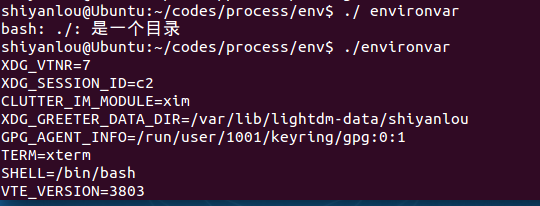
sigactdemo.c
程序代码:
#include	<stdio.h>
#include    <unistd.h>
#include	<signal.h>
#define	INPUTLEN	100
void inthandler();
int main()
{
	struct sigaction newhandler;
	sigset_t blocked;
	char x[INPUTLEN];
	newhandler.sa_handler = inthandler;//新的信号处理函数效果与signal()类似
	newhandler.sa_flags = SA_RESTART|SA_NODEFER
	|SA_RESETHAND;//设置信号处理相关操作
	sigemptyset(&blocked);	//将blocked信号集初始化,并清空。
	sigaddset(&blocked, SIGQUIT);//将SIGQUIT信号加入参数blocked信号集。
	newhandler.sa_mask = blocked;//暂时将block信号阻塞
	if (sigaction(SIGINT, &newhandler, NULL) == -1)
		perror("sigaction");
	else
		while (1) {
			fgets(x, INPUTLEN, stdin);
			printf("input: %s", x);
		}
	return 0;
}
void inthandler(int s)
{
	printf("Called with signal %d
", s);
	sleep(s * 4);
	printf("done handling signal %d
", s);
}
sigation结构体:
struct sigaction {

void (*sa_handler)(int);
void (*sa_sigaction)(int, siginfo_t *, 	void *);
sigset_t sa_mask;
int sa_flags;
void (*sa_restorer)(void);
}
- sa_handler此参数和signal()的参数handler相同,代表新的信号处理函数,其他意义请参考signal()。
- sa_mask 指定在信号处理程序执行过程中,哪些信号应当被阻塞。默认当前信号本身被阻塞。
- sa_restorer 已过时,POSIX不支持它,不应再使用。
- sa_flags 用来设置信号处理的其他相关操作,下列的数值可用。
- sa_flags还可以设置其他标志:
- SA_RESETHAND:当调用信号处理函数时,将信号的处理函数重置为缺省值SIG_DFL
- SA_RESTART:如果信号中断了进程的某个系统调用,则系统自动启动该系统调用
- SA_NODEFER :一般情况下, 当信号处理函数运行时,内核将阻塞该给定信号。但是如果设置了 SA_NODEFER标记, 那么在该信号处理函数运行时,内核将不会阻塞该信号
运行效果:

sigactdemo2.c
#include <unistd.h>
#include <signal.h>
#include <stdio.h>

void sig_alrm( int signo )
{
	/*do nothing*/
}

unsigned int mysleep(unsigned int nsecs)
{
	struct sigaction newact, oldact;
	unsigned int unslept;

	newact.sa_handler = sig_alrm;//设置处理函数
	sigemptyset( &newact.sa_mask );//清空newact的阻塞信号集
	newact.sa_flags = 0;//设置信号处理的其它操作为空
	sigaction( SIGALRM, &newact, &oldact );//显式取消阻塞信号

	alarm( nsecs );//设置闹钟
	pause();

	unslept = alarm ( 0 );//取消闹钟,并返回剩余时间
	sigaction( SIGALRM, &oldact, NULL );

	return unslept;
}

int main( void )
{
	while( 1 )
	{
		mysleep( 2 );
		printf( "Two seconds passed
" );
	}

	return 0;
}
运行效果:
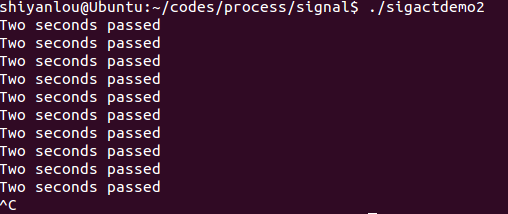
sigdemo1.c
#include	<stdio.h>
#include	<signal.h>
void	f(int);
int main()
{
	int	i;
	signal( SIGINT, f );//改变键盘ctril+C处理函数
	for(i=0; i<5; i++ ){
		printf("hello
");
		sleep(2);
	}

	return 0;
}

void f(int signum)
{
	printf("OUCH!
");
}
运行效果:
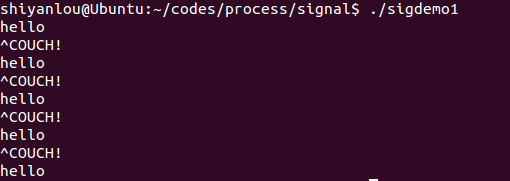
sigdemo2.c
#include	<stdio.h>
#include	<signal.h>

main()
{
	signal( SIGINT, SIG_IGN );//设置忽略Ctrl+C中断信号。

	printf("you can't stop me!
");
	while( 1 )
	{
		sleep(1);
		printf("haha
");
	}
}
运行效果:

sigdemo3.c
程序代码:
#include	<stdio.h>
#include    <string.h>
#include	<signal.h>
#include    <unistd.h>

#define	INPUTLEN	100

int main(int argc, char *argv[])
{
	void inthandler(int);
	void quithandler(int);
	char input[INPUTLEN];
	int nchars;

	signal(SIGINT, inthandler);//^C
	signal(SIGQUIT, quithandler);//^

	do {
		printf("
Type a message
");
		nchars = read(0, input, (INPUTLEN - 1));
		if (nchars == -1)
			perror("read returned an error");
		else {
			input[nchars] = '';
			printf("You typed: %s", input);
		}
	}
	while (strncmp(input, "quit", 4) != 0);
	return 0;
}

void inthandler(int s)
{
	printf(" Received signal %d .. waiting
", s);
	sleep(2);
	printf("  Leaving inthandler
");
}

void quithandler(int s)
{
	printf(" Received signal %d .. waiting
", s);
	sleep(3);
	printf("  Leaving quithandler
");
}
运行效果:
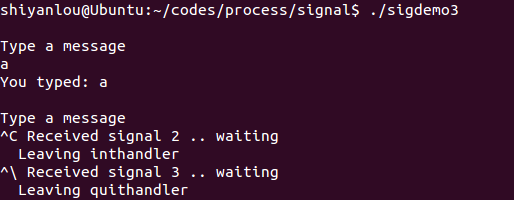
listargs.c
程序代码
#include	<stdio.h>

main( int ac, char *av[] )
{
	int	i;

	printf("Number of args: %d, Args are:
", ac);//ac为传入参数的个数。
	for(i=0;i<ac;i++)
		printf("args[%d] %s
", i, av[i]);

	fprintf(stderr,"This message is sent to stderr.
");
}
运行效果:


pipe.c
#include	<stdio.h>
#include    <stdlib.h>
#include	<unistd.h>

#define	oops(m,x)	{ perror(m); exit(x); }

int main(int ac, char **av)
{
	int	thepipe[2],
		newfd,
		pid;
	//判断管道输入格式是否正确
	if ( ac != 3 ){
		fprintf(stderr, "usage: pipe cmd1 cmd2
");
		exit(1);
	}
	//管道建立失败,输出错误信息
	if ( pipe( thepipe ) == -1 )
		oops("Cannot get a pipe", 1);
	//子进程创建失败,输出错误信息
	if ( (pid = fork()) == -1 )
		oops("Cannot fork", 2);

	if ( pid > 0 ){
		close(thepipe[1]);

		if ( dup2(thepipe[0], 0) == -1 )//将thepipe[0]重定向到标准输入
			oops("could not redirect stdin",3);

		close(thepipe[0]);
		execlp( av[2], av[2], NULL);//试着执行av[2]中的命令
		oops(av[2], 4);
	}

	close(thepipe[0]);

	if ( dup2(thepipe[1], 1) == -1 )//将thepipe[1]重定向到标准输出
		oops("could not redirect stdout", 4);

	close(thepipe[1]);
	execlp( av[1], av[1], NULL);//试着执行av[1]中的命令
	oops(av[1], 5);
}
-
pipe():
-
头文件 #include<unistd.h>
-
定义函数: int pipe(int filedes[2]);
-
函数说明: pipe()会建立管道,并将文件描述词由参数filedes数组返回。
filedes[0]为管道里的读取端
filedes[1]则为管道的写入端。 -
返回值: 若成功则返回零,否则返回-1,错误原因存于errno中。
-
execlp():
从PATH 环境变量所指的目录中查找符合参数file的文件名,找到后便执行该文件,然后将第二个以后的参数当做该文件的argv[0]、argv[1]……,最后一个参数必须用空指针(NULL)作结束。如果用常数0来表示一个空指针,则必须将它强制转换为一个字符指针,否则将它解释为整形参数,如果一个整形数的长度与char * 的长度不同,那么exec函数的实际参数就将出错。如果函数调用成功,进程自己的执行代码就会变成加载程序的代码,execlp()后边的代码也就不会执行了。
返回值:
如果执行成功则函数不会返回,执行失败则直接返回-1,失败原因存于errno 中。
运行效果:
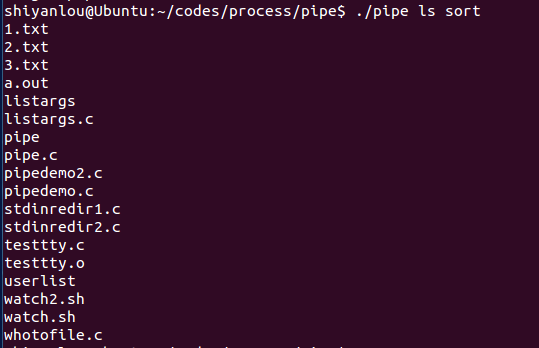
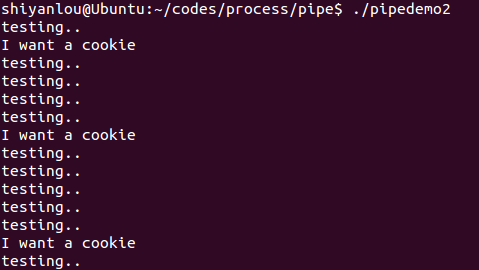
pipedemo2.c
#include	<stdio.h>
#include    <stdlib.h>
#include    <string.h>
#include    <unistd.h>


#define	CHILD_MESS	"I want a cookie
"
#define	PAR_MESS	"testing..
"
#define	oops(m,x)	{ perror(m); exit(x); }

main()
{
	int	pipefd[2];
	int	len;
	char	buf[BUFSIZ];
	int	read_len;

	if ( pipe( pipefd ) == -1 )
		oops("cannot get a pipe", 1);

	switch( fork() ){
		case -1:
			oops("cannot fork", 2);

		case 0:
			len = strlen(CHILD_MESS);
			while ( 1 ){
				if (write( pipefd[1], CHILD_MESS, len) != len )
					oops("write", 3);
				sleep(5);
			}

		default:
			len = strlen( PAR_MESS );
			while ( 1 ){
				if ( write( pipefd[1], PAR_MESS, len)!=len )
					oops("write", 4);
				sleep(1);
				read_len = read( pipefd[0], buf, BUFSIZ );
				if ( read_len <= 0 )
					break;
				write( 1 , buf, read_len );
			}
	}
}
运行结果:
pipedemo.c
#include	<stdio.h>
#include    <stdlib.h>
#include    <string.h>
#include	<unistd.h>

int main()
{
	int	len, i, apipe[2];
	char	buf[BUFSIZ];

	if ( pipe ( apipe ) == -1 ){
		perror("could not make pipe");
		exit(1);
	}
	printf("Got a pipe! It is file descriptors: { %d %d }
",
						apipe[0], apipe[1]);


	while ( fgets(buf, BUFSIZ, stdin) ){
		len = strlen( buf );
		if (  write( apipe[1], buf, len) != len ){
			perror("writing to pipe");
			break;
		}
		for ( i = 0 ; i<len ; i++ )
			buf[i] = 'X' ;
		len = read( apipe[0], buf, BUFSIZ ) ;
		if ( len == -1 ){
			perror("reading from pipe");
			break;
		}
		if ( write( 1 , buf, len ) != len ){	//将标准输入写到标准输出
			perror("writing to stdout");
			break;
		}
	}
}
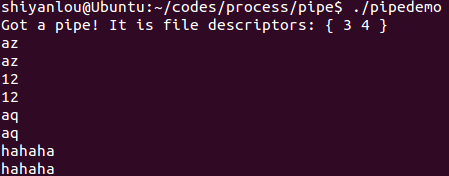
运行结果:
stdinerdir1.c
程序代码:
#include	<stdio.h>
#include	<fcntl.h>

int main()
{
	int	fd ;
	char	line[100];

	fgets( line, 100, stdin ); printf("%s", line );
	fgets( line, 100, stdin ); printf("%s", line );
	fgets( line, 100, stdin ); printf("%s", line );

	close(0);
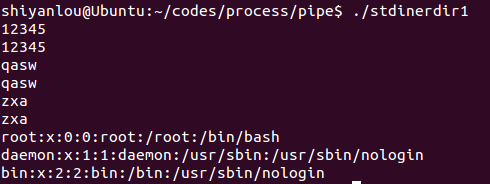
	fd = open("/etc/passwd", O_RDONLY);//读取passwd文件到stdin
	if ( fd != 0 ){
		fprintf(stderr,"Could not open data as fd 0
");
		exit(1);
	}

	fgets( line, 100, stdin ); printf("%s", line );
	fgets( line, 100, stdin ); printf("%s", line );
	fgets( line, 100, stdin ); printf("%s", line );
}
stdinredir2.c
#include		<stdio.h>
#include    <stdlib.h>
#include	<fcntl.h>

//#define	CLOSE_DUP
//#define	USE_DUP2

main()
{
	int	fd ;
	int	newfd;
	char	line[100];

	fgets( line, 100, stdin ); printf("%s", line );
	fgets( line, 100, stdin ); printf("%s", line );
	fgets( line, 100, stdin ); printf("%s", line );

	fd = open("data", O_RDONLY);
#ifdef CLOSE_DUP
	close(0);
	newfd = dup(fd);
#else
	newfd = dup2(fd,0);	//将fd重定向到标准输入
#endif
	if ( newfd != 0 ){
		fprintf(stderr,"Could not duplicate fd to 0
");
		exit(1);
	}
	close(fd);

	fgets( line, 100, stdin ); printf("%s", line );
	fgets( line, 100, stdin ); printf("%s", line );
	fgets( line, 100, stdin ); printf("%s", line );
}
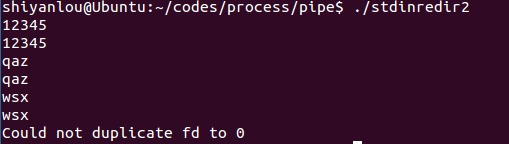
运行效果:(没有data文件,无法获取文件描述符,重定向失败)
testtty.c
#include <unistd.h>

int main()
{
	char *buf = "abcde
";
	write(0, buf, 6);//将字符串写到标准输入
}
运行效果:

whotofile.c
#include	<stdio.h>
#include    <stdlib.h>
#include    <unistd.h>

int main()
{
	int	pid ;
	int	fd;

	printf("About to run who into a file
");

	if( (pid = fork() ) == -1 ){
		perror("fork"); exit(1);
	}
	if ( pid == 0 ){
		close(1);				/* close, */
		fd = creat( "userlist", 0644 );		/* then open *///以写的方式创建一个文件,因为前面关闭了文件描述符1,所以fd=1,为标准输出。
		execlp( "who", "who", NULL );		/* and run	*///执行who命令,输出到文件表描述符1中。
		perror("execlp");
		exit(1);
	}
	if ( pid != 0 ){
		wait(NULL);
		printf("Done running who.  results in userlist
");
	}

	return 0;
}
运行结果:
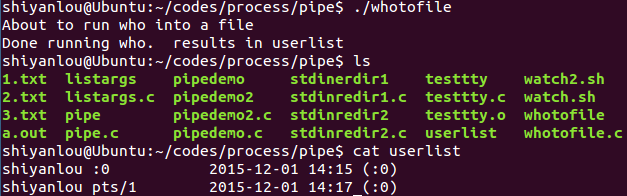
consumer.c
#include <stdio.h>
#include <stdlib.h>
#include <string.h>
#include <fcntl.h>
#include <limits.h>
#include <sys/types.h>
#include <sys/stat.h>

#define FIFO_NAME "/tmp/myfifo"
#define BUFFER_SIZE PIPE_BUF


int main()
{
	int pipe_fd;
	int res;

	int open_mode = O_RDONLY;
	char buffer[BUFFER_SIZE + 1];
	int bytes = 0;

	memset(buffer, 0, sizeof(buffer));//数组置零

	printf("Process %d opeining FIFO O_RDONLY
", getpid());
	pipe_fd = open(FIFO_NAME, open_mode);
	printf("Process %d result %d
", getpid(), pipe_fd);

	if (pipe_fd != -1) {
		do {
			res = read(pipe_fd, buffer, BUFFER_SIZE);
			bytes += res;
		} while (res > 0);
		close(pipe_fd);
	} else {
		exit(EXIT_FAILURE);
	}

	printf("Process %d finished, %d bytes read
", getpid(), bytes);
	exit(EXIT_SUCCESS);
}
运行效果:
文件不存在,打开失败。

文件存在读取成功。

producer.c
程序代码:
#include <stdio.h>
#include <stdlib.h>
#include <string.h>
#include <fcntl.h>
#include <limits.h>
#include <sys/types.h>
#include <sys/stat.h>

#define FIFO_NAME "/tmp/myfifo"
#define BUFFER_SIZE PIPE_BUF
#define TEN_MEG (1024 * 1024 * 10)

int main()
{
	int pipe_fd;
	int res;
	int open_mode = O_WRONLY;

	int bytes = 0;
	char buffer[BUFFER_SIZE + 1];
	//判断文件是否存在。
	if (access(FIFO_NAME, F_OK) == -1) {
		res = mkfifo(FIFO_NAME, 0777);//创建一个FIFO文件
		if (res != 0) {
			fprintf(stderr, "Could not create fifo %s
",
			FIFO_NAME);
			exit(EXIT_FAILURE);
		}
	}

	printf("Process %d opening FIFO O_WRONLY
", getpid());
	pipe_fd = open(FIFO_NAME, open_mode);
	printf("Process %d result %d
", getpid(), pipe_fd);

	if (pipe_fd != -1) {
		while (bytes < TEN_MEG) {
			res = write(pipe_fd, buffer, BUFFER_SIZE);
			if (res == -1) {
				fprintf(stderr, "Write error on pipe
");
				exit(EXIT_FAILURE);
			}
			bytes += res;
		}
		close(pipe_fd);
	} else {
		exit(EXIT_FAILURE);
	}

	printf("Process %d finish
", getpid());
	exit(EXIT_SUCCESS);
}
access():
判断是否具有存取文件的权限
相关函数
stat,open,chmod,chown,setuid,setgid
表头文件include<unistd.h>
定义函数
int access(const char * pathname, int mode);
函数说明
access()会检查是否可以读/写某一已存在的文件。参数mode有几种情况组合:
R_OK,W_OK,X_OK 和F_OK。
R_OK,W_OK与X_OK用来检查文件是否具有读取、写入和执行的权限。
F_OK则是用来判断该文件是否存在。由于access()只作权限的核查,并不理会文件形态或文件内容,因此,如果一目录表示为“可写入”,表示可以在该目录中建立新文件等操作,而非意味此目录可以被当做文件处理。例如,你会发现DOS的文件都具有“可执行”权限,但用execve()执行时则会失败。
返回值
若所有欲查核的权限都通过了检查则返回0值,表示成功,只要有一权限被禁止则返回-1。
mkfifo()
mkfifo函数的作用是在文件系统中创建一个文件(该文件之前必须不存在),该文件用于提供FIFO功能,即命名管道。前边讲的那些管道都没有名字,因此它们被称为匿名管道,或简称管道。
#include <sys/types.h>
  #include <sys/stat.h>
  int mkfifo( const char *pathname, mode_t mode );
mkfifo函数需要两个参数,第一个参数(pathname)是将要在文件系统中创建的一个专用文件。第二个参数(mode)用来规定FIFO的读写权限。Mkfifo函数如果调用成功的话,返回值为0;如果调用失败返回值为-1。
运行结果:

遇到的问题及解决
1.sigactdemo.c中的inthandler中的参数int s是怎么传进去的?
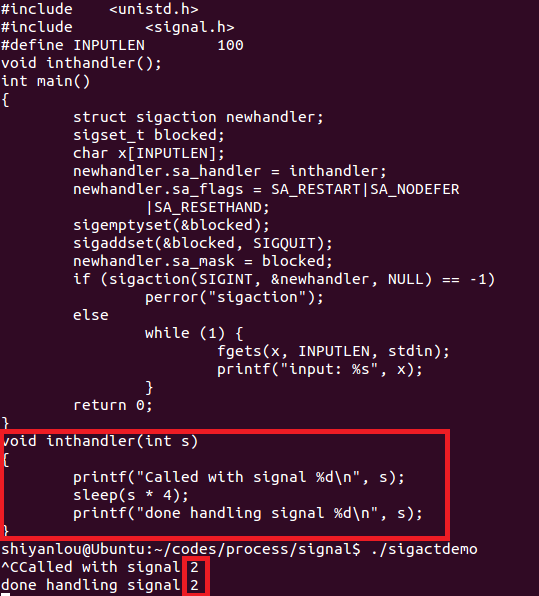
解决方法:在博客园提问。
inthandler被当做函数指针传给了newhandler.sa_handler
后面调用int sigaction(int signum,const struct sigaction *act ,struct sigaction *oldact);
它的第一个参数signum指定的信号编号就是用来设置这个信号的处理函数的。信号SIGINT序号为2。
命令kill -l可以查看各信号的序号。
2.运行testpp时遇到段错误(核心已转储)。
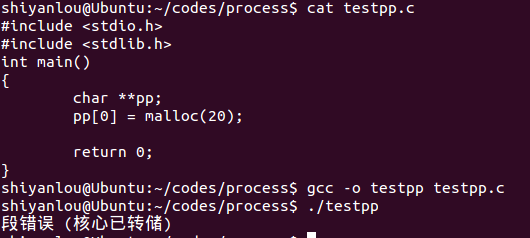
解决方法:在博客园提问。
二维数组越界申请空间。
将代码改为
pp=malloc(20);
即可编译成功。
参考资料
《深入理解计算机系统》第8章异常控制流