1. 安装轻量级网络仿真工具Mininet
使用github上的Mininet源安装,使用命令依次为:
git clone https://github.com/mininet/mininet.git
cd mininet/util
./install.sh

安装成功终端显示Enjoy Mininet

2. 用字符命令搭建如下拓扑,要求写出命令
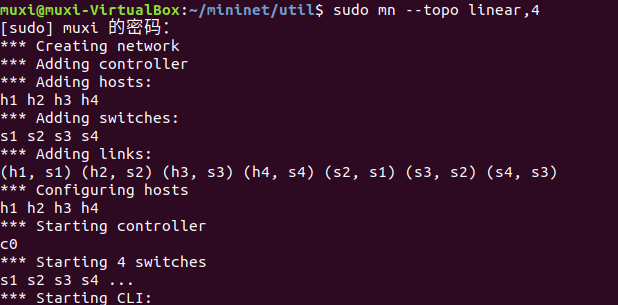
sudo mn --topo linear,4
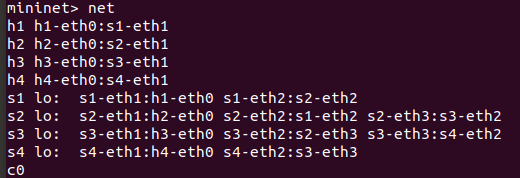
查看net信息 输入命令net
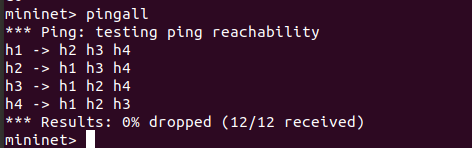
查看所有节点连通性 输入命令pingall
创建树形拓扑
sudo mn --topo tree,depth=3,fanout=2
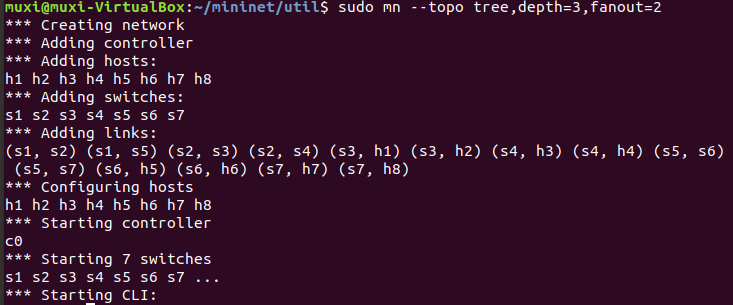
查看net信息 输入命令net

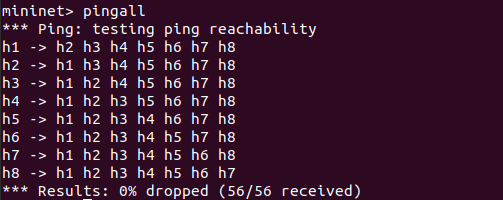
查看所有节点连通性 输入命令pingall
3.利用可视化工具搭建如下拓扑,并要求支持OpenFlow 1.0 1.1 1.2 1.3,设置h1(10.0.0.10)、h2(10.0.0.11)、h3(10.0.0.12),拓扑搭建完成后使用命令验证主机ip,查看拓扑端口连接情况。
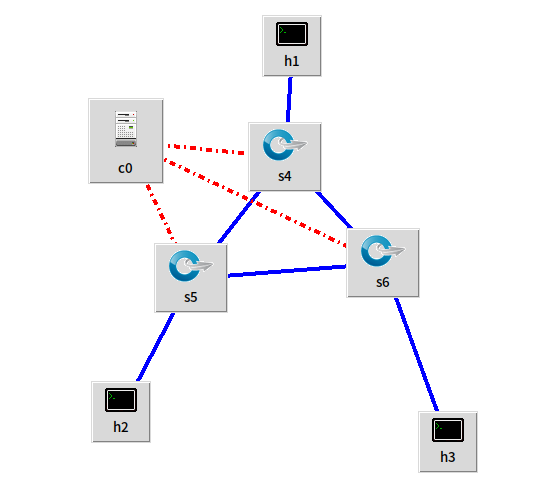
在配置完后,执行run,终端产生拓扑信息,同时展示网络信息和测试连通性
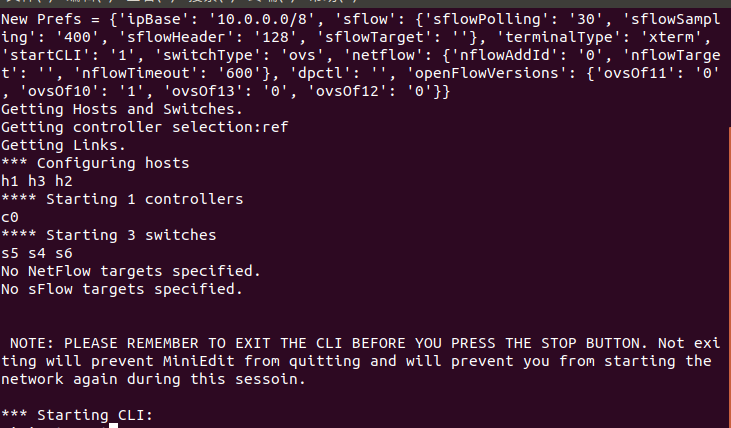
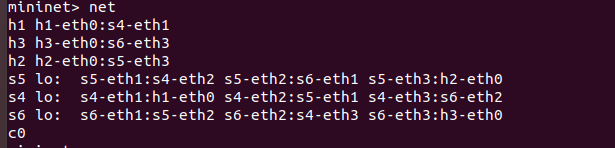
验证主机ip,查看拓扑端口连接情况

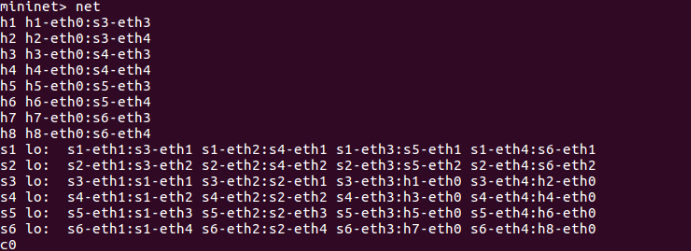
4.利用Python脚本完成如下图所示的一个Fat-tree型的拓扑(交换机和主机名需与图中一致,即s1s6,h1h8,并且链路正确,请给出Mininet相关截图)
python脚本代码
#!/usr/bin/python
# sudo mn --custom fattree.py --topo mytopo --switch ovsk,protocols=OpenFlow10
"""Custom topology example
Adding the 'topos' dict with a key/value pair to generate our newly defined
topology enables one to pass in '--topo=mytopo' from the command line.
"""

from mininet.topo import Topo
from mininet.net import Mininet
from mininet.node import RemoteController,CPULimitedHost
from mininet.link import TCLink
from mininet.util import dumpNodeConnections

class MyTopo(Topo):
    "Simple topology example."

    def __init__(self):
        "Create custom topo."

        # Initialize topology
        Topo.__init__(self)
        L1 = 2
        L2 = 4
        c = []
        a = []

        # add core ovs
        for i in range(L1):
                sw = self.addSwitch('s{}'.format(i+1))
                c.append(sw)

        # add aggregation ovs
        for i in range(L2):
                sw = self.addSwitch('s{}'.format(L1+i+1))
                a.append(sw)

        # add links between core and aggregation ovs
        for i in range(L1):
                sw1 = c[i]
                for sw2 in a[0: :1]:
                    self.addLink(sw2, sw1)

        #add hosts and its links with aggregation ovs
        count = 1
        for sw1 in a:
                for i in range(2):
                    host = self.addHost('h{}'.format(count))
                    self.addLink(sw1, host)
                    count += 1
topos = {'mytopo': (lambda: MyTopo())}
命令行输入sudo mn --custom fattree.py --topo mytopo --switch ovsk,protocols=OpenFlow10
mininet截图