233 Matrix
Time Limit: 10000/5000 MS (Java/Others) Memory Limit: 65536/65536 K (Java/Others)Total Submission(s): 749 Accepted Submission(s): 453
Problem Description
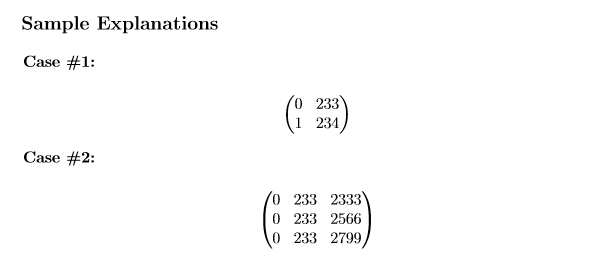
In our daily life we often use 233 to express our feelings. Actually, we may say 2333, 23333, or 233333 ... in the same meaning. And here is the question: Suppose we have a matrix called 233 matrix. In the first line, it would be 233, 2333, 23333... (it means
a0,1 = 233,a0,2 = 2333,a0,3 = 23333...) Besides, in 233 matrix, we got ai,j = ai-1,j +ai,j-1( i,j ≠ 0). Now you have known a1,0,a2,0,...,an,0, could you tell
me an,m in the 233 matrix?
Input
There are multiple test cases. Please process till EOF.
For each case, the first line contains two postive integers n,m(n ≤ 10,m ≤ 109). The second line contains n integers, a1,0,a2,0,...,an,0(0 ≤ ai,0 < 231).
For each case, the first line contains two postive integers n,m(n ≤ 10,m ≤ 109). The second line contains n integers, a1,0,a2,0,...,an,0(0 ≤ ai,0 < 231).
Output
For each case, output an,m mod 10000007.
Sample Input
1 1
1
2 2
0 0
3 7
23 47 16
Sample Output
234 2799 72937Hint
思路:
第一列元素为:
0
a1
a2
a3
a4
转化为:23
a1
a2
a3
a4
3
则第二列为:
23*10+3
23*10+3+a1
23*10+3+a1+a2
23*10+3+a1+a2+a3
23*10+3+a1+a2+a3+a4
3
依据前后两列的递推关系,有等式可得矩阵A的元素为:
#include"iostream"
#include"stdio.h"
#include"string.h"
#include"algorithm"
#include"queue"
#include"vector"
using namespace std;
#define N 15
#define LL __int64
const int mod=10000007;
int n;
int b[N];
struct Mat
{
    LL mat[N][N];
}a,ans;
Mat operator*(Mat a,Mat b)
{
    int i,j,k;
    Mat c;
    memset(c.mat,0,sizeof(c.mat));
    for(i=0; i<=n+1; i++)
    {
        for(j=0; j<=n+1; j++)
        {
            c.mat[i][j]=0;
            for(k=0; k<=n+1; k++)
            {
                if(a.mat[i][k]&&b.mat[k][j])
                {
                    c.mat[i][j]+=a.mat[i][k]*b.mat[k][j];
                    c.mat[i][j]%=mod;
                }
            }
        }
    }
    return c;
}
void mult(int k)
{
    int i;
    memset(ans.mat,0,sizeof(ans.mat));
    for(i=0;i<=n+1;i++)
        ans.mat[i][i]=1;
    while(k)
    {
        if(k&1)
            ans=ans*a;
        k>>=1;
        a=a*a;
    }
}
void inti()
{
    int i,j;
    b[0]=23;
    b[n+1]=3;
    for(i=1; i<=n; i++)
        scanf("%d",&b[i]);
    memset(a.mat,0,sizeof(a.mat));
    for(i=0; i<=n; i++)
    {
        a.mat[i][0]=10;
        a.mat[i][n+1]=1;
    }
    a.mat[n+1][n+1]=1;
    for(i=1; i<n+1; i++)
    {
        for(j=1; j<=i; j++)
        {
            a.mat[i][j]=1;
        }
    }
}
int main()
{
    int i,m;
    while(scanf("%d%d",&n,&m)!=-1)
    {
        inti();
        mult(m);
        LL s=0;
        for(i=0;i<=n+1;i++)
            s=(s+(ans.mat[n][i]*b[i])%mod)%mod;
        printf("%I64d
",s);
    }
    return 0;
}