说树状数组其实是一个索引表,但是是一个特殊的,树状的索引表,它利用了二进制的一些特性。
就区间求和的要求来说:
首先我们用a[]数组来存储原始数据。然后在a[]之上构造c[]数组来作为树状数组。
如图
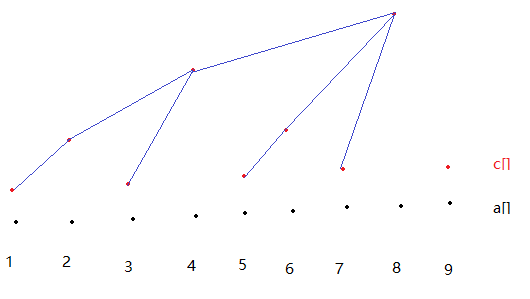
这个图表示,当i为奇数时,c[i]中保存的都是a[i]本身。然后,c[2]中保存了a[1], a[2],共2个,c[4]中保存的是a[1], a[2], a[3], a[4],c[6]又是保存两个,c[5]和c[6]。c[8]保存8个,c[1], c[2], c[3], c[4], c[5], c[6], c[7], c[8]。
看出什么规律没有?
如果将这些下标差成2进制序列就容易看出来规律了——
如果从右向左看,第一个是1的数位是第1位,那么c[i]中只有1个数,如果第一个是1的数位式第2位,那么c[i]中有2个数,如果是3,那么c[i]中有4个数,以此类推。
但是怎么代码怎么实现呢?
我们可以这样做——
首先取这个数的下标i,然后取这个数按位数最右边的1加在i上,所得就是下一个需要加当前数的下标,以此类推,直到取到下标大于等于最大下标n。
代码——
void Add(int x, int y)
{
    a[x] += y;
    while(x <= n)
    {
        c[x] += y;
        x += lowbit(x);
    }
}
当然,给某个数加上减上多少也可以用这个做。
区间求和的方法:
取从i到j之间的区间和
一种方法是取从1到j的和,然后减去从1到i的和。
取的方法——
从j开始,然后j减去j按位数最右端的1,得到的就是下一个需要的下标,减到0时结束。
int Sum(int x)
{
    int rt = 0;
    while(x > 0)
    {
        rt += c[x];
        x -= lowbit(x);
    }
    return rt;
}

printf("%d
", Sum(b)-Sum(a-1));
另一种方法是从j开始,如果j减去从右往左第一个1的差小于i,则结果加a[j],然后j -= 1;否则结果加c[j], j减去从右向左第一个1。
int Summ(int l, int r)
{
    int rt = 0;
    while(r >= l)
    {
        if(r-lowbit(r) < l)
        {
            rt += a[r];
            r -= 1;
        }
        else
        {
            rt += c[r];
            r -= lowbit(r);
        }
    }
    return rt;
}
不过这个貌似较慢……
完整代码——


 1 #include <cstdio>
 2 #include <cmath>
 3 #include <cstring>
 4 #include <algorithm>
 5 using namespace std;
 6
 7 const int N = 50005;
 8
 9 int t, n;
10 int a[N];
11 int c[N];
12 char s[10];
13 int x, y;
14
15 int lowbit(int x)
16 {
17     return x&(-x);
18 }
19
20 void Add(int x, int y)
21 {
22     a[x] += y;
23     while(x <= n)
24     {
25         c[x] += y;
26         x += lowbit(x);
27     }
28 }
29
30 int Sum(int x)
31 {
32     int rt = 0;
33     while(x > 0)
34     {
35         rt += c[x];
36         x -= lowbit(x);
37     }
38     return rt;
39 }
40
41 int Summ(int l, int r)
42 {
43     int rt = 0;
44     while(r >= l)
45     {
46         if(r-lowbit(r) < l)
47         {
48             rt += a[r];
49             r -= 1;
50         }
51         else
52         {
53             rt += c[r];
54             r -= lowbit(r);
55         }
56     }
57     return rt;
58 }
59
60 void Query(int a, int b)
61 {
62     printf("%d
", Sum(b)-Sum(a-1));
63     //printf("%d
", Summ(a, b));
64 }
65
66 int main()
67 {
68     //freopen("test.in", "r", stdin);
69     scanf("%d", &t);
70     for(int tm = 1; tm <= t; tm++)
71     {
72         scanf("%d", &n);
73         memset(c, 0, sizeof(c));
74         memset(a, 0, sizeof(a));
75         int y;
76         for(int i = 1; i <= n; i++)
77         {
78             scanf("%d", &y);
79             Add(i, y);
80         }
81         printf("Case %d:
", tm);
82
83         scanf("%s", s);
84         while(s[0] != 'E')
85         {
86             scanf("%d%d", &x, &y);
87             if(s[0] == 'A') Add(x, y);
88             if(s[0] == 'Q') Query(x, y);
89             if(s[0] == 'S') Add(x, -y);
90             scanf("%s", s);
91         }
92     }
93 }