转载自:http://ganeshtiwaridotcomdotnp.blogspot.com/2011/08/silence-removal-and-end-point-detection.html
Visit http://ganeshtiwaridotcomdotnp.blogspot.com/2011/06/final-report-text-prompted-remote.html for more detail about our project.
For the purpose of silence removal of captured sound, we used the algorithm specified in
"A New Silence Removal and Endpoint Detection Algorithm for Speech and Speaker Recognition Applications"
Our actual system was in JAVA but we verified the performance of this algorithm in MATLAB.
Inputs and Output

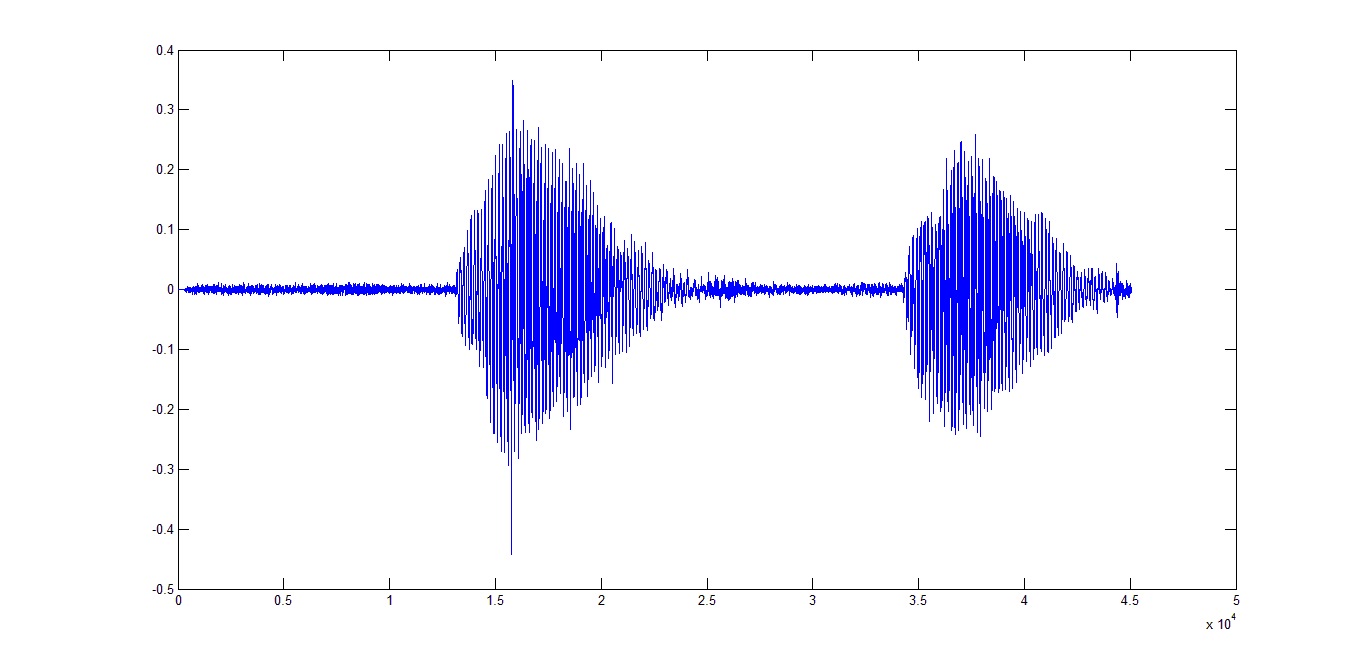
Here is the Matlab code :
It first records sound for 5 seconds and removes the silence and then plays back.
//silence removal and end point detection
THRESHOLD=0.3; // adjust value yourself
TIME=5;
%capture;
Fs = 11025;
y = wavrecord(TIME*Fs,Fs);
%plot(y)
%wavplay(y,Fs);
samplePerFrame=floor(Fs/100);
bgSampleCount=floor(Fs/5); %according to formula, 1600 sample needed for 8 khz

%----------
%calculation of mean and std
bgSample=[];
for i=1:1:bgSampleCount
    bgSample=[bgSample y(i)];
end
meanVal=mean(bgSample);
sDev=std(bgSample);
%----------
%identify voiced or not for each value
for i=1:1:length(y)
   if(abs(y(i)-meanVal)/sDev > THRESHOLD)
       voiced(i)=1;
   else
       voiced(i)=0;
   end
end


% identify voiced or not for each frame
%discard insufficient samples of last frame

usefulSamples=length(y)-mod(length(y),samplePerFrame);
frameCount=usefulSamples/samplePerFrame;
voicedFrameCount=0;
for i=1:1:frameCount
   cVoiced=0;
   cUnVoiced=0;
   for j=i*samplePerFrame-samplePerFrame+1:1:(i*samplePerFrame)
       if(voiced(j)==1)
           cVoiced=(cVoiced+1);
       else
           cUnVoiced=cUnVoiced+1;
       end
   end
   %mark frame for voiced/unvoiced
   if(cVoiced>cUnVoiced)
       voicedFrameCount=voicedFrameCount+1;
       voicedUnvoiced(i)=1;
   else
       voicedUnvoiced(i)=0;
   end
end

silenceRemovedSignal=[];

%-----
for i=1:1:frameCount
    if(voicedUnvoiced(i)==1)
    for j=i*samplePerFrame-samplePerFrame+1:1:(i*samplePerFrame)
            silenceRemovedSignal= [silenceRemovedSignal y(j)];
        end
    end
end

%---display plot and play both sounds
    figure; plot(y);
    figure; plot(silenceRemovedSignal);
%%%play
wavplay(y,Fs);
wavplay(silenceRemovedSignal,Fs);
NOTE: Don't forget to adjust the microphone level and sound boost feature to achieve good results.
问:Wow.. Excellent.. Can u help me compare the efficiency of this algorithm with the STE and ZCR methods?? Thank you
答:As shown in research paper, the comparision of efficiency is as follows :
Phrases______STE______ZCR-STE__Proposed_Method
Combination
lock number__77.9531% 70.3720% 83.5565%
Running Text_50.8391% 50.1231% 59.7181%