1.%s,%d
举例1:name='egon'
age=20
print("my name is %s my age is %s" %(name,age)) #%s既能接受字符串,也能接受数字
print(‘my name is %s my age is %d’ %(name,age)) #%d只能接受数字
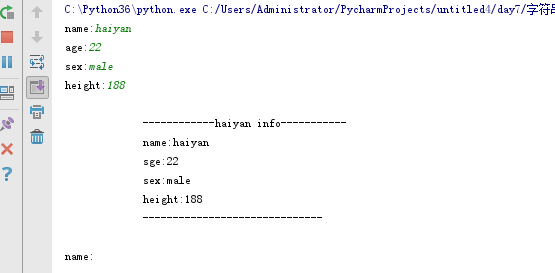
举例2:用户信息的显示
while True:
    name=input("name:")
    age=input("age:")
    sex=input("sex:")
    height=input("height:")
    msg='''
             ------------%s info-----------
             name:%s
             age:%s
             sex:%s
             height:%s
             ------------------------------
        '''%(name,name,age,sex,height)
    print(msg)
运行结果如下:
2.字符串方法
 # name='egon' #name=str('egon')# print(type(name))#优先掌握#1.移除空白strip# msg=' hello '# print(msg)# print(msg.strip())# 移除‘*’
# msg='***hello*********'
# msg=msg.strip('*')
# print(msg)
#移除左边的
# print(msg.lstrip('*'))
#移除右边的
# print(msg.rstrip('*'))

#用处
while True:
    name=input('user: ').strip()
    password=input('password: ').strip()
    if name == 'egon' and password == '123':
        print('login successfull')


#切分split
# info='root:x:0:0::/root:/bin/bash'
# print(info[0]+info[1]+info[2]+info[3])

# user_l=info.split(':')
# print(user_l[0])

# msg='hello world egon say hahah'
# print(msg.split()) #默认以空格作为分隔符

#cmd='download|xhp.mov|3000'
# cmd_l=cmd.split('|')
# print(cmd_l[1])
# print(cmd_l[0])
# print(cmd.split('|',1))

#用处
while True:
    cmd=input('>>: ').strip()
    if len(cmd) == 0:continue
    cmd_l=cmd.split()
    print('命令是:%s 命令的参数是:%s' %(cmd_l[0],cmd_l[1]))
 ###输入 hell 123 返回 命令是:hell 命令的参数是:123


#长度len
# print(len('hell 123'))


#索引
# 切片:切出子字符串
# msg='hello world'
# print(msg[1:3]) #1 2
# print(msg[1:4]) #1 2 3


# 掌握部分
oldboy_age=84
while True:
    age=input('>>: ').strip()
    if len(age) == 0:
        continue
    if age.isdigit():
        age=int(age)
    else:
        print('must be int')

## input输入的值永远都是字符串


#startswith,endswith
# name='alex_SB'
# print(name.endswith('SB'))
# print(name.startswith('alex'))


#replace
# name='alex say :i have one tesla,my name is alex'
# print(name.replace('alex','SB',1))

# print('my name is %s my age is %s my sex is %s' %('egon',18,'male'))
# print('my name is {} my age is {} my sex is {}'.format('egon',18,'male'))
# print('my name is {0} my age is {1} my sex is {2}'.format('egon',18,'male'))
# print('my name is {name} my age is {age} my sex is {sex}'.format(sex='male',age=18,name='egon'))


# name='goee say hello'
# # print(name.find('S',1,3)) #顾头不顾尾,找不到则返回-1不会报错,找到了则显示索引
# # print(name.index('S')) #同上,但是找不到会报错
#
# print(name.count('S',1,5)) #顾头不顾尾,如果不指定范围则查找所有


#join
# info='root:x:0:0::/root:/bin/bash'
# print(info.split(':'))

# l=['root', 'x', '0', '0', '', '/root', '/bin/bash']
# print(':'.join(l))


#lower,upper
# name='eGon'
# print(name.lower())   ##全部换成小写
# print(name.upper())   ##全部换成大写


#了解部分
#expandtabs
# name='egon	hello'
# print(name)
# print(name.expandtabs(1))


#center,ljust,rjust,zfill
# name='egon'
# # print(name.center(30,'-'))
# print(name.ljust(30,'*'))
# print(name.rjust(30,'*'))
# print(name.zfill(50)) #用0填充


#captalize,swapcase,title
# name='eGon'
# print(name.capitalize()) #首字母大写,其余部分小写
# print(name.swapcase()) #大小写翻转
# msg='egon say hi'
# print(msg.title()) #每个单词的首字母大写


#在python3中
num0='4'
num1=b'4' #bytes
num2=u'4' #unicode,python3中无需加u就是unicode
num3='四' #中文数字
num4='Ⅳ' #罗马数字


#isdigt:str,bytes,unicode
# print(num0.isdigit())
# print(num1.isdigit())
# print(num2.isdigit())
# print(num3.isdigit())
# print(num4.isdigit())

#isdecimal:str,unicode
# num0='4'
# num1=b'4' #bytes
# num2=u'4' #unicode,python3中无需加u就是unicode
# num3='四' #中文数字
# num4='Ⅳ' #罗马数字
# print(num0.isdecimal())
# # print(num1.)
# print(num2.isdecimal())
# print(num3.isdecimal())
# print(num4.isdecimal())

#isnumeric:str,unicode,中文,罗马
# num0='4'
# num1=b'4' #bytes
# num2=u'4' #unicode,python3中无需加u就是unicode
# num3='四' #中文数字
# num4='Ⅳ' #罗马数字
#
# print(num0.isnumeric())
# # print(num1)
# print(num2.isnumeric())
# print(num3.isnumeric())
# print(num4.isnumeric())


#is其他
# name='egon123'
# print(name.isalnum()) #字符串由字母和数字组成
# name='asdfasdfa sdf'
# print(name.isalpha()) #字符串只由字母组成
#

# name='asdfor123'
# print(name.isidentifier())
name='egGon'
print(name.islower())
# print(name.isupper())
# print(name.isspace())
name='Egon say'
print(name.istitle())