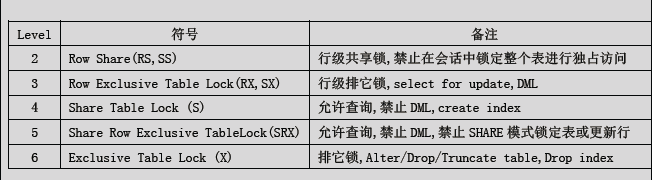
Row Share (RS)
This lock, also called a subshare table lock (SS), indicates that the transaction holding the lock on the table has locked rows in the table and intends to update them. A row share lock is the least restrictive mode of table lock, offering the highest degree of concurrency for a table.
Row Exclusive Table Lock (RX)
This lock, also called a subexclusive table lock (SX), generally indicates that the transaction holding the lock has updated table rows or issued SELECT ... FOR UPDATE. An SX lock allows other transactions to query, insert, update, delete, or lock rows concurrently in the same table. Therefore, SX locks allow multiple transactions to obtain simultaneous SX and subshare table locks for the same table.
Share Table Lock (S)
A share table lock held by a transaction allows other transactions to query the table (without using SELECT ... FOR UPDATE), but updates are allowed only if a single transaction holds the share table lock. Because multiple transactions may hold a share table lock concurrently, holding this lock is not sufficient to ensure that a transaction can modify the table.
Share Row Exclusive Table Lock (SRX)
This lock, also called a share-subexclusive table lock (SSX), is more restrictive than a share table lock. Only one transaction at a time can acquire an SSX lock on a given table. An SSX lock held by a transaction allows other transactions to query the table (except for SELECT ... FOR UPDATE) but not to update the table.
Exclusive Table Lock (X)
This lock is the most restrictive, prohibiting other transactions from performing any type of DML statement or placing any type of lock on the table.