工具方法。对函数的统一管理。
jquery2.0.3版本$.Callback()部分的源码如下:


// String to Object options format cache
var optionsCache = {};

// Convert String-formatted options into Object-formatted ones and store in cache
function createOptions( options ) {
    var object = optionsCache[ options ] = {};
    jQuery.each( options.match( core_rnotwhite ) || [], function( _, flag ) {
        object[ flag ] = true;
    });
    return object;
}

/*
 * Create a callback list using the following parameters:
 *
 *    options: an optional list of space-separated options that will change how
 *            the callback list behaves or a more traditional option object
 *
 * By default a callback list will act like an event callback list and can be
 * "fired" multiple times.
 *
 * Possible options:
 *
 *    once:            will ensure the callback list can only be fired once (like a Deferred)
 *
 *    memory:            will keep track of previous values and will call any callback added
 *                    after the list has been fired right away with the latest "memorized"
 *                    values (like a Deferred)
 *
 *    unique:            will ensure a callback can only be added once (no duplicate in the list)
 *
 *    stopOnFalse:    interrupt callings when a callback returns false
 *
 */
jQuery.Callbacks = function( options ) {

    // Convert options from String-formatted to Object-formatted if needed
    // (we check in cache first)
    options = typeof options === "string" ?
        ( optionsCache[ options ] || createOptions( options ) ) :
        jQuery.extend( {}, options );

    var // Last fire value (for non-forgettable lists)
        memory,
        // Flag to know if list was already fired
        fired,
        // Flag to know if list is currently firing
        firing,
        // First callback to fire (used internally by add and fireWith)
        firingStart,
        // End of the loop when firing
        firingLength,
        // Index of currently firing callback (modified by remove if needed)
        firingIndex,
        // Actual callback list
        list = [],
        // Stack of fire calls for repeatable lists
        stack = !options.once && [],
        // Fire callbacks
        fire = function( data ) {
            memory = options.memory && data;
            fired = true;
            firingIndex = firingStart || 0;
            firingStart = 0;
            firingLength = list.length;
            firing = true;
            for ( ; list && firingIndex < firingLength; firingIndex++ ) {
                if ( list[ firingIndex ].apply( data[ 0 ], data[ 1 ] ) === false && options.stopOnFalse ) {
                    memory = false; // To prevent further calls using add
                    break;
                }
            }
            firing = false;
            if ( list ) {
                if ( stack ) {
                    if ( stack.length ) {
                        fire( stack.shift() );
                    }
                } else if ( memory ) {
                    list = [];
                } else {
                    self.disable();
                }
            }
        },
        // Actual Callbacks object
        self = {
            // Add a callback or a collection of callbacks to the list
            add: function() {
                if ( list ) {
                    // First, we save the current length
                    var start = list.length;
                    (function add( args ) {
                        jQuery.each( args, function( _, arg ) {
                            var type = jQuery.type( arg );
                            if ( type === "function" ) {
                                if ( !options.unique || !self.has( arg ) ) {
                                    list.push( arg );
                                }
                            } else if ( arg && arg.length && type !== "string" ) {
                                // Inspect recursively
                                add( arg );
                            }
                        });
                    })( arguments );
                    // Do we need to add the callbacks to the
                    // current firing batch?
                    if ( firing ) {
                        firingLength = list.length;
                    // With memory, if we're not firing then
                    // we should call right away
                    } else if ( memory ) {
                        firingStart = start;
                        fire( memory );
                    }
                }
                return this;
            },
            // Remove a callback from the list
            remove: function() {
                if ( list ) {
                    jQuery.each( arguments, function( _, arg ) {
                        var index;
                        while( ( index = jQuery.inArray( arg, list, index ) ) > -1 ) {
                            list.splice( index, 1 );
                            // Handle firing indexes
                            if ( firing ) {
                                if ( index <= firingLength ) {
                                    firingLength--;
                                }
                                if ( index <= firingIndex ) {
                                    firingIndex--;
                                }
                            }
                        }
                    });
                }
                return this;
            },
            // Check if a given callback is in the list.
            // If no argument is given, return whether or not list has callbacks attached.
            has: function( fn ) {
                return fn ? jQuery.inArray( fn, list ) > -1 : !!( list && list.length );
            },
            // Remove all callbacks from the list
            empty: function() {
                list = [];
                firingLength = 0;
                return this;
            },
            // Have the list do nothing anymore
            disable: function() {
                list = stack = memory = undefined;
                return this;
            },
            // Is it disabled?
            disabled: function() {
                return !list;
            },
            // Lock the list in its current state
            lock: function() {
                stack = undefined;
                if ( !memory ) {
                    self.disable();
                }
                return this;
            },
            // Is it locked?
            locked: function() {
                return !stack;
            },
            // Call all callbacks with the given context and arguments
            fireWith: function( context, args ) {
                if ( list && ( !fired || stack ) ) {
                    args = args || [];
                    args = [ context, args.slice ? args.slice() : args ];
                    if ( firing ) {
                        stack.push( args );
                    } else {
                        fire( args );
                    }
                }
                return this;
            },
            // Call all the callbacks with the given arguments
            fire: function() {
                self.fireWith( this, arguments );
                return this;
            },
            // To know if the callbacks have already been called at least once
            fired: function() {
                return !!fired;
            }
        };

    return self;
};
一、$.Callback()的简单使用及应用场景
1、$.Callback()的用法。
观察者模式,添加完后统一触发。
       function aaa(){
            alert(1);
        }
        function bbb(){
            alert(2);
        }
        var cb= $.Callbacks();
        cb.add(aaa);
        cb.add(bbb);
        cb.fire();
2、好处,应用场景。
要统一的管理aaa和bbb。有时候如下,很难对不同作用域下的函数进行统一管理。
  function aaa(){
            alert(1);
        }
        (function(){
            function bbb(){
                alert(2);
            }
        })();
        aaa();
        bbb();
只能弹出1,因为bbb是局部作用域中的。
$callback可以做到。如下,只要cb是全局的。
 var cb= $.Callbacks();
        function aaa(){
            alert(1);
        }
        cb.add(aaa);
        (function(){
            function bbb(){
                alert(2);
            }
            cb.add(bbb);
        })();
        cb.fire();
对应复杂情况很有用。统一管理,通过fire统一触发。
二、原理图
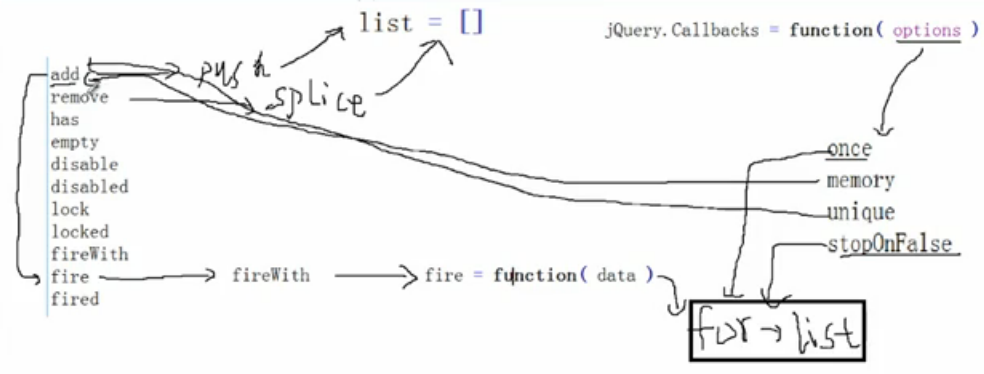
Callback接收一个参数,可以有4个选项,once,memory,unique,stopOnFalse。
self单体有这些方法:add,remove,has,empty,disable,disabled,lock,locked, fireWith,fire,fired。
list=[]数组变量,用来收集回调函数。fire的时候对其循环调用。
add:push数组
fire:调用fireWith,fireWith允许传参,fire可传可不传。
fireWith:调用私有函数fire,在私有函数fire中for循环list。
remove:splice数组。
4个参数:
- once针对fire()只循环一次
- memory 针对add,作用到add上,add时判断有memory就去执行fire。
- unique 针对add,添加的时候就可以去重
- stopOnFalse 针对fire,在for循环时遇到false,立即跳出循环
三、更多用法
1、callback4个参数的作用
- once: 只能够触发一次。
- memory: 当队列已经触发之后,再添加进来的函数就会直接被调用,不需要再触发一次。
- unique: 保证函数的唯一
- stopOnFalse: 只要有一个回调返回 false,就中断后续的调用。
举例:
不传参数,fire几次就触发几次。
function aaa() {
            alert(1);
        }

        function bbb() {
            alert(2);
        }
        var cb = $.Callbacks();
        cb.add(aaa);
        cb.add(bbb);
        cb.fire(); //1 2
        cb.fire();//1 2
- once:fire只能触发一次,源码中fire后如果有once就把list干掉了,list=undefined了。
        function aaa() {
            alert(1);
        }

        function bbb() {
            alert(2);
        }
        var cb = $.Callbacks('once');
        cb.add(aaa);
        cb.add(bbb);
        cb.fire(); //1 2
        cb.fire();
不传参数,在fire之后add的回调不能被fire。
//不写参数,只弹出1,2不会弹出
 function aaa() {
            alert(1);
        }

        function bbb() {
            alert(2);
        }
        var cb = $.Callbacks();
        cb.add(aaa);
        cb.fire(); //1
        cb.add(bbb);
- memory记忆,在fire前面后面add的方法都能得到执行。
function aaa() {
            alert(1);
        }

        function bbb() {
            alert(2);
        }
        var cb = $.Callbacks('memory');
        cb.add(aaa);
        cb.fire(); //1 2
        cb.add(bbb);
- unique:去重
//不加参数,add2次aaa,就会触发2次aaa
function aaa() {
            alert(1);
        }


        var cb = $.Callbacks();
        cb.add(aaa);
        cb.add(aaa);
        cb.fire(); //1 1
function aaa() {
            alert(1);
        }


        var cb = $.Callbacks('unique');
        cb.add(aaa);
        cb.add(aaa);
        cb.fire(); //1 加了unique参数,同样的函数不能多次add
- stopOnFalse:函数返回false跳出循环
function aaa() {
            alert(1);
            return false;
        }
        function bbb() {
            alert(2);
        }

        var cb = $.Callbacks();
        cb.add(aaa);
        cb.add(bbb);
        cb.fire(); //1 2 不传参,第一个函数返回false时后面的函数也能正常执行
function aaa() {
            alert(1);
            return false;
        }
        function bbb() {
            alert(2);
        }

        var cb = $.Callbacks('stopOnFalse');
        cb.add(aaa);
        cb.add(bbb);
        cb.fire(); //1
        //传参stopOnFalse,第一个函数返回false时后面的函数不再执行
2、callback也可以接收组合的形式
 function aaa() {
            alert(1);
        }
        function bbb() {
            alert(2);
        }
        //组合使用,只执行一次,并且弹出1 2
        var cb = $.Callbacks('once memory');
        cb.add(aaa);
        cb.fire(); //1
        cb.add(bbb);
        cb.fire();
源码中:
传入了 once和memory后,
options={once:true,memory:true}
optionCache={

"once memory":{once:true,memory:true}
}
6、fire()可以传参
参数作为每个回调函数的实参
function aaa(n) {
            alert("aaa "+n);
        }
        function bbb(n) {
            alert("bbb "+n);
        }
        var cb = $.Callbacks();
        cb.add(aaa);
        cb.add(bbb);
        //fire传参
        cb.fire("hello"); //弹出aaa hello 和bbb hello
四、源码
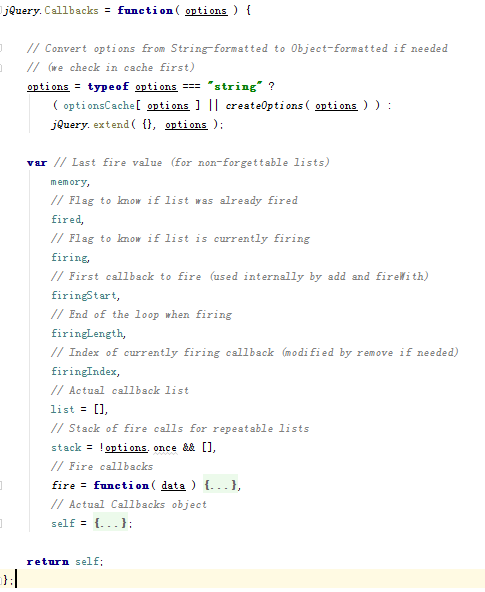
Callbacks就是一个工具函数,内部定义了一个self ,add和remove还有has等挂在self上。
1、参数处理
$.Callbacks有4个可选的参数,可以组合传入,用空格分隔。比如 $.Callbacks("once memory unique");
这样传入的构造函数字符串实际上是一个字符串,源码中做了处理会把这个字符串转成对象。
// String to Object options format cache
var optionsCache = {};

// Convert String-formatted options into Object-formatted ones and store in cache
function createOptions( options ) {
    var object = optionsCache[ options ] = {};
    jQuery.each( options.match( core_rnotwhite ) || [], function( _, flag ) {
        object[ flag ] = true;
    });
    return object;
}
在构造函数中传入一个options后,先进行如下处理调用。把一个字符串处理成一个对象。
传入的options="once memory unique"处理后options={once:true,memory:true,unique:true}。
    // Convert options from String-formatted to Object-formatted if needed
    // (we check in cache first)
    options = typeof options === "string" ?
        ( optionsCache[ options ] || createOptions( options ) ) :
        jQuery.extend( {}, options );
过程如下:options="once memory unique"是string类型,所以先从optionsCache中获取,现在optionsCache为{}所以optionsCache[ options ]是undefined走后面的createOptions( options ) 。create操作中先新建一个以options为键的空对象,再循环给对象中填充。循环操作完
optionCache为
optionCache={ "once memory unique":{once:true,memory:true,unique:true} }
options为
options={once:true,memory:true,unique:true}
2、add源码
主要是把回调函数Push到数组list中。
       add: function() {
            if ( list ) { //list初始化为[],if判断会返回true
                // First, we save the current length
                var start = list.length;
                (function add( args ) {
                    jQuery.each( args, function( _, arg ) { ////处理cb.add(aaa,bbb)这种调用
                        var type = jQuery.type( arg );//arg就是每一个函数
                        if ( type === "function" ) {//arg是函数就push到list中,此时有个判断有没有unique
                            if ( !options.unique || !self.has( arg ) ) {//有unique走后面,判断list中有没有这个函数,有就不添加了
                                list.push( arg );
                            }
                        } else if ( arg && arg.length && type !== "string" ) { //处理cb.add([aaa,bbb])这种调用
                            // Inspect recursively
                            add( arg );//递归分解,最终还是push到list
                        }
                    });
                })( arguments );
                // Do we need to add the callbacks to the
                // current firing batch?
                if ( firing ) {
                    firingLength = list.length;
                    // With memory, if we're not firing then
                    // we should call right away
                } else if ( memory ) {
                    firingStart = start;
                    fire( memory );
                }
            }
            return this;
        },
3、remove源码
// Remove a callback from the list
        remove: function() {
            if ( list ) {
                jQuery.each( arguments, function( _, arg ) {
                    var index;
                    while( ( index = jQuery.inArray( arg, list, index ) ) > -1 ) {
                        list.splice( index, 1 );//主要就是splice删除操作
                        // Handle firing indexes
                        if ( firing ) {
                            if ( index <= firingLength ) {
                                firingLength--;
                            }
                            if ( index <= firingIndex ) {
                                firingIndex--;
                            }
                        }
                    }
                });
            }
            return this;
        },
4、fire源码
1、整体调用逻辑
self的fire调用self的fireWith,fireWith把参数传递到fire()函数。
// Call all callbacks with the given context and arguments
            fireWith: function( context, args ) {
                if ( list && ( !fired || stack ) ) {
                    args = args || [];
                    args = [ context, args.slice ? args.slice() : args ];
                    if ( firing ) {
                        stack.push( args );
                    } else {
                        fire( args );
                    }
                }
                return this;
            },
            // Call all the callbacks with the given arguments
            fire: function() {
                self.fireWith( this, arguments );
                return this;
            },
fire()时主要是for循环
 // Fire callbacks
        fire = function( data ) {
            memory = options.memory && data;
            fired = true;//fired变为true说明已经调用过一次了,
            firingIndex = firingStart || 0;
            firingStart = 0;
            firingLength = list.length;
            firing = true;//触发进行时
            for ( ; list && firingIndex < firingLength; firingIndex++ ) {
                if ( list[ firingIndex ].apply( data[ 0 ], data[ 1 ] ) === false && options.stopOnFalse ) {//每次函数调用同时处理stopOnFalse的情况
                    memory = false; // To prevent further calls using add //stopOnFalse后有memory也不好使了
                    break;
                }
            }
            firing = false;//触发结束
            if ( list ) {
                if ( stack ) {
                    if ( stack.length ) {
                        fire( stack.shift() );
                    }
                } else if ( memory ) {
                    list = [];
                } else {
                    self.disable();
                }
            }
        },
2、firing特殊情况
比如在 fire 处理队列中,某个函数又在队列中添加了一个回调函数,或者,在队列中又删除了某个回调函数。 fire 处理过程中,某个函数又调用了 fire 来触发事件呢?
先通过例子来看一下效果
        function aaa() {
            alert(1);
            cb.fire(); //在这里调用fire()会出现什么问题 死循环
        }
        function bbb() {
            alert(2);
        }
        var cb = $.Callbacks();
        cb.add(aaa);
        cb.add(bbb);

        cb.fire();
在执行函数的过程中再次调用fire()的执行顺序是怎样的?
var bBtn=true;//用bBtn避免死循环
        function aaa() {
            alert(1);
            if(bBtn){
                cb.fire();//注意这里fire调用后执行顺序是1 2 1 2,而不是1 1 2 2
                bBtn=false;
            }

        }
        function bbb() {
            alert(2);
        }
        var cb = $.Callbacks();
        cb.add(aaa);
        cb.add(bbb);

        cb.fire();
结论:把函数运行过程中触发的fire()放到了运行过程的队列当中。
fire 处理过程中,某个函数又调用了 fire 来触发事件时,jQuery的处理方式如下:
将这个嵌套的事件先保存起来,等到当前的回调序列处理完成之后,再检查被保存的事件,继续完成处理。显然,使用队列是处理这种情况的理想数据结构,如果遇到这种状况,我们就将事件数据入队,待处理的时候,依次出队数据进行处理。什么时候需要这种处理呢?显然不是once的情况。在JavaScript中,堆队列也是通过数组来实现的,push用来将数据追加到数组的最后,而shift用来出队,从数据的最前面获取数据。
不过,jQuery没有称之为队列,而是取名stack。
// Stack of fire calls for repeatable lists
stack = !options.once && [],
入队
源码中,在fireWith的时候判断for循环有没有执行完
 fireWith: function( context, args ) {
            ...if ( firing ) {//firing在for循环没有走完时一直是true
                    stack.push( args );//所以这句话意思就是函数执行时再去fire()调用就会push到stack数组中
                } else {
                    fire( args );
                }
            }
            return this;
        },
出队
再去调用fire()的时候
  // Fire callbacks
        fire = function( data ) {
            memory = options.memory && data;
            fired = true;//fired变为true说明已经调用过一次了,
            firingIndex = firingStart || 0;
            firingStart = 0;
            firingLength = list.length;
            firing = true;//触发进行时
            for ( ; list && firingIndex < firingLength; firingIndex++ ) {
                if ( list[ firingIndex ].apply( data[ 0 ], data[ 1 ] ) === false && options.stopOnFalse ) {//每次函数调用同时处理stopOnFalse的情况
                    memory = false; // To prevent further calls using add //stopOnFalse后有memory也不好使了
                    break;
                }
            }
            firing = false;//触发结束
            if ( list ) {
                if ( stack ) {        //这就是出现在函数执行过程中再次fire()的时候,等循环执行完,再去按顺序执行
                    if ( stack.length ) {
                        fire( stack.shift() );
                    }
                } else if ( memory ) {//只执行一次的时候,有once,memory就清空list,此时fire()就相当于一个执行一个空数组
                    list = [];
                } else {
                    self.disable();//disable阻止后续任何的fire()操作
                }
            }
        },
针对下面这段源码的一个例子:
once和memory同时存在的时候,fire()无效因为list为[]了,但是add仍然有效。
当有memory的时候,把之前添加的清空;允许添加并再次运行fire后清空;当不存在memory的时候既只有once配置,fire之后既不允许做任何操作了。
else if ( memory ) {//只执行一次的时候,有once,memory就清空list,此时fire()就相当于一个执行一个空数组
                    list = [];
                } else {
                    self.disable();//disable阻止后续任何的fire()操作
                }
disable阻止后续任何的fire()操作。
 function aaa() {
            alert(1);
        }
        function bbb() {
            alert(2);
        }
        //组合使用,只执行一次,并且弹出1 2 3
        var cb = $.Callbacks('once memory');
        cb.add(aaa);
        cb.fire(); //1
        cb.fire();//此时list为[]
        cb.add(bbb);
        cb.fire();
        function ccc(){
            alert(3);
        }
        cb.add(ccc);
5、其他源码
has(fn):判断list有没有fn
empty: 清空数组list=[]
disable:全部锁住,禁止了,如下
// Have the list do nothing anymore
            disable: function() {
                list = stack = memory = undefined;
                return this;
            },
disabled:判断是不是禁止了。return !list;
lock:只是把stack锁住
// Lock the list in its current state
            lock: function() {
                stack = undefined;
                if ( !memory ) {
                    self.disable();
                }
                return this;
            },
locked:是否locked。 return !stack;
6、 lock和disable的区别
disable禁止所有操作
 function aaa() {
            alert(1);
        }
        function bbb() {
            alert(2);
        }

        var cb = $.Callbacks('memory');
        cb.add(aaa);
        cb.fire(); //1
        cb.disable();//disable()后只能弹出1 因为禁止所有操作了,虽然有Memory
        cb.add(bbb);//不起作用了,此时list变为undefined了
        cb.fire();//不起作用了
lock只是锁住数组
function aaa() {
            alert(1);
        }
        function bbb() {
            alert(2);
        }

        var cb = $.Callbacks('memory');
        cb.add(aaa);
        cb.fire(); //1 2
        cb.lock();//lock()只是把后续的fire()锁住,其他操作是锁不住的
        cb.add(bbb);
        cb.fire();//不起作用了 此时list为[]
参考:
http://www.cnblogs.com/haogj/p/4473477.html
本文作者starof,因知识本身在变化,作者也在不断学习成长,文章内容也不定时更新,为避免误导读者,方便追根溯源,请诸位转载注明出处:http://www.cnblogs.com/starof/p/6885500.html有问题欢迎与我讨论,共同进步。