前言
-
深度卷积网络极大地推进深度学习各领域的发展,ILSVRC作为最具影响力的竞赛功不可没,促使了许多经典工作。我梳理了ILSVRC分类任务的各届冠军和亚军网络,简单介绍了它们的核心思想、网络架构及其实现。
-
ImageNet和ILSVRC
-
ImageNet是一个超过15 million的图像数据集,大约有22,000类。
-
ILSVRC全称ImageNet Large-Scale Visual Recognition Challenge,从2010年开始举办到2017年最后一届,使用ImageNet数据集的一个子集,总共有1000类。
-
-
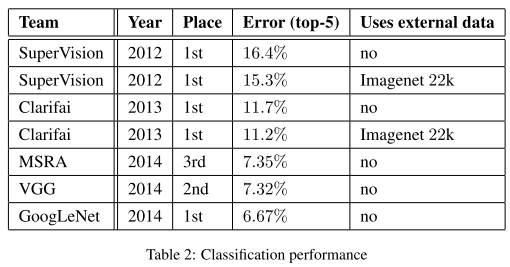
历届结果
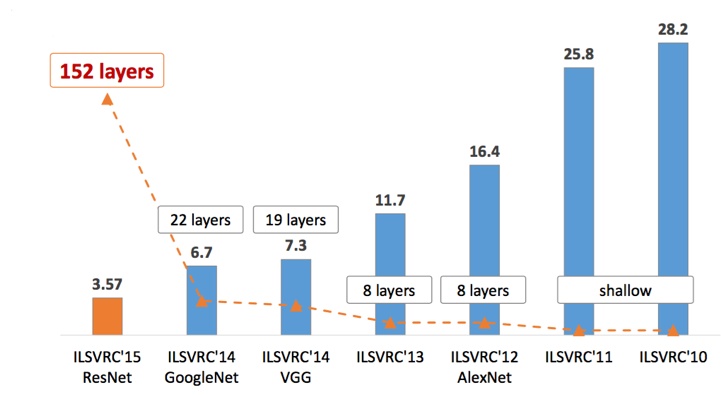
| 年 | 网络/队名 | val top-1 | val top-5 | test top-5 | 备注 |
|---|---|---|---|---|---|
| 2012 | AlexNet | 38.1% | 16.4% | 16.42% | 5 CNNs |
| 2012 | AlexNet | 36.7% | 15.4% | 15.32% | 7CNNs。用了2011年的数据 |
| 2013 | OverFeat | 14.18% | 7 fast models | ||
| 2013 | OverFeat | 13.6% | 赛后。7 big models | ||
| 2013 | ZFNet | 13.51% | ZFNet论文上的结果是14.8 | ||
| 2013 | Clarifai | 11.74% | |||
| 2013 | Clarifai | 11.20% | 用了2011年的数据 | ||
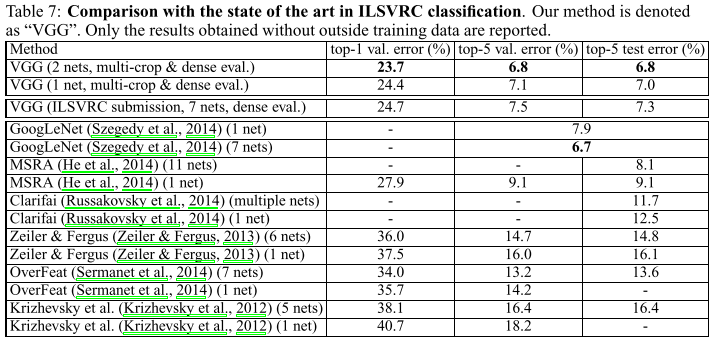
| 2014 | VGG | 7.32% | 7 nets, dense eval | ||
| 2014 | VGG(亚军) | 23.7% | 6.8% | 6.8% | 赛后。2 nets |
| 2014 | GoogleNet v1 | 6.67% | 7 nets, 144 crops | ||
| GoogleNet v2 | 20.1% | 4.9% | 4.82% | 赛后。6 nets, 144 crops | |
| GoogleNet v3 | 17.2% | 3.58% | 赛后。4 nets, 144 crops | ||
| GoogleNet v4 | 16.5% | 3.1% | 3.08% | 赛后。v4+Inception-Res-v2 | |
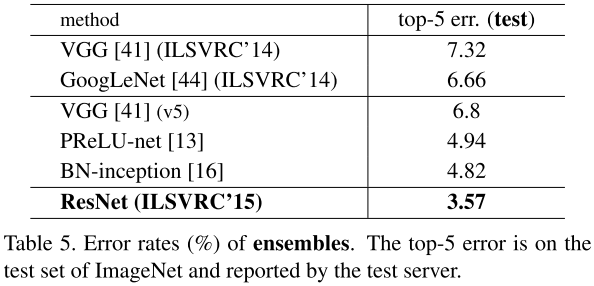
| 2015 | ResNet | 3.57% | 6 models | ||
| 2016 | Trimps-Soushen | 2.99% | 公安三所 | ||
| 2016 | ResNeXt(亚军) | 3.03% | 加州大学圣地亚哥分校 | ||
| 2017 | SENet | 2.25% | Momenta 与牛津大学 |
-
评价标准
top1是指概率向量中最大的作为预测结果,若分类正确,则为正确;top5则只要概率向量中最大的前五名里有分类正确的,则为正确。
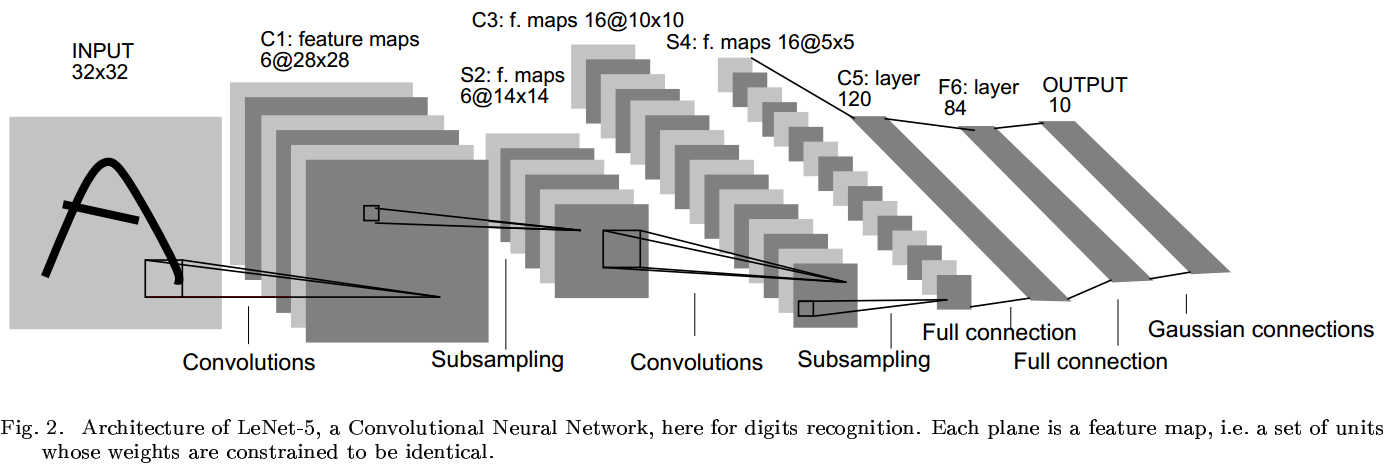
LeNet
Gradient-Based Learning Applied to Document Recognition
网络架构
import torch.nn as nn
import torch.nn.functional as func
class LeNet(nn.Module):
    def __init__(self):
        super(LeNet, self).__init__()
        self.conv1 = nn.Conv2d(1, 6, kernel_size=5)
        self.conv2 = nn.Conv2d(6, 16, kernel_size=5)
        self.fc1 = nn.Linear(16*16, 120)
        self.fc2 = nn.Linear(120, 84)
        self.fc3 = nn.Linear(84, 10)

    def forward(self, x):
        x = func.relu(self.conv1(x))
        x = func.max_pool2d(x, 2)
        x = func.relu(self.conv2(x))
        x = func.max_pool2d(x, 2)
        x = x.view(x.size(0), -1)
        x = func.relu(self.fc1(x))
        x = func.relu(self.fc2(x))
        x = self.fc3(x)
        return x
AlexNet
ImageNet Classification with Deep Convolutional Neural Networks
核心思想
-
AlexNet相比前人有以下改进:
-
采用ReLU激活函数
-
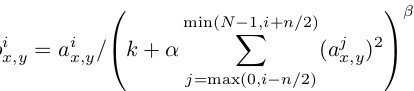
局部响应归一化LRN
-
Overlapping Pooling
-
引入Drop out
-
数据增强
-
多GPU并行
-
网络架构

- 代码实现
class AlexNet(nn.Module):
    def __init__(self, num_classes=NUM_CLASSES):
        super(AlexNet, self).__init__()
        self.features = nn.Sequential(
            nn.Conv2d(1, 96, kernel_size=11,padding=1),
            nn.ReLU(inplace=True),
            nn.MaxPool2d(kernel_size=2),
            nn.Conv2d(96, 256, kernel_size=3, padding=1),
            nn.ReLU(inplace=True),
            nn.MaxPool2d(kernel_size=2),
            nn.Conv2d(256, 384, kernel_size=3, padding=1),
            nn.ReLU(inplace=True),
            nn.Conv2d(384, 384, kernel_size=3, padding=1),
            nn.ReLU(inplace=True),
            nn.Conv2d(384, 256, kernel_size=3, padding=1),
            nn.ReLU(inplace=True),
            nn.MaxPool2d(kernel_size=2),
        )
        self.classifier = nn.Sequential(
            nn.Dropout(),
            nn.Linear(256 * 2 * 2, 4096),
            nn.ReLU(inplace=True),
            nn.Dropout(),
            nn.Linear(4096, 4096),
            nn.ReLU(inplace=True),
            nn.Linear(4096, 10),
        )

    def forward(self, x):
        x = self.features(x)
        x = x.view(x.size(0), 256 * 2 * 2)
        x = self.classifier(x)
        return x
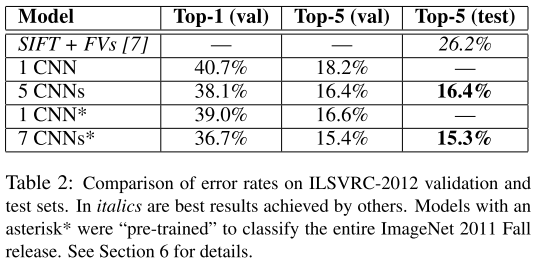
实验结果
ZFNet
Visualizing and Understanding Convolutional Networks
核心思想
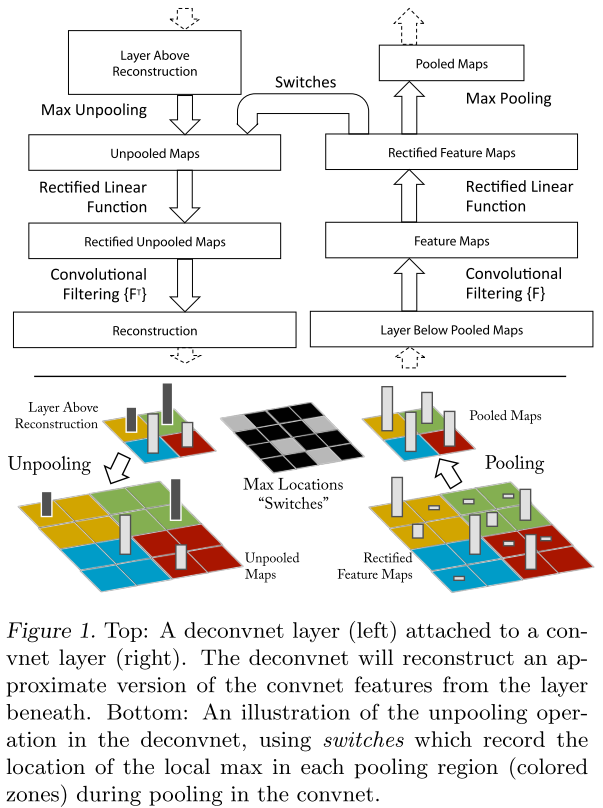
- 利用反卷积可视化CNN学到的特征。
- Unpooling:池化操作不可逆,但通过记录池化最大值的位置可实现逆操作。
- Rectification:ReLU
- Filtering:使用原卷积核的转置版本。
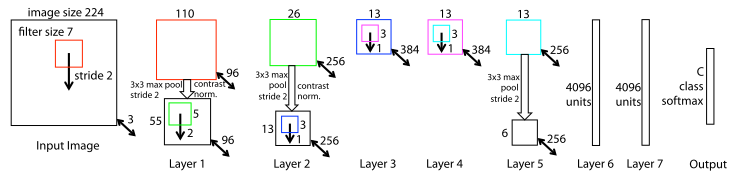
网络架构
实验结果
- 特征可视化:Layer2响应角落和边缘、颜色连接;Layer3有更复杂的不变性,捕获相似纹理;Layer4展示了明显的变化,跟类别更相关;Layer5看到整个物体。
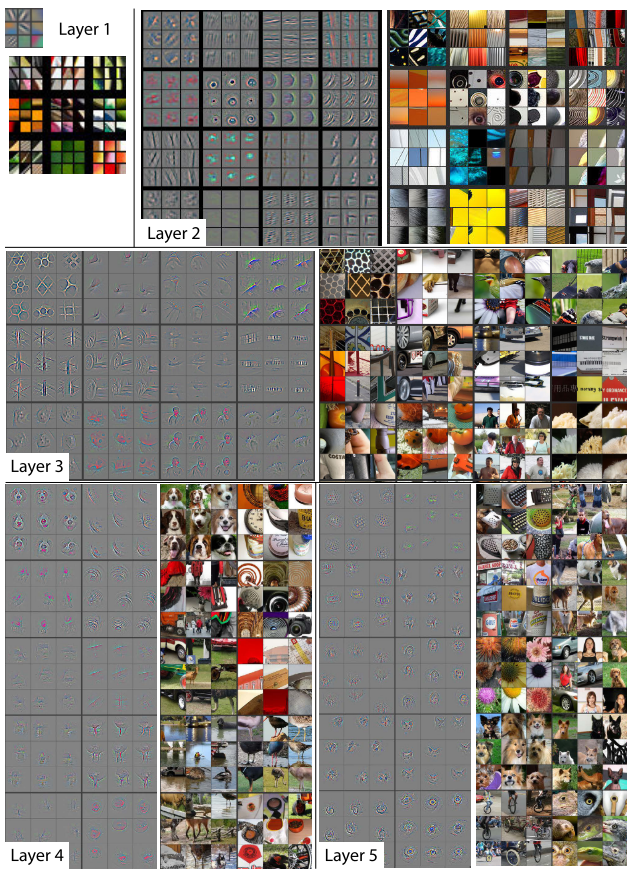
- 训练过程特征演化:低层特征较快收敛,高层到后面才开始变化。

- 特征不变性:小变换在模型第一层变化明显,但在顶层影响较小。网络输出对翻转和缩放是稳定的,但除了旋转对称性的物体,输出对旋转并不是不变的。
- 遮挡敏感性:当对象被遮挡,准确性会明显下降。
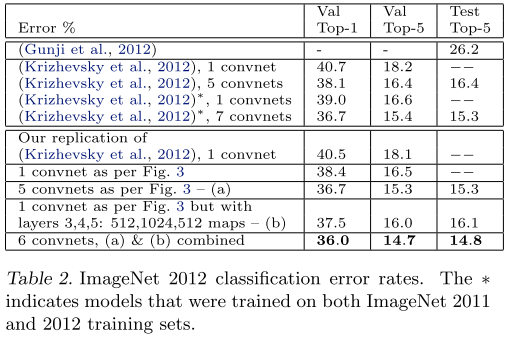
- ImageNet结果
VGG
Very Deep Convolutional Networks for Large-Scale Image Recognition
核心思想
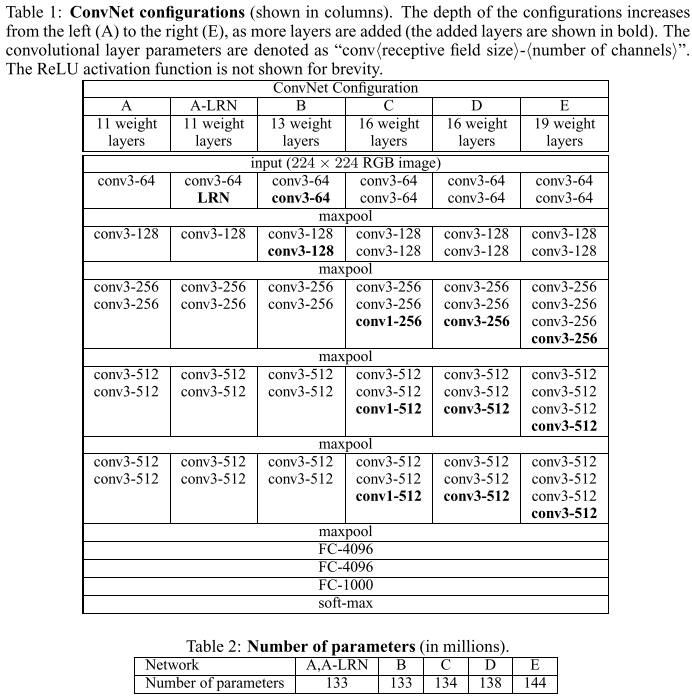
- 重复使用3x3卷积和2x2池化增加网络深度。
网络架构
- VGG19表示有19层conv或fc,参数量较大。
- 代码实现
cfg = {
    'A' : [64,     'M', 128,      'M', 256, 256,           'M', 512, 512,           'M', 512, 512,           'M'],
    'B' : [64, 64, 'M', 128, 128, 'M', 256, 256,           'M', 512, 512,           'M', 512, 512,           'M'],
    'D' : [64, 64, 'M', 128, 128, 'M', 256, 256, 256,      'M', 512, 512, 512,      'M', 512, 512, 512,      'M'],
    'E' : [64, 64, 'M', 128, 128, 'M', 256, 256, 256, 256, 'M', 512, 512, 512, 512, 'M', 512, 512, 512, 512, 'M']
}

def vgg19_bn():
    return VGG(make_layers(cfg['E'], batch_norm=True))

class VGG(nn.Module):

    def __init__(self, features, num_class=100):
        super().__init__()
        self.features = features

        self.classifier = nn.Sequential(
            nn.Linear(512, 4096),
            nn.ReLU(inplace=True),
            nn.Dropout(),
            nn.Linear(4096, 4096),
            nn.ReLU(inplace=True),
            nn.Dropout(),
            nn.Linear(4096, num_class)
        )

    def forward(self, x):
        output = self.features(x)
        output = output.view(output.size()[0], -1)
        output = self.classifier(output)

        return output

    def make_layers(cfg, batch_norm=False):
    	layers = []

        input_channel = 3
        for l in cfg:
            if l == 'M':
                layers += [nn.MaxPool2d(kernel_size=2, stride=2)]
                continue

            layers += [nn.Conv2d(input_channel, l, kernel_size=3, padding=1)]

            if batch_norm:
                layers += [nn.BatchNorm2d(l)]

            layers += [nn.ReLU(inplace=True)]
            input_channel = l

        return nn.Sequential(*layers)
实验结果
GoogLeNet(v1)
Going Deeper with Convolutions
核心思想
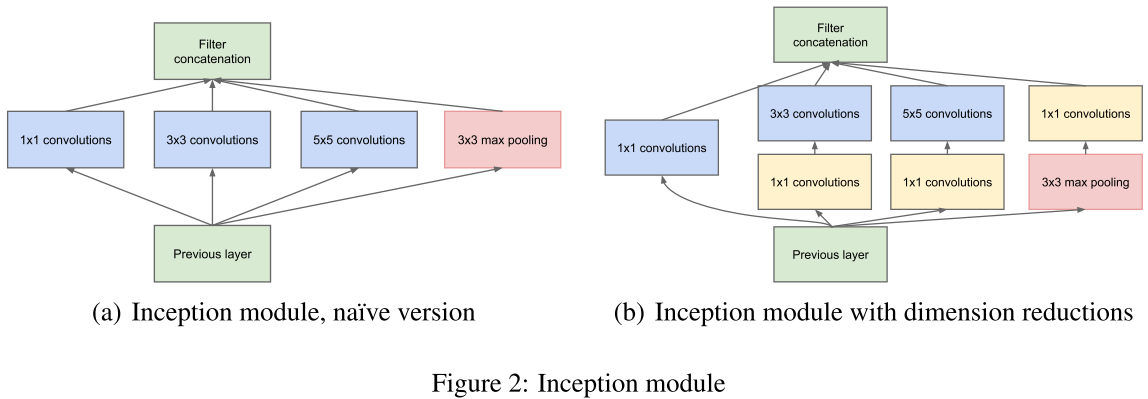
- 提出Inception模块,可在保持计算成本的同时增加网络的深度和宽度。
- 代码实现
class Inception(nn.Module):
    def __init__(self, input_channels, n1x1, n3x3_reduce, n3x3, n5x5_reduce, n5x5, pool_proj):
        super().__init__()

        #1x1conv branch
        self.b1 = nn.Sequential(
            nn.Conv2d(input_channels, n1x1, kernel_size=1),
            nn.BatchNorm2d(n1x1),
            nn.ReLU(inplace=True)
        )

        #1x1conv -> 3x3conv branch
        self.b2 = nn.Sequential(
            nn.Conv2d(input_channels, n3x3_reduce, kernel_size=1),
            nn.BatchNorm2d(n3x3_reduce),
            nn.ReLU(inplace=True),
            nn.Conv2d(n3x3_reduce, n3x3, kernel_size=3, padding=1),
            nn.BatchNorm2d(n3x3),
            nn.ReLU(inplace=True)
        )

        #1x1conv -> 5x5conv branch
        #we use 2 3x3 conv filters stacked instead
        #of 1 5x5 filters to obtain the same receptive
        #field with fewer parameters
        self.b3 = nn.Sequential(
            nn.Conv2d(input_channels, n5x5_reduce, kernel_size=1),
            nn.BatchNorm2d(n5x5_reduce),
            nn.ReLU(inplace=True),
            nn.Conv2d(n5x5_reduce, n5x5, kernel_size=3, padding=1),
            nn.BatchNorm2d(n5x5, n5x5),
            nn.ReLU(inplace=True),
            nn.Conv2d(n5x5, n5x5, kernel_size=3, padding=1),
            nn.BatchNorm2d(n5x5),
            nn.ReLU(inplace=True)
        )

        #3x3pooling -> 1x1conv
        #same conv
        self.b4 = nn.Sequential(
            nn.MaxPool2d(3, stride=1, padding=1),
            nn.Conv2d(input_channels, pool_proj, kernel_size=1),
            nn.BatchNorm2d(pool_proj),
            nn.ReLU(inplace=True)
        )

    def forward(self, x):
        return torch.cat([self.b1(x), self.b2(x), self.b3(x), self.b4(x)], dim=1)
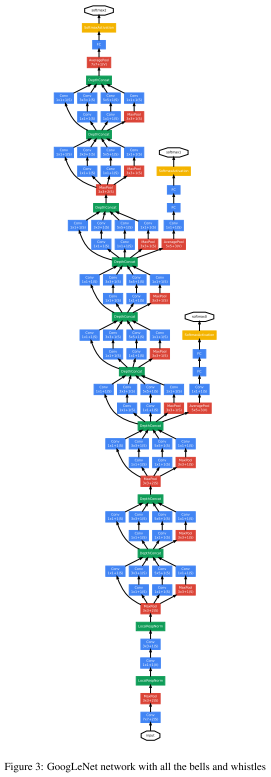
网络架构
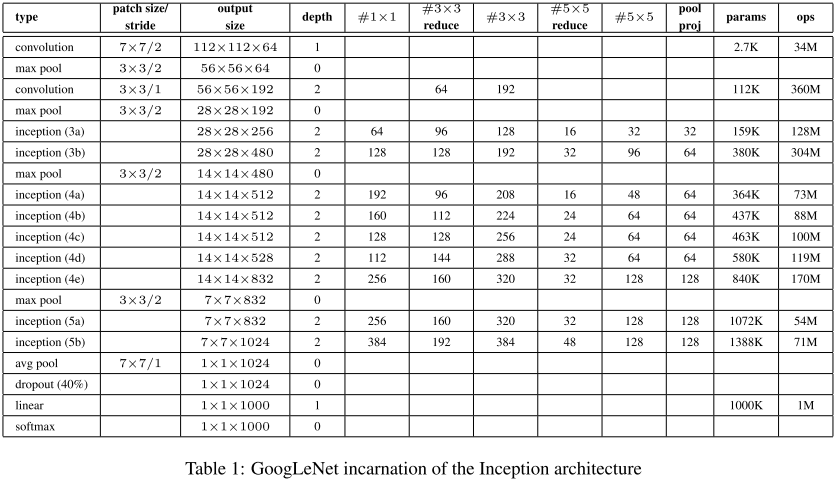
- 代码实现
def googlenet():
    return GoogleNet()

class GoogleNet(nn.Module):

    def __init__(self, num_class=100):
        super().__init__()
        self.prelayer = nn.Sequential(
            nn.Conv2d(3, 192, kernel_size=3, padding=1),
            nn.BatchNorm2d(192),
            nn.ReLU(inplace=True)
        )

        #although we only use 1 conv layer as prelayer,
        #we still use name a3, b3.......
        self.a3 = Inception(192, 64, 96, 128, 16, 32, 32)
        self.b3 = Inception(256, 128, 128, 192, 32, 96, 64)

        #"""In general, an Inception network is a network consisting of
        #modules of the above type stacked upon each other, with occasional
        #max-pooling layers with stride 2 to halve the resolution of the
        #grid"""
        self.maxpool = nn.MaxPool2d(3, stride=2, padding=1)

        self.a4 = Inception(480, 192, 96, 208, 16, 48, 64)
        self.b4 = Inception(512, 160, 112, 224, 24, 64, 64)
        self.c4 = Inception(512, 128, 128, 256, 24, 64, 64)
        self.d4 = Inception(512, 112, 144, 288, 32, 64, 64)
        self.e4 = Inception(528, 256, 160, 320, 32, 128, 128)

        self.a5 = Inception(832, 256, 160, 320, 32, 128, 128)
        self.b5 = Inception(832, 384, 192, 384, 48, 128, 128)

        #input feature size: 8*8*1024
        self.avgpool = nn.AdaptiveAvgPool2d((1, 1))
        self.dropout = nn.Dropout2d(p=0.4)
        self.linear = nn.Linear(1024, num_class)

    def forward(self, x):
        output = self.prelayer(x)
        output = self.a3(output)
        output = self.b3(output)

        output = self.maxpool(output)

        output = self.a4(output)
        output = self.b4(output)
        output = self.c4(output)
        output = self.d4(output)
        output = self.e4(output)

        output = self.maxpool(output)

        output = self.a5(output)
        output = self.b5(output)

        #"""It was found that a move from fully connected layers to
        #average pooling improved the top-1 accuracy by about 0.6%,
        #however the use of dropout remained essential even after
        #removing the fully connected layers."""
        output = self.avgpool(output)
        output = self.dropout(output)
        output = output.view(output.size()[0], -1)
        output = self.linear(output)

        return output
实验结果
ResNet
Deep Residual Learning for Image Recognition
核心思想
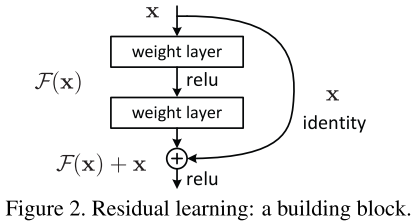
- 为了解决深层网络难以训练的问题,提出了残差模块和深度残差网络
- 假设网络输入是(x),经学习的输出是(F(x)),最终拟合目标是(H(x))。
- 深层网络相比浅层网络有一些层是多余的,若让多余层学习恒等变换(H(x)=x),那么网络性能不该比浅层网络要差。
- 传统网络训练目标(H(x)=F(x)),残差网络训练目标(H(x)=F(x)+x)。
- 为了学习恒等变换,传统网络要求网络学习(F(x)=H(x)=x),残差网络只需学习(F(x)=H(x)-x=x-x=0)。残差学习之所以有效是因为让网络学习(F(x)=0)比学习(F(x)=x)要容易。
- bottleneck
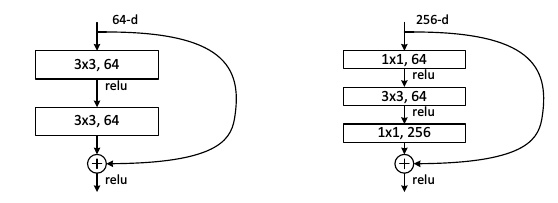
- 代码实现
class BottleNeck(nn.Module):
    """Residual block for resnet over 50 layers

    """
    expansion = 4
    def __init__(self, in_channels, out_channels, stride=1):
        super().__init__()
        self.residual_function = nn.Sequential(
            nn.Conv2d(in_channels, out_channels, kernel_size=1, bias=False),
            nn.BatchNorm2d(out_channels),
            nn.ReLU(inplace=True),
            nn.Conv2d(out_channels, out_channels, stride=stride, kernel_size=3, padding=1, bias=False),
            nn.BatchNorm2d(out_channels),
            nn.ReLU(inplace=True),
            nn.Conv2d(out_channels, out_channels * BottleNeck.expansion, kernel_size=1, bias=False),
            nn.BatchNorm2d(out_channels * BottleNeck.expansion),
        )

        self.shortcut = nn.Sequential()

        if stride != 1 or in_channels != out_channels * BottleNeck.expansion:
            self.shortcut = nn.Sequential(
                nn.Conv2d(in_channels, out_channels * BottleNeck.expansion, stride=stride, kernel_size=1, bias=False),
                nn.BatchNorm2d(out_channels * BottleNeck.expansion)
            )

    def forward(self, x):
        return nn.ReLU(inplace=True)(self.residual_function(x) + self.shortcut(x))
网络架构
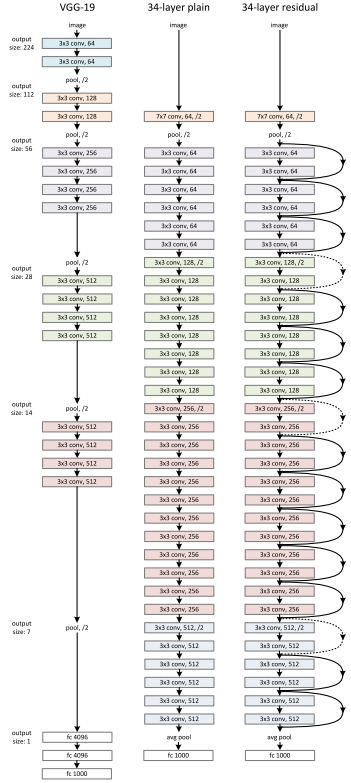
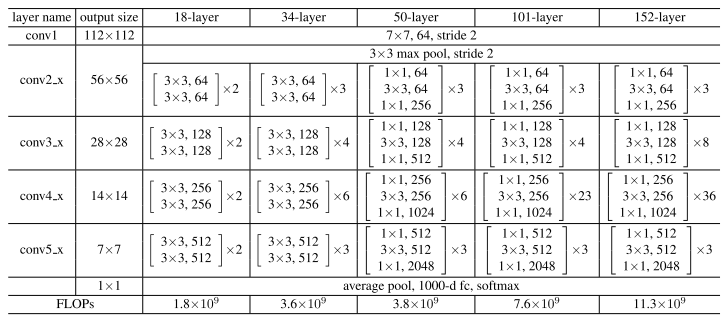
- 代码实现
def resnet152():
    """ return a ResNet 152 object
    """
    return ResNet(BottleNeck, [3, 8, 36, 3])

class ResNet(nn.Module):

    def __init__(self, block, num_block, num_classes=100):
        super().__init__()

        self.in_channels = 64

        self.conv1 = nn.Sequential(
            nn.Conv2d(3, 64, kernel_size=3, padding=1, bias=False),
            nn.BatchNorm2d(64),
            nn.ReLU(inplace=True))
        #we use a different inputsize than the original paper
        #so conv2_x's stride is 1
        self.conv2_x = self._make_layer(block, 64, num_block[0], 1)
        self.conv3_x = self._make_layer(block, 128, num_block[1], 2)
        self.conv4_x = self._make_layer(block, 256, num_block[2], 2)
        self.conv5_x = self._make_layer(block, 512, num_block[3], 2)
        self.avg_pool = nn.AdaptiveAvgPool2d((1, 1))
        self.fc = nn.Linear(512 * block.expansion, num_classes)

    def _make_layer(self, block, out_channels, num_blocks, stride):
        """make resnet layers(by layer i didnt mean this 'layer' was the
        same as a neuron netowork layer, ex. conv layer), one layer may
        contain more than one residual block

        Args:
            block: block type, basic block or bottle neck block
            out_channels: output depth channel number of this layer
            num_blocks: how many blocks per layer
            stride: the stride of the first block of this layer

        Return:
            return a resnet layer
        """

        # we have num_block blocks per layer, the first block
        # could be 1 or 2, other blocks would always be 1
        strides = [stride] + [1] * (num_blocks - 1)
        layers = []
        for stride in strides:
            layers.append(block(self.in_channels, out_channels, stride))
            self.in_channels = out_channels * block.expansion

        return nn.Sequential(*layers)

    def forward(self, x):
        output = self.conv1(x)
        output = self.conv2_x(output)
        output = self.conv3_x(output)
        output = self.conv4_x(output)
        output = self.conv5_x(output)
        output = self.avg_pool(output)
        output = output.view(output.size(0), -1)
        output = self.fc(output)

        return output
实验结果
ResNeXt
Aggregated Residual Transformations for Deep Neural Networks
核心思想
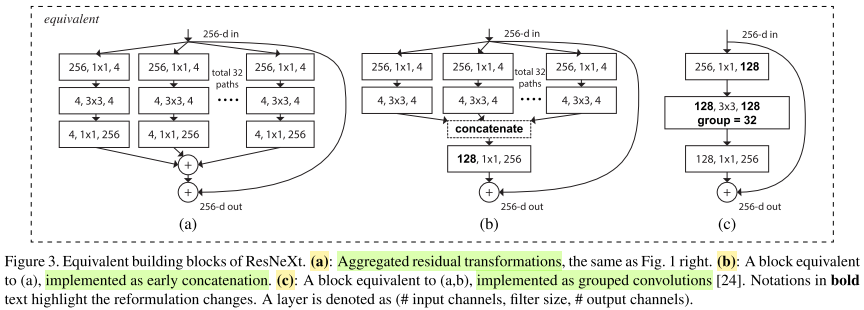
- 通过重复构建block来聚合一组相同拓扑结构的特征,并提出一个新维度”cardinality“。
- ResNeXt结合了VGG、ResNet重复堆叠模块和Inception的split-transform-merge的思想。
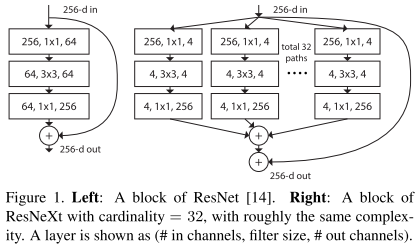
以下三者等价,文章采用第三种实现,其使用了组卷积。
- 代码实现
CARDINALITY = 32
DEPTH = 4
BASEWIDTH = 64

class ResNextBottleNeckC(nn.Module):
    def __init__(self, in_channels, out_channels, stride):
        super().__init__()

        C = CARDINALITY #How many groups a feature map was splitted into

        #"""We note that the input/output width of the template is fixed as
        #256-d (Fig. 3), We note that the input/output width of the template
        #is fixed as 256-d (Fig. 3), and all widths are dou- bled each time
        #when the feature map is subsampled (see Table 1)."""
        D = int(DEPTH * out_channels / BASEWIDTH) #number of channels per group
        self.split_transforms = nn.Sequential(
            nn.Conv2d(in_channels, C * D, kernel_size=1, groups=C, bias=False),
            nn.BatchNorm2d(C * D),
            nn.ReLU(inplace=True),
            nn.Conv2d(C * D, C * D, kernel_size=3, stride=stride, groups=C, padding=1, bias=False),
            nn.BatchNorm2d(C * D),
            nn.ReLU(inplace=True),
            nn.Conv2d(C * D, out_channels * 4, kernel_size=1, bias=False),
            nn.BatchNorm2d(out_channels * 4),
        )

        self.shortcut = nn.Sequential()

        if stride != 1 or in_channels != out_channels * 4:
            self.shortcut = nn.Sequential(
                nn.Conv2d(in_channels, out_channels * 4, stride=stride, kernel_size=1, bias=False),
                nn.BatchNorm2d(out_channels * 4)
            )

    def forward(self, x):
        return F.relu(self.split_transforms(x) + self.shortcut(x))
网络架构
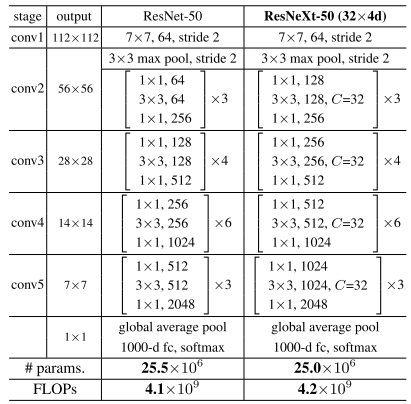
-
代码实现
以下部分跟ResNet基本一致,重点关注ResNextBottleNeckC的实现。
def resnext50():
    """ return a resnext50(c32x4d) network
    """
    return ResNext(ResNextBottleNeckC, [3, 4, 6, 3])

class ResNext(nn.Module):
    def __init__(self, block, num_blocks, class_names=100):
        super().__init__()
        self.in_channels = 64

        self.conv1 = nn.Sequential(
            nn.Conv2d(3, 64, 3, stride=1, padding=1, bias=False),
            nn.BatchNorm2d(64),
            nn.ReLU(inplace=True)
        )
        self.conv2 = self._make_layer(block, num_blocks[0], 64, 1)
        self.conv3 = self._make_layer(block, num_blocks[1], 128, 2)
        self.conv4 = self._make_layer(block, num_blocks[2], 256, 2)
        self.conv5 = self._make_layer(block, num_blocks[3], 512, 2)
        self.avg = nn.AdaptiveAvgPool2d((1, 1))
        self.fc = nn.Linear(512 * 4, 100)

    def forward(self, x):
        x = self.conv1(x)
        x = self.conv2(x)
        x = self.conv3(x)
        x = self.conv4(x)
        x = self.conv5(x)
        x = self.avg(x)
        x = x.view(x.size(0), -1)
        x = self.fc(x)
        return x

    def _make_layer(self, block, num_block, out_channels, stride):
        """Building resnext block
        Args:
            block: block type(default resnext bottleneck c)
            num_block: number of blocks per layer
            out_channels: output channels per block
            stride: block stride

        Returns:
            a resnext layer
        """
        strides = [stride] + [1] * (num_block - 1)
        layers = []
        for stride in strides:
            layers.append(block(self.in_channels, out_channels, stride))
            self.in_channels = out_channels * 4

        return nn.Sequential(*layers)
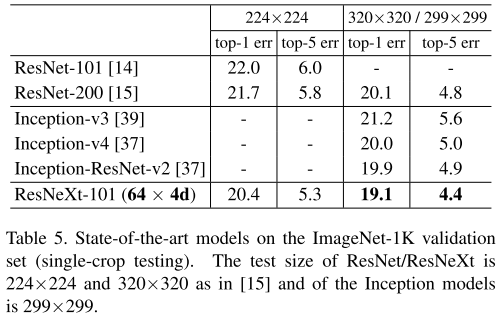
实验结果
SENet
Squeeze-and-Excitation Networks
核心思想
-
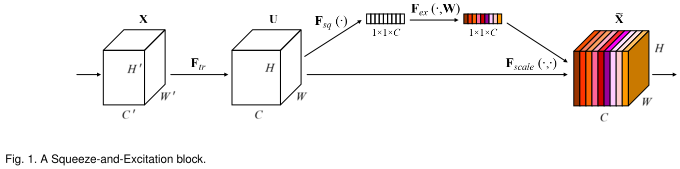
卷积操作融合了空间和特征通道信息。大量工作研究了空间部分,而本文重点关注特征通道的关系,并提出了Squeeze-and-Excitation(SE)block,对通道间的依赖关系进行建模,自适应校准通道方面的特征响应。
-
SE block
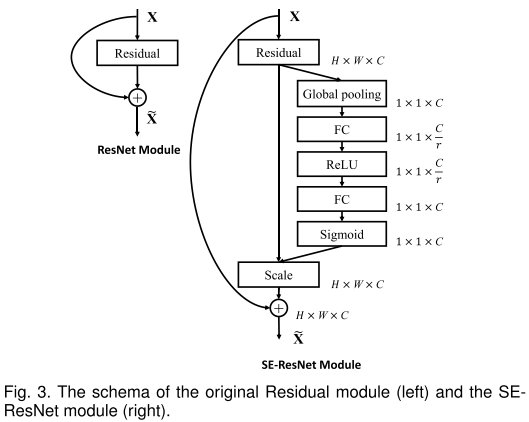
(F_{tr})表示transformation(一系列卷积操作);(F_{sq})表示squeeze,产生通道描述;(F_{ex})表示excitation,通过参数(W)来建模通道的重要性。(F_{scale})表示reweight,将excitation输出的权重逐乘以先前特征,完成特征重标定。
-
SE-ResNet Module
-
代码实现
class BottleneckResidualSEBlock(nn.Module):
    expansion = 4

    def __init__(self, in_channels, out_channels, stride, r=16):
        super().__init__()

        self.residual = nn.Sequential(
            nn.Conv2d(in_channels, out_channels, 1),
            nn.BatchNorm2d(out_channels),
            nn.ReLU(inplace=True),

            nn.Conv2d(out_channels, out_channels, 3, stride=stride, padding=1),
            nn.BatchNorm2d(out_channels),
            nn.ReLU(inplace=True),

            nn.Conv2d(out_channels, out_channels * self.expansion, 1),
            nn.BatchNorm2d(out_channels * self.expansion),
            nn.ReLU(inplace=True)
        )

        self.squeeze = nn.AdaptiveAvgPool2d(1)
        self.excitation = nn.Sequential(
            nn.Linear(out_channels * self.expansion, out_channels * self.expansion // r),
            nn.ReLU(inplace=True),
            nn.Linear(out_channels * self.expansion // r, out_channels * self.expansion),
            nn.Sigmoid()
        )

        self.shortcut = nn.Sequential()
        if stride != 1 or in_channels != out_channels * self.expansion:
            self.shortcut = nn.Sequential(
                nn.Conv2d(in_channels, out_channels * self.expansion, 1, stride=stride),
                nn.BatchNorm2d(out_channels * self.expansion)
            )

    def forward(self, x):

        shortcut = self.shortcut(x)

        residual = self.residual(x)
        squeeze = self.squeeze(residual)
        squeeze = squeeze.view(squeeze.size(0), -1)
        excitation = self.excitation(squeeze)
        excitation = excitation.view(residual.size(0), residual.size(1), 1, 1)

        x = residual * excitation.expand_as(residual) + shortcut

        return F.relu(x)
网络架构
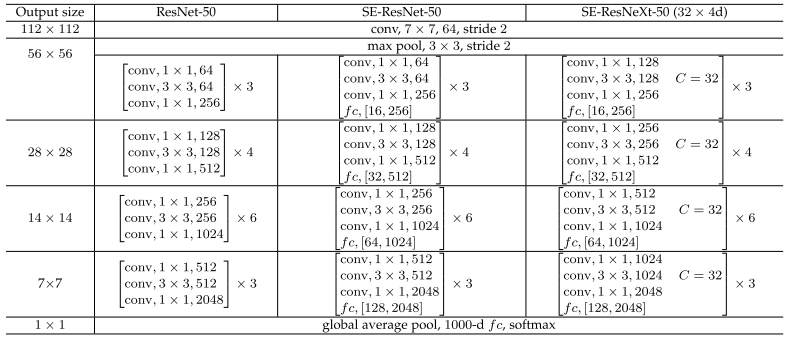
- 代码实现
def seresnet50():
    return SEResNet(BottleneckResidualSEBlock, [3, 4, 6, 3])

class SEResNet(nn.Module):

    def __init__(self, block, block_num, class_num=100):
        super().__init__()

        self.in_channels = 64

        self.pre = nn.Sequential(
            nn.Conv2d(3, 64, 3, padding=1),
            nn.BatchNorm2d(64),
            nn.ReLU(inplace=True)
        )

        self.stage1 = self._make_stage(block, block_num[0], 64, 1)
        self.stage2 = self._make_stage(block, block_num[1], 128, 2)
        self.stage3 = self._make_stage(block, block_num[2], 256, 2)
        self.stage4 = self._make_stage(block, block_num[3], 516, 2)

        self.linear = nn.Linear(self.in_channels, class_num)

    def forward(self, x):
        x = self.pre(x)

        x = self.stage1(x)
        x = self.stage2(x)
        x = self.stage3(x)
        x = self.stage4(x)

        x = F.adaptive_avg_pool2d(x, 1)
        x = x.view(x.size(0), -1)

        x = self.linear(x)

        return x


    def _make_stage(self, block, num, out_channels, stride):

        layers = []
        layers.append(block(self.in_channels, out_channels, stride))
        self.in_channels = out_channels * block.expansion

        while num - 1:
            layers.append(block(self.in_channels, out_channels, 1))
            num -= 1

        return nn.Sequential(*layers)
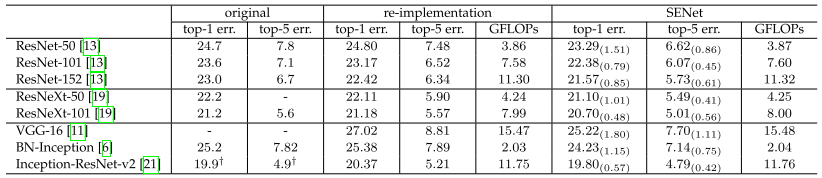
实验结果
总结
- 小结
- LeNet[1998]:CNN的鼻祖。
- AlexNet[2012]:第一个深度CNN。
- ZFNet[2012]:通过DeconvNet可视化CNN学习到的特征。
- VGG[2014]:重复堆叠3x3卷积增加网络深度。
- GoogLeNet[2014]:提出Inception模块,在控制参数和计算量的前提下,增加网络的深度与宽度。
- ResNet[2015]:提出残差网络,解决了深层网络的优化问题。
- ResNeXt[2016]:ResNet和Inception的结合体,Inception中每个分支结构相同,无需人为设计。
- SENet[2017]:提出SE block,关注特征的通道关系。
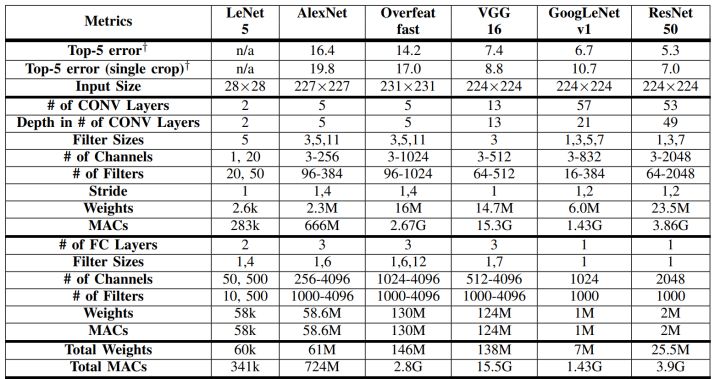
- 经典模型中结构、参数对比
参考
- paper
[1]LeCun Y, Bottou L, Bengio Y, et al. Gradient-based learning applied to document recognition[J]. Proceedings of the IEEE, 1998, 86(11): 2278-2324.
[2]Krizhevsky A, Sutskever I, Hinton G E. Imagenet classification with deep convolutional neural networks[C]//Advances in neural information processing systems. 2012: 1097-1105.
[3]Zeiler M D, Fergus R. Visualizing and understanding convolutional networks[C]//European conference on computer vision. springer, Cham, 2014: 818-833.
[4]Simonyan K, Zisserman A. Very deep convolutional networks for large-scale image recognition[J]. arXiv preprint arXiv:1409.1556, 2014.
[5]Szegedy C, Liu W, Jia Y, et al. Going deeper with convolutions[C]//Proceedings of the IEEE conference on computer vision and pattern recognition. 2015: 1-9.
[6]He K, Zhang X, Ren S, et al. Deep residual learning for image recognition[C]//Proceedings of the IEEE conference on computer vision and pattern recognition. 2016: 770-778.
[7]Xie S, Girshick R, Dollár P, et al. Aggregated residual transformations for deep neural networks[C]//Proceedings of the IEEE conference on computer vision and pattern recognition. 2017: 1492-1500.
[8]Hu J, Shen L, Sun G. Squeeze-and-excitation networks[C]//Proceedings of the IEEE conference on computer vision and pattern recognition. 2018: 7132-7141.
- blog
论文笔记:CNN经典结构2(WideResNet,FractalNet,DenseNet,ResNeXt,DPN,SENet)