今天介绍一个简单验证的识别。
主要是标准的格式,没有扭曲和变现。就用 pytesseract 去识别一下。
验证码地址:http://wscx.gjxfj.gov.cn/zfp/webroot/xfsxcx.html
需要识别的验证码是:
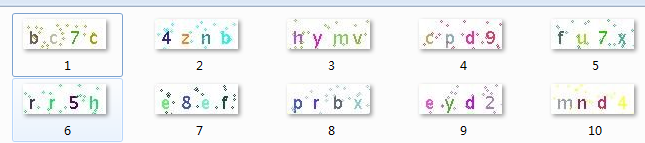
因为这个验证码有干扰点,所以直接识别的效果非常不好。
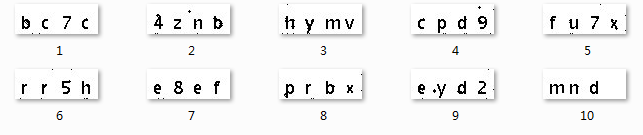
首先对验证码进行二值化和降噪。
效果如下:
识别结果:
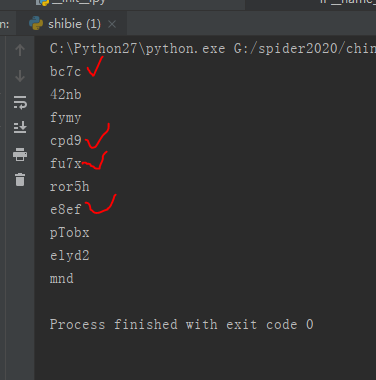
识别率只有百分之四十,针对这么低的识别率,可以去切割分类,目前这个验证码很容易去切割。提高验证码的识别率问题。
二值化代码:
# coding:utf-8
import sys, os
from PIL import Image, ImageDraw

# 二值数组
t2val = {}


def twoValue(image, G):
    for y in xrange(0, image.size[1]):
        for x in xrange(0, image.size[0]):
            g = image.getpixel((x, y))
            if g > G:
                t2val[(x, y)] = 1
            else:
                t2val[(x, y)] = 0


# 根据一个点A的RGB值,与周围的8个点的RBG值比较,设定一个值N(0 <N <8),当A的RGB值与周围8个点的RGB相等数小于N时,此点为噪点
# G: Integer 图像二值化阀值
# N: Integer 降噪率 0 <N <8
# Z: Integer 降噪次数
# 输出
#  0:降噪成功
#  1:降噪失败
def clearNoise(image, N, Z):
    for i in xrange(0, Z):
        t2val[(0, 0)] = 1
        t2val[(image.size[0] - 1, image.size[1] - 1)] = 1

        for x in xrange(1, image.size[0] - 1):
            for y in xrange(1, image.size[1] - 1):
                nearDots = 0
                L = t2val[(x, y)]
                if L == t2val[(x - 1, y - 1)]:
                    nearDots += 1
                if L == t2val[(x - 1, y)]:
                    nearDots += 1
                if L == t2val[(x - 1, y + 1)]:
                    nearDots += 1
                if L == t2val[(x, y - 1)]:
                    nearDots += 1
                if L == t2val[(x, y + 1)]:
                    nearDots += 1
                if L == t2val[(x + 1, y - 1)]:
                    nearDots += 1
                if L == t2val[(x + 1, y)]:
                    nearDots += 1
                if L == t2val[(x + 1, y + 1)]:
                    nearDots += 1

                if nearDots < N:
                    t2val[(x, y)] = 1


def saveImage(filename, size):
    image = Image.new("1", size)
    draw = ImageDraw.Draw(image)

    for x in xrange(0, size[0]):
        for y in xrange(0, size[1]):
            draw.point((x, y), t2val[(x, y)])

    image.save(filename)
for i in range(1,11):
    path =  "5/" + str(i) + ".jpg"
    image = Image.open(path).convert("L")
    twoValue(image, 222)
    clearNoise(image, 3, 6)
    path1 = "5/" + str(i) + ".png"
    saveImage(path1, image.size)
识别代码:
#coding:utf-8
from common.contest import *
from PIL import Image
import pytesseract

def recognize_captcha(img_path):
    im = Image.open(img_path)
    tessdata_dir_config = '--tessdata-dir "C:\Program Files (x86)\Tesseract-OCR\tessdata"'
    num = pytesseract.image_to_string(im,config=tessdata_dir_config)
    return num

if __name__ == '__main__':
    for i in range(1, 11):
        img_path = "5/" + str(i) + ".png"
        res = recognize_captcha(img_path)
        strs = res.split("
")
        print strs[0].replace(" ",'')