对象序列化
对象序列化又叫对象的持久化,对象的串行化(或反串行化)
当使用Serializable接口实现序列化操作时,如果一个对象中的某个属性不希望被序列化,则可以使用transient关键字进行声明。
static修饰的静态属性也不能被序列化,序列化的只是堆内存中对象的属性。
ANY-ACCESS-MODIFIER(任意的访问修饰符) static final long serialVersionUID = 42L;
语句的作用:给类定义一个固定标识,为了序列化方便,新的类还能操作曾经被序列化的对象。
举例说之,示例代码如下:
序列化的Person类:
import java.io.Serializable;

public class Person implements Serializable {
    /*
     * 给类定义一个固定标识,为了序列化方便,新的类还能操作曾经被序列化的对象。
     */
    public static final long serialVersionUID = 42L;
    private String name;
    transient int age;//transient保证其值在堆内存中存在,不被序列化到文件。
    static String country = "cn";//静态不能序列化
    public Person(String name, int age, String country) {
        this.name = name;
        this.age = age;
        this.country = country;
    }
    public String toString() {
        return name + "::" + age+":" + country;
    }

}
序列化Person类的代码:
import java.io.FileInputStream;
import java.io.FileOutputStream;
import java.io.IOException;
import java.io.ObjectInputStream;
import java.io.ObjectOutputStream;

public class ObjectStreamDemo {

    public static void main(String[] args) throws IOException, ClassNotFoundException {
        //writeObj();
        readObj();
    }

    public static void readObj() throws IOException, ClassNotFoundException {
        ObjectInputStream ois = new ObjectInputStream(
                new FileInputStream("obj.txt"));
        Person p = (Person)ois.readObject();
        System.out.println(p);
        ois.close();
    }

    public static void writeObj() throws IOException {
        ObjectOutputStream oos = new ObjectOutputStream(
                new FileOutputStream("obj.txt"));
        oos.writeObject(new Person("lisi0", 399, "kr"));
        oos.close();
    }

}
管道流
管道流的主要作用是可以进行两个线程间的通信。反正管道流结合的是多线程技术,可以查看JDK帮助文档。
示例代码如下:
import java.io.IOException;
import java.io.PipedInputStream;
import java.io.PipedOutputStream;

class Read implements Runnable {
    private PipedInputStream in;

    Read(PipedInputStream in) {
        this.in = in;
    }
    @Override
    public void run() {
        try {
            byte[] buf = new byte[1024];
            System.out.println("读取前。。。没有数据,就阻塞");
            int len = in.read(buf);
            System.out.println("读到数据。。。阻塞结束");
            String s = new String(buf, 0, len);
            System.out.println(s);
            in.close();
        } catch (IOException e) {
            throw new RuntimeException("管道读取流失败");
        }
    }

}
class Write implements Runnable {
    private PipedOutputStream out;

    Write(PipedOutputStream out) {
        this.out = out;
    }
    @Override
    public void run() {
        try {
            System.out.println("开始写入数据,等待6秒后.");
            Thread.sleep(6000);

            out.write("piped lai la".getBytes());
            out.close();
        } catch (Exception e) {
            throw new RuntimeException("管道输出流失败");
        }
    }


}
public class PipedStreamDemo {

    public static void main(String[] args) throws IOException {
        PipedInputStream in = new PipedInputStream();
        PipedOutputStream out = new PipedOutputStream();
        in.connect(out);

        Read r = new Read(in);
        Write w = new Write(out);

        new Thread(r).start();
        new Thread(w).start();
    }

}
RandomAccessFile
该类不算是IO体系中子类,而是直接继承自Object。但是它是IO包中的成员,因为它具备读和写的功能。内部封装了一个数组,而且通过指针对数组的元素进行操作。可以通过getFilePointer获取指针的位置。同时可以通过seek改变指针的位置。其实完成读写的原理就是内部封装了字节流输入流和输出流。
通过构造函数可以看出,该类只能操作文件,而且操作文件还有模式:只读r,读写rw等。
- 如果模式为只读r,不会创建文件,会去读取一个已存在的文件,如果该文件不存在,则会出现异常。
-
如果模式为rw,操作的文件不存在,会自动创建,如果存在则不会覆盖(会修改文件)。
示例代码如下:
import java.io.IOException;
import java.io.RandomAccessFile;

public class RandomAccessFileDemo {

    public static void main(String[] args) throws IOException {
        //writeFile();
        writeFile_2();
        //readFile();
        //System.out.println(Integer.toBinaryString(258));
    }

    public static void readFile() throws IOException {
        RandomAccessFile raf = new RandomAccessFile("ran.txt", "r");
        //raf.write("haha".getBytes());

        /*
         * 调整对象中的指针
         */
        //raf.seek(8*1);

        /*
         * 跳过指定的字节数,只能往下跳,不能往前跳。
         */
        raf.skipBytes(8);

        byte[] buf = new byte[4];
        raf.read(buf);
        String name = new String(buf);
        int age = raf.readInt();
        System.out.println("name="+name);
        System.out.println("age="+age);
        raf.close();
    }

    public static void writeFile_2() throws IOException {
        RandomAccessFile raf = new RandomAccessFile("ran.txt", "rw");
        raf.seek(8*0);
        raf.write("周七".getBytes());
        raf.writeInt(103);

        raf.close();
    }

    public static void writeFile() throws IOException {
        RandomAccessFile raf = new RandomAccessFile("ran.txt", "rw");
        raf.write("李四".getBytes());
        raf.writeInt(97);
        raf.write("王五".getBytes());
        raf.writeInt(99);
        raf.close();
    }

}
图解原理:

DataOutputStream与DataInputStream
可以用于操作基本数据类型的数据的流对象。
示例代码:
import java.io.DataInputStream;
import java.io.DataOutputStream;
import java.io.FileInputStream;
import java.io.FileOutputStream;
import java.io.IOException;
import java.io.OutputStreamWriter;

public class DataStreamDemo {

    public static void main(String[] args) throws IOException {
        //writeData();
        //readData();
        //writeUTFDemo();
        /*
        OutputStreamWriter osw = new OutputStreamWriter(
                new FileOutputStream("D:\java\lib\wo\gbk.txt"), "gbk");
        osw.write("你好");
        osw.close();
        */
        readUTFDemo();
    }

    public static void readUTFDemo() throws IOException {
        DataInputStream dis = new DataInputStream(
                new FileInputStream("D:\java\lib\wo\utf.txt"));
        String s = dis.readUTF();
        System.out.println(s);
        dis.close();
    }

    public static void writeUTFDemo() throws IOException {
        DataOutputStream dos = new DataOutputStream(
                new FileOutputStream("D:\java\lib\wo\utfdata.txt"));
        dos.writeUTF("你好");
        dos.close();
    }

    public static void readData() throws IOException {
        DataInputStream dis = new DataInputStream(new FileInputStream("D:\java\lib\wo\data.txt"));

        int num = dis.readInt();
        boolean b = dis.readBoolean();
        double d = dis.readDouble();

        System.out.println("num="+num);
        System.out.println("b="+b);
        System.out.println("d="+d);

        dis.close();
    }

    public static void writeData() throws IOException {
        DataOutputStream dos = new DataOutputStream(
                new FileOutputStream("D:\java\lib\wo\data.txt"));
        dos.writeInt(234);
        dos.writeBoolean(true);
        dos.writeDouble(9887.543);
        dos.close();
    }

}
内存操作流
ByteArrayInputStream:在构造的时候,需要接收数据源,而且数据源是一个字节数组。
ByteArrayOutputStream:在构造的时候,不用定义数据目的,因为该数据对象已经内部封装了可变长度的字节数组。这就是数据目的地。
在流操作规律讲解时:
源设备:
- 键盘:System.in
- 硬盘:FileStream
- 内存:ArrayStream
目的设备:
- 控制台:System.out
- 硬盘:FileStream
- 内存:ArrayStream
用流的读写思想来操作数组。
示例代码如下:
import java.io.ByteArrayInputStream;
import java.io.ByteArrayOutputStream;
import java.io.FileOutputStream;

public class ByteArrayDemo {

    public static void main(String[] args) {
        //数据源
        ByteArrayInputStream bis = new ByteArrayInputStream("ABCDEF".getBytes());

        //数据目的
        ByteArrayOutputStream bos = new ByteArrayOutputStream();

        int by = 0;
        while((by = bis.read()) != -1) {
            bos.write(by);
        }
        System.out.println(bos.size());
        System.out.println(bos.toString());

        //bos.writeTo(new FileOutputStream("a.txt"));
    }

}
字符编码
示例代码如下:
import java.io.FileInputStream;
import java.io.FileOutputStream;
import java.io.IOException;
import java.io.InputStreamReader;
import java.io.OutputStreamWriter;

public class EncodeStream {

    public static void main(String[] args) throws IOException {
        //writeText();
        readText();
    }
    public static void readText() throws IOException {
        InputStreamReader isr = new InputStreamReader(
                new FileInputStream("utf-8.txt"), "GBK");
        char[] buf = new char[10];
        int len = isr.read(buf);
        String str = new String(buf, 0, len);
        System.out.println(str);
        isr.close();
    }

    public static void writeText() throws IOException {
        OutputStreamWriter osw = new OutputStreamWriter(
                new FileOutputStream("utf-8.txt"), "UTF-8");
        osw.write("你好");
        osw.close();
    }

}
图解原理:


编码:字符串变成字节数组。String--->byte[]; str.getBytes(charsetName);
解码:字节数组变成字符串。byte[]--->String; new String(byte[], charsetName);
示例代码如下:
import java.io.UnsupportedEncodingException;
import java.util.Arrays;

public class EncodeStream1 {

    public static void main(String[] args) throws UnsupportedEncodingException {
        /*
        String s = "你好";
        byte[] b1 = s.getBytes("gbk");
        System.out.println(Arrays.toString(b1));
        String s1 = new String(b1, "iso8859-1");
        System.out.println("s1="+s1);

        // 对s1进行iso8859-1编码
        byte[] b2 = s1.getBytes("iso8859-1");
        System.out.println(Arrays.toString(b2));
        String s2 = new String(b2, "gbk");
        System.out.println("s2="+s2);
        */

        String s = "你好";
        byte[] b1 = s.getBytes("gbk");
        System.out.println(Arrays.toString(b1));
        String s1 = new String(b1, "utf-8");
        System.out.println("s1="+s1);
        /*
         * 对s1进行utf-8编码
         */
        byte[] b2 = s1.getBytes("utf-8");
        System.out.println(Arrays.toString(b2));
        String s2 = new String(b2, "gbk");
        System.out.println("s2="+s2);

    }
}
图解原理1:
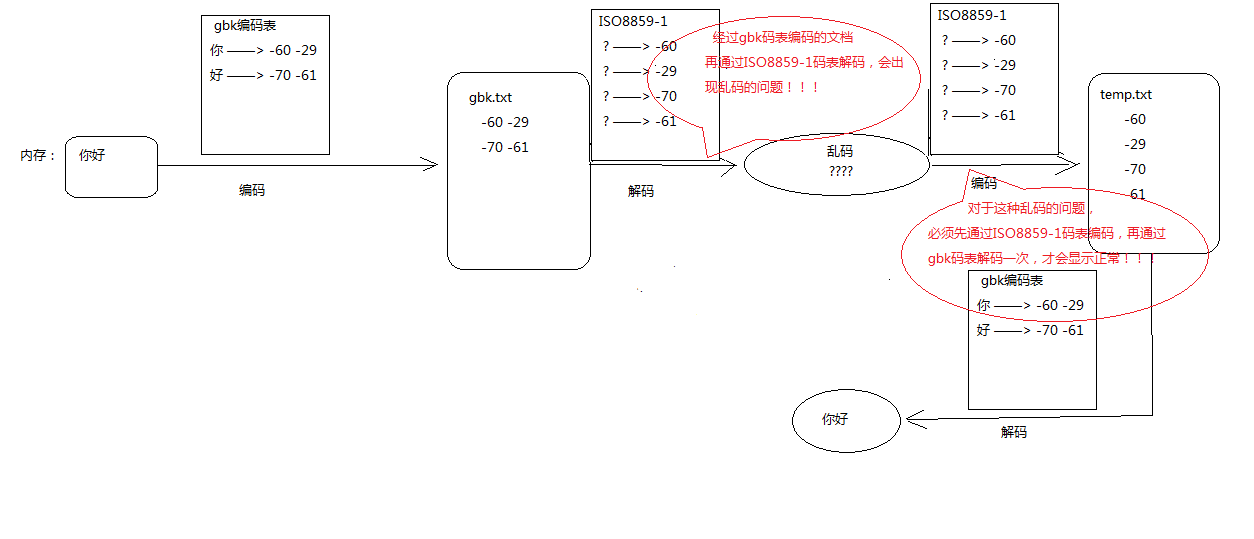
图解原理2:

应用:

一个非常特殊的例子:新建一个文本文档,输入"联通"二字,保存并退出,再次打开此文本文档时,会显示乱码!!!。
分析:


综合练习:有五个学生,每个学生有3门课的成绩,从键盘输入以上数据(包括姓名,三门可成绩),输入的格式:如:zhangsan,30,40,60计算出总成绩,并把学生的信息和计算出的总分数按高低顺序存放在磁盘文件"stud.txt"中。
分析:
- 描述学生对象。
- 定义一个可以操作学生对象的工具类。
思路:
- 通过获取键盘录入的一行数据,并将该行中的信息取出封装成学生对象。
- 因为学生对象有很多,那么就需要存储,使用到集合。因为要对学生的总分进行排序,所以可以使用TreeSet。
- 将集合的信息写入到一个文件中。
代码:


import java.io.BufferedReader;
import java.io.BufferedWriter;
import java.io.FileWriter;
import java.io.IOException;
import java.io.InputStreamReader;
import java.util.Collections;
import java.util.Comparator;
import java.util.Set;
import java.util.TreeSet;

class Student implements Comparable<Student> {
    private String name;
    private int ma, cn, en;
    private int sum;

    public Student(String name, int ma, int cn, int en) {
        this.name = name;
        this.ma = ma;
        this.cn = cn;
        this.en = en;
        sum = ma + cn + en;
    }

    public String getName() {
        return name;
    }

    public void setName(String name) {
        this.name = name;
    }

    public int getMa() {
        return ma;
    }

    public void setMa(int ma) {
        this.ma = ma;
    }

    public int getCn() {
        return cn;
    }

    public void setCn(int cn) {
        this.cn = cn;
    }

    public int getEn() {
        return en;
    }

    public void setEn(int en) {
        this.en = en;
    }

    public int getSum() {
        return sum;
    }

    public void setSum(int sum) {
        this.sum = sum;
    }

    public int hashCode() {
        return name.hashCode() + sum * 78;
    }

    public boolean equals(Object obj) {
        if(!(obj instanceof Student))
            throw new ClassCastException("类型不匹配");
        Student s = (Student) obj;
        return this.name.equals(s.name) && this.sum == s.sum;
    }

    public String toString() {
        return "student["+name+", "+ma+", "+cn+", "+en+"]";
    }

    @Override
    public int compareTo(Student s) {
        int num = new Integer(this.sum).compareTo(new Integer(s.sum));
        if(num == 0)
            return this.name.compareTo(s.name);
        return num;
    }
}
class StudentInfoTool {

    public static Set<Student> getStudents() throws IOException {
        return getStudents(null);
    }

    public static Set<Student> getStudents(Comparator<Student> cmp) throws IOException {
        BufferedReader bufr = new BufferedReader(
                new InputStreamReader(System.in));

        String line = null;
        Set<Student> stus = null;
        if(cmp == null)
            stus = new TreeSet<Student>();
        else
            stus = new TreeSet<Student>(cmp);
        while((line = bufr.readLine()) != null){
            if("over".equals(line))
                break;
            String[] info = line.split(",");
            Student stu = new Student(info[0], Integer.parseInt(info[1]),
                                               Integer.parseInt(info[2]),
                                               Integer.parseInt(info[3]));
            stus.add(stu);
        }
        bufr.close();
        return stus;
    }

    public static void write2File(Set<Student> stus) throws IOException {
        BufferedWriter bufw = new BufferedWriter(
                new FileWriter("stuinfo.txt"));
        for(Student stu : stus) {
            bufw.write(stu.toString() + "	");
            bufw.write(stu.getSum() + "");//分数变为字符串再写进去,因为写入int值,只是写入的最后1个字节
            bufw.newLine();
            bufw.flush();
        }
        bufw.close();
    }
}

public class Test {

    public static void main(String[] args) throws IOException {

        Comparator<Student> cmp = Collections.reverseOrder();//反转Student类中的默认排序

        Set<Student> stus = StudentInfoTool.getStudents(cmp);
        StudentInfoTool.write2File(stus);
    }

}