1、AT&T格式汇编
在 Unix 和 Linux 系统中,更多采用的还是 AT&T 格式,两者在语法格式上有着很大的不同:
-
在 AT&T 汇编格式中,寄存器名要加上 '%' 作为前缀;而在 Intel 汇编格式中,寄存器名不需要加前缀。例如:
AT&T 格式 Intel 格式 pushl %eax push eax -
在 AT&T 汇编格式中,用 '$' 前缀表示一个立即操作数;而在 Intel 汇编格式中,立即数的表示不用带任何前缀。例如:
AT&T 格式 Intel 格式 pushl $1 push 1 -
AT&T 和 Intel 格式中的源操作数和目标操作数的位置正好相反。在 Intel 汇编格式中,目标操作数在源操作数的左边;而在 AT&T 汇编格式中,目标操作数在源操作数的右边。例如:
AT&T 格式 Intel 格式 addl $1, %eax add eax, 1 -
在 AT&T 汇编格式中,操作数的字长由操作符的最后一个字母决定,后缀'b'、'w'、'l'分别表示操作数为字节(byte,8 比特)、字(word,16 比特)和长字(long,32比特);而在 Intel 汇编格式中,操作数的字长是用 "byte ptr" 和 "word ptr" 等前缀来表示的。例如:
AT&T 格式 Intel 格式 movb val, %al mov al, byte ptr val - 在 AT&T 汇编格式中,绝对转移和调用指令(jump/call)的操作数前要加上'*'作为前缀,而在 Intel 格式中则不需要。
-
远程转移指令和远程子调用指令的操作码,在 AT&T 汇编格式中为 "ljump" 和 "lcall",而在 Intel 汇编格式中则为 "jmp far" 和 "call far",即:
AT&T 格式 Intel 格式 ljump $section, $offset jmp far section:offset lcall $section, $offset call far section:offset 与之相应的远程返回指令则为:
AT&T 格式 Intel 格式 lret $stack_adjust ret far stack_adjust -
在 AT&T 汇编格式中,内存操作数的寻址方式是
section:disp(base, index, scale)
而在 Intel 汇编格式中,内存操作数的寻址方式为:
section:[base + index*scale + disp]
由于 Linux 工作在保护模式下,用的是 32 位线性地址,所以在计算地址时不用考虑段基址和偏移量,而是采用如下的地址计算方法:
disp + base + index * scale
下面是一些内存操作数的例子:
AT&T 格式 Intel 格式 movl -4(%ebp), %eax mov eax, [ebp - 4] movl array(, %eax, 4), %eax mov eax, [eax*4 + array] movw array(%ebx, %eax, 4), %cx mov cx, [ebx + 4*eax + array] movb $4, %fs:(%eax) mov fs:eax, 4
2、寄存器
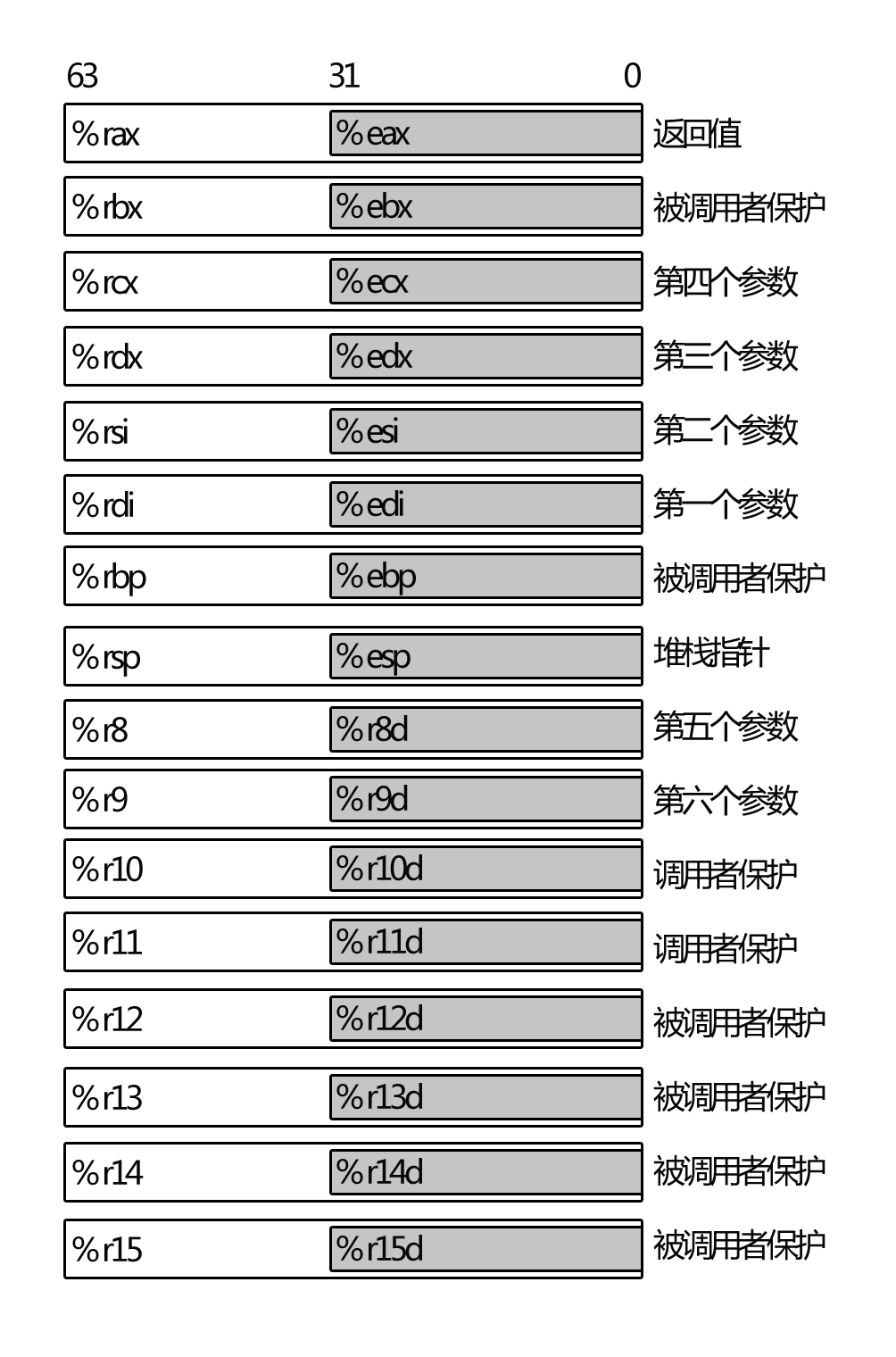
X84中原有8个32位通用寄存器%eax,%ebx,%ecx,%edx,%esi,%edi,%ebp,%esp, 在X86_64中
分别被扩展为64位,并且多了8个寄存器。因此X86_64的寄存器如下:
- rax, eax, ax, ah, al;
- rbx, ebx, bx, bh, bl;
- rcx, ecx, cx, ch, cl;
- rdx, edx, dx, dh, dl;
- rsi, esi, si;
- rdi, edi, di;
- rbp, ebp;
- rsp, esp;
- r8-r15;
GCC中对这些寄存器的调用规则如下:
- %rax 作为函数返回值使用。
- %rsp 栈指针寄存器,指向栈顶
- %rdi,%rsi,%rdx,%rcx,%r8,%r9 用作函数参数,依次对应第1参数,第2参数。。。
- %rbx,%rbp,%r12,%r13,%14,%15 用作数据存储,遵循被调用者使用规则,简单说就是随便用,调用子函数之前要备份它,以防他被修改
- %r10,%r11 用作数据存储,遵循调用者使用规则,简单说就是使用之前要先保存原值
3、栈帧
以一个简单的add函数为例:
 1 #include <stdio.h>
 2
 3 int add(int a, int b)
 4 {
 5     return a + b;
 6 }
 7
 8 int main(void)
 9 {
10     int c, a = 1, b = 2;
11
12     c = add(a, b);
13
14     return c;
15 }
编译并反汇编,
1 scripts$ gcc -g test.c -o test
2 scripts$ objdump -S -d test > test.s
3 scripts$ vim test.s
 1 0000000000400474 <add>:
 2 #include <stdio.h>
 3
 4 int add(int a, int b)
 5 {
 6   400474:   55                      push   %rbp
 7   400475:   48 89 e5                mov    %rsp,%rbp
 8   400478:   89 7d fc                mov    %edi,-0x4(%rbp)
 9   40047b:   89 75 f8                mov    %esi,-0x8(%rbp)
10     return a + b;
11   40047e:   8b 45 f8                mov    -0x8(%rbp),%eax
12   400481:   8b 55 fc                mov    -0x4(%rbp),%edx
13   400484:   8d 04 02                lea    (%rdx,%rax,1),%eax
14 }
15   400487:   c9                      leaveq
16   400488:   c3                      retq
17
18 0000000000400489 <main>:
19
20 int main(void)
21 {
22   400489:   55                      push   %rbp
23   40048a:   48 89 e5                mov    %rsp,%rbp
24   40048d:   48 83 ec 10             sub    $0x10,%rsp
25     int c, a = 1, b = 2;
26   400491:   c7 45 f8 01 00 00 00    movl   $0x1,-0x8(%rbp)
27   400498:   c7 45 fc 02 00 00 00    movl   $0x2,-0x4(%rbp)
28
29     c = add(a, b);
30   40049f:   8b 55 fc                mov    -0x4(%rbp),%edx
31   4004a2:   8b 45 f8                mov    -0x8(%rbp),%eax
32   4004a5:   89 d6                   mov    %edx,%esi
33   4004a7:   89 c7                   mov    %eax,%edi
34   4004a9:   e8 c6 ff ff ff          callq  400474 <add>
35   4004ae:   89 45 f4                mov    %eax,-0xc(%rbp)
36
37     return c;
38   4004b1:   8b 45 f4                mov    -0xc(%rbp),%eax
39 }
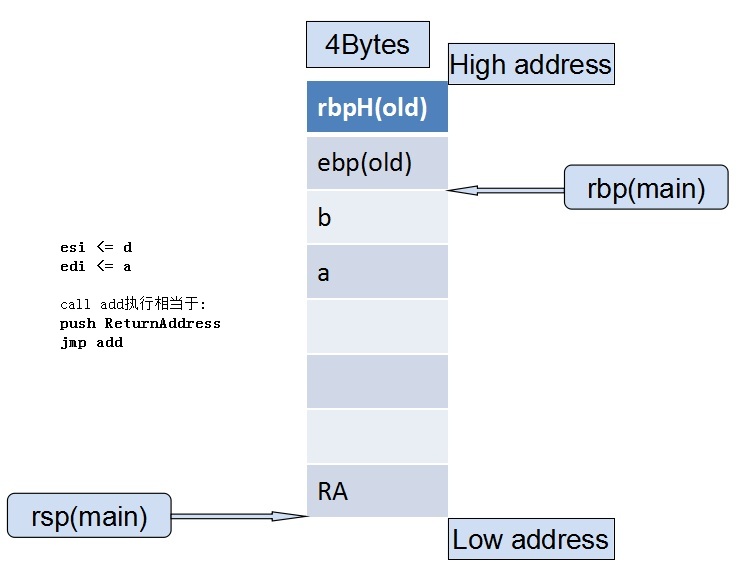
从32、33行可知,edi<- a, esi<- b, 然后 call add,此时main函数中的栈帧结构如下(某个寄存器为x,则xH表示高4位):
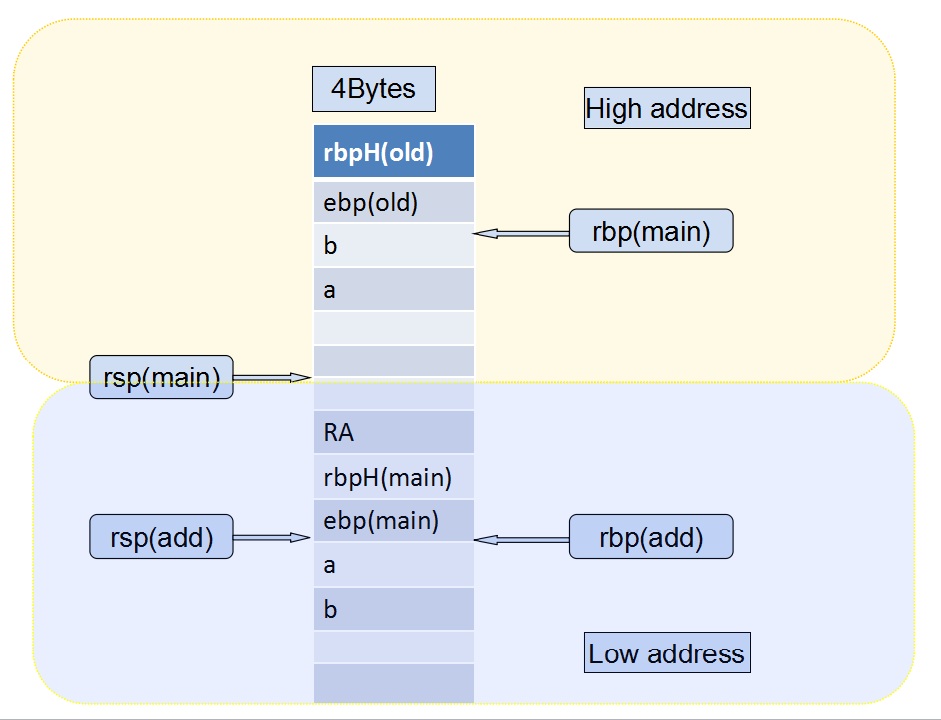
然后跳入add中执行:
从4-12行完毕,eax存储b, edx存储a, 此时整体的栈帧结构:
之后是指令:
lea (%rdx,%rax,1),%eax
lea是load effective address,加载有效地址,类似于C语言中的“&”取地址符的作用,本例中是将 rdx + rax * 1 ==> eax, 即 eax = a + b,
然后rax自动作为返回值。