2018-7-30 17:31:41
学了几天的数据库,今天开始进入了python操作数据库啦.
数据库最重要的就是前几天的SQL语句 还有查数据的
整理一下笔记 有点懒,直接手动摘抄啦!
s4day60

上节回顾:
    1. MySQL:文件管理的软件
    2. 三部分:
        - 服务端
        - SQL语句
        - 客户端
    3. 客户端:
        - mysql
        - navicat

    4. 授权操作
        - 用户操作
        - 授权操作
    5. SQL语句
        - 数据库操作
            - create database xx default charset utf8;
            - drop database xx;
        - 数据表
            - 列
                - 数字
                    整数
                    小数
                - 字符串
                - 时间
                - 二进制
            - 其他:引擎,字符编码,起始值

            - 主键索引
            - 唯一索引
            - 外键
                - 一对多
                - 一对一
                - 多对多
        - 数据行
            - 增
            - 删
            - 改
            - 查
                - in   not in
                - between and
                - limit
                - group by  having
                - order by
                - like "%a"
                - left join xx on  关系
                - 临时表
                    select * from (select * from tb where id< 10) as B;

                -
                    select
                        id,
                        name,
                        1,
                        (select count(1) from tb)
                    from tb2

                    SELECT
                        student_id,
                        (select num from score as s2 where s2.student_id=s1.student_id and course_id = 1) as 语文,
                        (select num from score as s2 where s2.student_id=s1.student_id and course_id = 2) as 数学,
                        (select num from score as s2 where s2.student_id=s1.student_id and course_id = 3) as 英语
                    from score as s1;

                - 条件
                    select
                        course_id,
                        max(num),
                        min(num),
                        min(num)+1,
                        case when min(num) <10 THEN 0 ELSE min(num) END as c
                    from score GROUP BY course_id

                    select course_id,avg(num),sum(case when num <60 THEN 0 ELSE 1 END),sum(1),sum(case when num <60 THEN 0 ELSE 1 END)/sum(1) as jgl from score GROUP BY course_id order by AVG(num) asc,jgl desc;
        PS: 数据放在硬盘上


    思想:
        - 操作
        - 设计


今日内容:
    1. 练习题
        7、查询学过“001”并且也学过编号“002”课程的同学的学号、姓名;
        -- select score.student_id,student.sname from score
        --
        -- left join student on score.student_id=student.sid
        --
        -- where course_id =1 or course_id =2 GROUP BY student_id HAVING count(course_id) > 1


        8、查询学过“叶平”老师所教的所有课的同学的学号、姓名;
        -- select student_id from score where course_id in (
        --     select cid from course left JOIN teacher on course.teacher_id = teacher.tid where teacher.tname = "李平老师"
        -- ) GROUP BY student_id having count(course_id) =  (select count(cid) from course left JOIN teacher on course.teacher_id = teacher.tid where teacher.tname = "李平老师")
        --
        --
        10、查询有课程成绩小于60分的同学的学号、姓名;
        -- select student_id from score where num < 60 GROUP BY student_id
        -- select DISTINCT student_id from score where num < 60

        -- 查询没有学全所有课的同学的学号、姓名;

        11、查询没有学全所有课的同学的学号、姓名;
        -- select student_id,count(1) from score GROUP BY student_id  HAVING count(1) < (select count(cid) from course);
        --

        -- 12、查询至少有一门课与学号为“001”的同学所学相同的同学的学号和姓名;
        -- select course_id from score where student_id = 1;
        -- select student_id from score where student_id != 1 and course_id in (select course_id from score where student_id = 1) GROUP BY student_id

        -- 13、查询至少学过学号为“001”同学所有课的其他同学学号和姓名;
        -- select course_id from score where student_id = 1;
        -- select student_id,count(1) from score where student_id != 1 and course_id in (select course_id from score where student_id = 1) GROUP BY student_id HAVING count(1) = (select count(course_id) from score where student_id = 1)


        -- 14、查询和“002”号的同学学习的课程完全相同的其他同学学号和姓名;

        -- 获取和方少伟选课个数相同的通许
        -- select count(1) from score where student_id = 1;
        --

        -- select student_id from score where  student_id in (
        --     select student_id from score where student_id !=1 GROUP BY student_id HAVING count(1) = (select count(1) from score where student_id = 1)
        -- ) and course_id in (select course_id from score where student_id = 1) GROUP BY student_id HAVING count(1) = (select count(1) from score where student_id = 1)
        --
        --
        -- insert into tb(student_id,course_id,num)
        --
        -- select student_id,2,(SELECT AVG(num) from score where course_id = 2) from score where course_id != 2

        -- 17、按平均成绩从低到高 显示所有学生的“语文”、“数学”、“英语”三门的课程成绩,按如下形式显示: 学生ID,语文,数学,英语,有效课程数,有效平均分;
        -- 1  90  80   99
        -- 2  90  80   99
        -- SELECT
        --     student_id,
        --     (select num from score as s2 where s2.student_id=s1.student_id and course_id = 1) as 语文,
        --     (select num from score as s2 where s2.student_id=s1.student_id and course_id = 2) as 数学,
        --     (select num from score as s2 where s2.student_id=s1.student_id and course_id = 3) as 英语
        -- from score as s1;
        --
        -- 18、查询各科成绩最高和最低的分:以如下形式显示:课程ID,最高分,最低分;
        -- select course_id,max(num),min(num),min(num)+1,case when min(num) <10 THEN 0 ELSE min(num) END as c  from score GROUP BY course_id

        -- 19、按各科平均成绩从低到高和及格率的百分数从高到低顺序;


        select course_id,avg(num),sum(case when num <60 THEN 0 ELSE 1 END),sum(1),sum(case when num <60 THEN 0 ELSE 1 END)/sum(1) as jgl from score GROUP BY course_id order by AVG(num) asc,jgl desc;


    pymysql模块:
        pip3 install pymysql -i https://pypi.douban.com/simple
        Python模块:对数据库进行操作(SQL语句)

        1. Python实现用户登录
        2. MySQL保存数据


        - 连接、关闭(游标)
        - execute()   -- SQL注入
        - 增删改: conn.commit()
        - fetchone fetchall
        - 获取插入数据自增ID


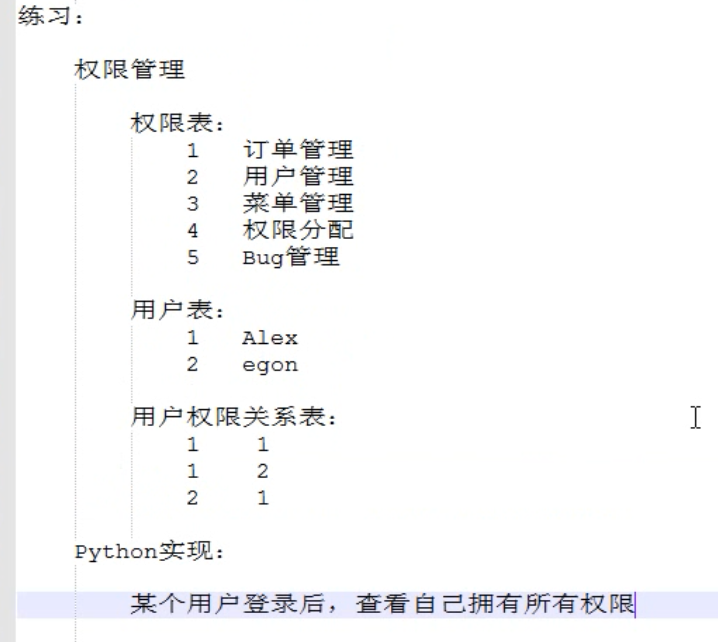
练习:

    权限管理

        权限表:
            1   订单管理
            2   用户管理
            3   菜单管理
            4   权限分配
            5   Bug管理

        用户表:
            1   Alex
            2   egon

        用户权限关系表:
            1    1
            1    2
            2    1

    Python实现:

        某个用户登录后,查看自己拥有所有权限
已经实现了,就是有点繁琐,应该还有更好地方法
# !/usr/bin/env python
# !--*--coding:utf-8 --*--
# !@Time    :2018/7/30 16:26
# !@Author   TrueNewBee
import pymysql

# 思路
# 1.创建好了表
# 2.先登入成功,显示个人职位
# 3.关于SQL语句书写思路
#   1.首先先把user_work这个表和users这个表链表 left join on
#   2  通过输入的用户名,在连过的表A中查找work_id  AS A
#   3.得到work_id后表A与works表连接,然后通过work_id找到所对应的权限
#   select work_name from B left join A on A.work_id = B.id
#   意识就是我的思路
user = input('请输入账户')
pwd = input('请输入密码')

conn = pymysql.connect(host='localhost', user='root', password='123', database='db1')
cursor = conn.cursor()
sql = "select * from user where  username='%s' and password='%s' "
cursor.execute(sql, [user, pwd])
result = cursor.fetchone()

if result:
    print('登入成功,你的权限如下:')
    w_sql = "select works.workname from (select work_id from user_work left join  users on users.id=user_work.use_id WHERE users.`user`='%s') as A LEFT JOIN works on A.work_id=works.id " % user
    cursor.execute(w_sql)
    result = cursor.fetchone()
    print(result)

else:
    print('登入失败')
cursor.close()
conn.close()
先把其他的代码粘贴过来
 1 # !/usr/bin/env python
 2 # !--*--coding:utf-8 --*--
 3 # !@Time    :2018/7/30 11:58
 4 # !@Author   TrueNewBee
 5 # 练习使用pyMySQL
 6 # 对数据库的交互
 7 import pymysql
 8
 9
10 user = input('请输入账号:')
11 pwd = input('请输入密码:')
12
13 # 创建与数据库的连接
14 conn = pymysql.connect(host='localhost', user='root', password='123', database='db666')
15 cursor = conn.cursor()
16 # 通过sql语句查询数据   这种是错误的,容易被SQL注入  asdasdas' or 1=1 --
17 sql = "select * from userinfo where  username='%s' and password='%s' " % (user, pwd)
18 cursor.execute(sql)
19 # 获取数据
20 result = cursor.fetchone()
21 # 关闭
22 cursor.close()
23 conn.close()
24
25 if result:
26     print('登入成功')
27 else:
28     print('登入失败')


 1 # !/usr/bin/env python
 2 # !--*--coding:utf-8 --*--
 3 # !@Time    :2018/7/30 12:40
 4 # !@Author   TrueNewBee
 5 import pymysql
 6
 7
 8 # 增加 删
 9 # conn = pymysql.connect(host='localhost', user='root', password='123', database='db666')
10 # cursor = conn.cursor()
11 # sql = "insert into userinfo(username,password)values('root','123')"
12 # 守影响的行数
13 # r = cursor.execute(sql)
14 # cursor.execute(sql)
15 # # 选择增加的时候要  提交数据
16 # conn.commit()
17 # result = cursor.fetchone()
18 # cursor.close()
19 # conn.close()
20
21 # 2018-7-30 15:38:06
22
23 # 批量增加
24 # conn = pymysql.connect(host='localhost', user='root', password='123', database='db666')
25 # cursor = conn.cursor()
26 # sql = "insert into userinfo(username,password)values(%s, %s)"
27 # # 守影响的行数
28 # r = cursor.execute(sql)
29 # cursor.executemany(sql, [('egon', 'sb'), ('laoyao', 'BS')])
30 # conn.commit()
31 # result = cursor.fetchone()
32 # cursor.close()
33 # conn.close()
34
35
36 # # 查
37 # conn = pymysql.connect(host='localhost', user='root', password='123', database='db666')
38 # cursor = conn.cursor()
39 # sql = "select * from userinfo"
40 # cursor.execute(sql)
41 # # cursor.scroll(1,mode='relative')  # 相对当前位置移动
42 # # cursor.scroll(2,mode='absolute')  # 相对绝对位置移动
43 # result = cursor.fetchone()
44 # print(result)
45 # cursor.close()
46 # conn.close()
47
48
49 # 新插入数据的自增ID
50
51 conn = pymysql.connect(host='localhost', user='root', password='123', database='db666')
52 cursor = conn.cursor()
53 sql = "insert into userinfo(username,password) values ('asdfasdf', '123')"
54 cursor.execute(sql)
55 conn.commit()
56 print(cursor.lastrowid) # 显示新插入数据的自增ID
57 cursor.close()
58 conn.close()
 1 # !/usr/bin/env python
 2 # !--*--coding:utf-8 --*--
 3 # !@Time    :2018/7/30 12:29
 4 # !@Author   TrueNewBee
 5 import pymysql
 6
 7
 8 user = input('请输入账号:')
 9 pwd = input('请输入密码:')
10
11 # 创建与数据库的连接
12 conn = pymysql.connect(host='localhost', user='root', password='123', database='db666')
13 cursor = conn.cursor()
14 # 通过sql语句查询数据   这种是错误的,容易被SQL注入  asdasdas' or 1=1 --
15 # sql = "select * from userinfo where  username='%s' and password='%s' "
16 sql = "select * from userinfo where  username='%(u)' and password='%(p)' "
17 # 通过内部的传参拼接
18 # cursor.execute(sql,user, pwd)
19 # cursor.execute(sql, [user, pwd])
20 cursor.execute(sql, {'u': user, 'p': pwd})  # 占位符也支持字典
21 # 获取数据
22 result = cursor.fetchone()
23 cursor.close()
24 conn.close()