分析以下需求,并用代码实现:
-
  1.按照以下描述完成类的定义
  	学生类
  		属性:
  			姓名name
  			年龄age
  			成绩score
  		行为:
  			吃饭eat()
  			study(String content)(content:表示学习的内容)
  2.定义学生工具StudentsTool,有四个方法,描述如下
  	public void listStudents(Student[] arr):遍历打印学生信息
  	public int getMaxScore(Student[] arr):获取学生成绩的最高分
  	public Student getMaxStudent(Student[] arr):获取成绩最高的学员
  	public int getAverageScore(Student[] arr):获取学生成绩的平均值
  	public int getCount(Student[] arr):获取不及格的学员数量

  3.定义测试类TestStudentTool
	在main方法中首先创建长度为5的Student数组并初始化数据
	再创建StudentsTool类的对象,并调用以上方法
package com.itheima;

public class Student {
	//定义学生类属性
	private String name;
	private int age;
	private int score;

	public Student() {
		super();
		// TODO Auto-generated constructor stub
	}

	public Student(String name, int age, int score) {
		super();
		this.name = name;
		this.age = age;
		this.score = score;
	}

	public String getName() {
		return name;
	}

	public void setName(String name) {
		this.name = name;
	}

	public int getAge() {
		return age;
	}

	public void setAge(int age) {
		this.age = age;
	}

	public int getScore() {
		return score;
	}

	public void setScore(int score) {
		this.score = score;
	}

	public static void eat() {}

	public static void study(String content) {}
}
package com.itheima;

public class StudentTool {
	// public void listStudents(Student[] arr):遍历打印学生信息
	public void listStudents(Student[] arr) {
		for (int x = 0; x < arr.length; x++) {
			Student s = arr[x];
			System.out.println(s.getName() + "---" + s.getAge() + "---" + s.getScore());
		}
	}

	// public Student getMaxStudent(Student[] arr):获取成绩最高的学员
	public Student getMaxStudent(Student[] arr) {
		Student s = arr[0];
		for (int x = 1; x < arr.length; x++) {
			if (arr[x].getScore() > s.getScore()) {
				s = arr[x];
			}
		}
		return s;
	}

	// public int getMaxScore(Student[] arr):获取学生成绩的最高分
	public int getMaxScore(Student[] arr) {
		Student s = getMaxStudent(arr);
		return s.getScore();
	}

	// public int getAverageScore(Student[] arr):获取学生成绩的平均值
	public int getAverageScore(Student[] arr) {
		// 先定义一个总值变量
		int sum = 0;
		for (int x = 0; x < arr.length; x++) {
			Student s = arr[x];
			sum += s.getScore();
		}
		return sum / arr.length;
	}

	//	public int getCount(Student[] arr):获取不及格的学员数量
	public int getCount(Student[] arr){
		int count = 0;
		for(int x = 0;x < arr.length;x++) {
			Student s = arr[x];
			if(s.getScore() < 60) {
				count++;
			}
		}
		return count;
	}

}
package com.itheima;

public class TestStudentTool {
	public static void main(String[] args) {
		//创建Student对象
		Student s1 = new Student("马化腾",19,70);
		Student s2 = new Student("求伯君",21,90);
		Student s3 = new Student("雷军",20,80);
		Student s4 = new Student("马云",19,40);
		Student s5 = new Student("刘强东",19,30);

		//创建长度为5的Student数组
		Student[] arr = {s1,s2,s3,s4,s5};

		//创建StudentTool的对象
		StudentTool st = new StudentTool();

		//遍历打印学生信息
		st.listStudents(arr);
		//获取学生成绩的最高分
		System.out.println("几位学生中成绩最高分为:"+st.getMaxScore(arr));
		//获取成绩最高的学生姓名
		Student s = st.getMaxStudent(arr);
		System.out.println("成绩最高的学生为:"+s.getName());
		//获取学生成绩的平均值
		System.out.println("学生的平均成绩为:"+st.getAverageScore(arr));
		//获取不及格的学员数量
		System.out.println("不及格的学生数量为:"+st.getCount(arr));
	}

}
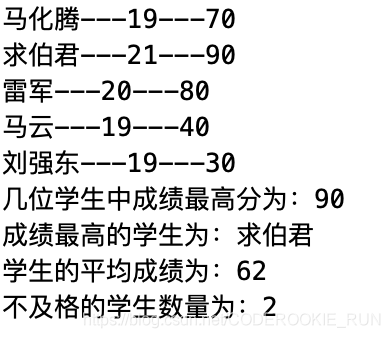
控制台输出内容