由树的直径定义可得,树上随意一点到树的直径上的两个端点之中的一个的距离是最长的...
三遍BFS求树的直径并预处理距离.......
Computer
Time Limit: 1000/1000 MS (Java/Others) Memory Limit: 32768/32768 K (Java/Others)Total Submission(s): 3522 Accepted Submission(s): 1784
Problem Description
A school bought the first computer some time ago(so this computer's id is 1). During the recent years the school bought N-1 new computers. Each new computer was connected to one of settled earlier. Managers of school are anxious about slow functioning of the
net and want to know the maximum distance Si for which i-th computer needs to send signal (i.e. length of cable to the most distant computer). You need to provide this information.
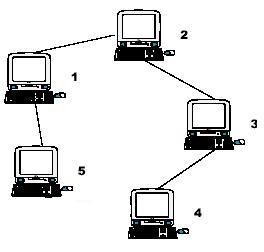
Hint: the example input is corresponding to this graph. And from the graph, you can see that the computer 4 is farthest one from 1, so S1 = 3. Computer 4 and 5 are the farthest ones from 2, so S2 = 2. Computer 5 is the farthest one from 3, so S3 = 3. we also get S4 = 4, S5 = 4.
Hint: the example input is corresponding to this graph. And from the graph, you can see that the computer 4 is farthest one from 1, so S1 = 3. Computer 4 and 5 are the farthest ones from 2, so S2 = 2. Computer 5 is the farthest one from 3, so S3 = 3. we also get S4 = 4, S5 = 4.
Input
Input file contains multiple test cases.In each case there is natural number N (N<=10000) in the first line, followed by (N-1) lines with descriptions of computers. i-th line contains two natural numbers - number of computer, to which i-th computer is connected
and length of cable used for connection. Total length of cable does not exceed 10^9. Numbers in lines of input are separated by a space.
Output
For each case output N lines. i-th line must contain number Si for i-th computer (1<=i<=N).
Sample Input
5
1 1
2 1
3 1
1 1
Sample Output
3
2
3
4
4
Author
scnu
#include <iostream>
#include <cstring>
#include <cstdio>
#include <algorithm>
#include <queue>

using namespace std;

const int maxn=20010;

struct Edge
{
  int to,next,w;
}edge[maxn*2];

int Adj[maxn],Size;

void init()
{
  memset(Adj,-1,sizeof(Adj)); Size=0;
}

void add_edge(int u,int v,int w)
{
  edge[Size].to=v;
  edge[Size].w=w;
  edge[Size].next=Adj[u];
  Adj[u]=Size++;
}

int dist_s[maxn],dist_t[maxn],dist[maxn];

int n;

bool vis[maxn];

int bfs1()
{
  int ret=1;
  queue<int> q;
  memset(vis,false,sizeof(vis));
  q.push(1);
  dist[1]=0;
  vis[1]=true;
  while(!q.empty())
    {
      int u=q.front(); q.pop();

      for(int i=Adj[u];~i;i=edge[i].next)
        {
          int v=edge[i].to;
          int c=edge[i].w;
          if(vis[v]) continue;
          dist[v]=dist[u]+c;
          vis[v]=true; q.push(v);
          if(dist[v]>dist[ret])
            ret=v;
        }
    }
  return ret;
}

int bfs2(int x)
{
  int ret=x;
  queue<int> q;
  memset(vis,false,sizeof(vis));
  q.push(x); vis[x]=true;
  dist_s[x]=0;
  while(!q.empty())
    {
      int u=q.front(); q.pop();
      for(int i=Adj[u];~i;i=edge[i].next)
        {
          int v=edge[i].to;
          int c=edge[i].w;
          if(vis[v]==true) continue;
          vis[v]=true;
          dist_s[v]=dist_s[u]+c;
          q.push(v);
          if(dist_s[v]>dist_s[ret])
            ret=v;
        }
    }
  return ret;
}

int bfs3(int x)
{
  int ret=x;
  queue<int> q;
  memset(vis,false,sizeof(vis));
  q.push(x); vis[x]=true;
  dist_t[x]=0;
  while(!q.empty())
    {
      int u=q.front(); q.pop();
      for(int i=Adj[u];~i;i=edge[i].next)
        {
          int v=edge[i].to;
          int c=edge[i].w;
          if(vis[v]==true) continue;
          vis[v]=true;
          dist_t[v]=dist_t[u]+c;
          q.push(v);
          if(dist_t[v]>dist_t[ret])
            ret=v;
        }
    }
  return ret;
}

int main()
{
  while(scanf("%d",&n)!=EOF)
    {
      init();
      memset(dist_s,0,sizeof(dist_s));
      memset(dist_t,0,sizeof(dist_t));
      memset(dist,0,sizeof(dist));

      for(int i=2;i<=n;i++)
        {
          int x,w;
          scanf("%d%d",&x,&w);
          add_edge(x,i,w);
          add_edge(i,x,w);
        }

      int s=bfs1();
      int t=bfs2(s);
      bfs3(t);
      //cout<<"s: "<<s<<"  t: "<<t<<endl;
      for(int i=1;i<=n;i++)
        {
          printf("%d
",max(dist_s[i],dist_t[i]));
        }
    }
  return 0;
}