转载请注明出处:
https://www.cnblogs.com/darkknightzh/p/10043864.html
参考网址:
论文:https://arxiv.org/abs/1506.01497
tf的第三方faster rcnn:https://github.com/endernewton/tf-faster-rcnn
IOU:https://www.cnblogs.com/darkknightzh/p/9043395.html
faster rcnn主要包括两部分:rpn网络和rcnn网络。rpn网络用于保留在图像内部的archors,同时得到这些archors是正样本还是负样本还是不关注。最终训练时通过nms保留最多2000个archors,测试时保留300个archors。另一方面,rpn网络会提供256个archors给rcnn网络,用于rcnn分类及回归坐标位置。
Network为基类,vgg16为派生类,重载了Network中的_image_to_head和_head_to_tail。
下面只针对vgg16进行分析。
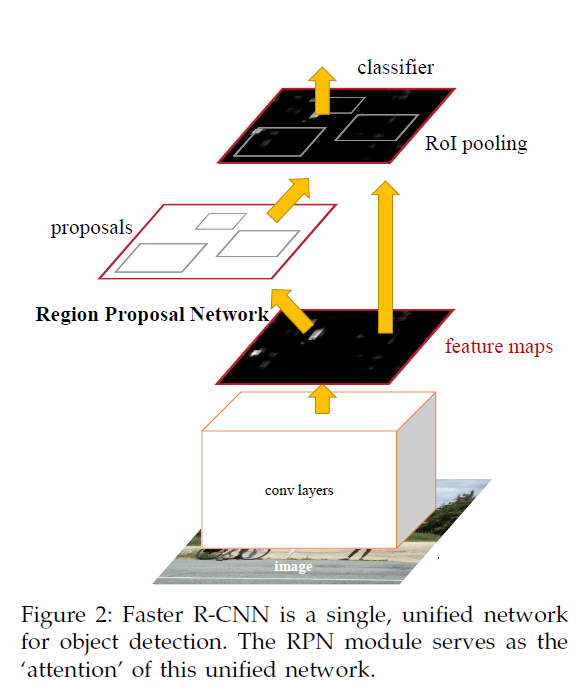
faster rcnn网络总体结构如下图所示。

1. 训练阶段:
SolverWrapper通过construct_graph创建网络、train_op等。
construct_graph通过Network的create_architecture创建网络。
1.1 create_architecture
create_architecture通过_build_network具体创建网络模型、损失及其他相关操作,得到rois, cls_prob, bbox_pred,定义如下


 1 def create_architecture(self, mode, num_classes, tag=None, anchor_scales=(8, 16, 32), anchor_ratios=(0.5, 1, 2)):
 2     self._image = tf.placeholder(tf.float32, shape=[1, None, None, 3])   # 由于图像宽高不定,因而第二维和第三维都是None
 3     self._im_info = tf.placeholder(tf.float32, shape=[3])        # 图像信息,高、宽、缩放到宽为600或者高为1000的最小比例
 4     self._gt_boxes = tf.placeholder(tf.float32, shape=[None, 5])   # ground truth框的信息。前四个为位置信息,最后一个为该框对应的类别(见roi_data_layer/minibatch.py/get_minibatch)
 5     self._tag = tag
 6
 7     self._num_classes = num_classes
 8     self._mode = mode
 9     self._anchor_scales = anchor_scales
10     self._num_scales = len(anchor_scales)
11
12     self._anchor_ratios = anchor_ratios
13     self._num_ratios = len(anchor_ratios)
14
15     self._num_anchors = self._num_scales * self._num_ratios    # self._num_anchors=9
16
17     training = mode == 'TRAIN'
18     testing = mode == 'TEST'
19
20     weights_regularizer = tf.contrib.layers.l2_regularizer(cfg.TRAIN.WEIGHT_DECAY)  # handle most of the regularizers here
21     if cfg.TRAIN.BIAS_DECAY:
22         biases_regularizer = weights_regularizer
23     else:
24         biases_regularizer = tf.no_regularizer
25
26     # list as many types of layers as possible, even if they are not used now
27     with arg_scope([slim.conv2d, slim.conv2d_in_plane, slim.conv2d_transpose, slim.separable_conv2d, slim.fully_connected],
28                    weights_regularizer=weights_regularizer, biases_regularizer=biases_regularizer, biases_initializer=tf.constant_initializer(0.0)):
29         # rois:256个archors的类别(训练时为每个archors的类别,测试时全0)
30         # cls_prob:256个archors每一类别的概率
31         # bbox_pred:预测位置信息的偏移
32         rois, cls_prob, bbox_pred = self._build_network(training)
33
34     layers_to_output = {'rois': rois}
35
36     for var in tf.trainable_variables():
37         self._train_summaries.append(var)
38
39     if testing:
40         stds = np.tile(np.array(cfg.TRAIN.BBOX_NORMALIZE_STDS), (self._num_classes))
41         means = np.tile(np.array(cfg.TRAIN.BBOX_NORMALIZE_MEANS), (self._num_classes))
42         self._predictions["bbox_pred"] *= stds   # 训练时_region_proposal中预测的位置偏移减均值除标准差,因而测试时需要反过来。
43         self._predictions["bbox_pred"] += means
44     else:
45         self._add_losses()
46         layers_to_output.update(self._losses)
47
48         val_summaries = []
49         with tf.device("/cpu:0"):
50             val_summaries.append(self._add_gt_image_summary())
51             for key, var in self._event_summaries.items():
52                 val_summaries.append(tf.summary.scalar(key, var))
53             for key, var in self._score_summaries.items():
54                 self._add_score_summary(key, var)
55             for var in self._act_summaries:
56                 self._add_act_summary(var)
57             for var in self._train_summaries:
58                 self._add_train_summary(var)
59
60         self._summary_op = tf.summary.merge_all()
61         self._summary_op_val = tf.summary.merge(val_summaries)
62
63     layers_to_output.update(self._predictions)
64
65     return layers_to_output
1.2 _build_network
_build_network用于创建网络
_build_network = _image_to_head + //得到输入图像的特征
_anchor_component + //得到所有可能的archors在原始图像中的坐标(可能超出图像边界)及archors的数量
_region_proposal + //对输入特征进行处理,最终得到2000个archors(训练)或300个archors(测试)
_crop_pool_layer + //将256个archors裁剪出来,并缩放到7*7的固定大小,得到特征
_head_to_tail + //将256个archors的特征增加fc及dropout,得到4096维的特征
_region_classification // 增加fc层及dropout层,用于rcnn的分类及回归
总体流程:网络通过vgg1-5得到特征net_conv后,送入rpn网络得到候选区域archors,去除超出图像边界的archors并选出2000个archors用于训练rpn网络(300个用于测试)。并进一步选择256个archors(用于rcnn分类)。之后将这256个archors的特征根据rois进行裁剪缩放及pooling,得到相同大小7*7的特征pool5,pool5通过两个fc层得到4096维特征fc7,fc7送入_region_classification(2个并列的fc层),得到21维的cls_score和21*4维的bbox_pred。
_build_network定义如下
 1 def _build_network(self, is_training=True):
 2     if cfg.TRAIN.TRUNCATED:  # select initializers
 3         initializer = tf.truncated_normal_initializer(mean=0.0, stddev=0.01)
 4         initializer_bbox = tf.truncated_normal_initializer(mean=0.0, stddev=0.001)
 5     else:
 6         initializer = tf.random_normal_initializer(mean=0.0, stddev=0.01)
 7         initializer_bbox = tf.random_normal_initializer(mean=0.0, stddev=0.001)
 8
 9     net_conv = self._image_to_head(is_training)   # 得到vgg16的conv5_3
10     with tf.variable_scope(self._scope, self._scope):
11         self._anchor_component()  # 通过特征图及相对原始图像的缩放倍数_feat_stride得到所有archors的起点及终点坐标
12         rois = self._region_proposal(net_conv, is_training, initializer)  # 通过rpn网络,得到256个archors的类别(训练时为每个archors的类别,测试时全0)及位置(后四维)
13         pool5 = self._crop_pool_layer(net_conv, rois, "pool5")  # 对特征图通过rois得到候选区域,并对候选区域进行缩放,得到14*14的固定大小,进一步pooling成7*7大小
14
15     fc7 = self._head_to_tail(pool5, is_training)  # 对固定大小的rois增加fc及dropout,得到4096维的特征,用于分类及回归
16     with tf.variable_scope(self._scope, self._scope):
17         cls_prob, bbox_pred = self._region_classification(fc7, is_training, initializer, initializer_bbox)  # 对rois进行分类,完成目标检测;进行回归,得到预测坐标
18
19     self._score_summaries.update(self._predictions)
20
21     # rois:256个archors的类别(训练时为每个archors的类别,测试时全0)
22     # cls_prob:256个archors每一类别的概率
23     # bbox_pred:预测位置信息的偏移
24     return rois, cls_prob, bbox_pred
1.3 _image_to_head
_image_to_head用于得到输入图像的特征
该函数位于vgg16.py中,定义如下
 1 def _image_to_head(self, is_training, reuse=None):
 2     with tf.variable_scope(self._scope, self._scope, reuse=reuse):
 3         net = slim.repeat(self._image, 2, slim.conv2d, 64, [3, 3], trainable=False, scope='conv1')
 4         net = slim.max_pool2d(net, [2, 2], padding='SAME', scope='pool1')
 5         net = slim.repeat(net, 2, slim.conv2d, 128, [3, 3], trainable=False, scope='conv2')
 6         net = slim.max_pool2d(net, [2, 2], padding='SAME', scope='pool2')
 7         net = slim.repeat(net, 3, slim.conv2d, 256, [3, 3], trainable=is_training, scope='conv3')
 8         net = slim.max_pool2d(net, [2, 2], padding='SAME', scope='pool3')
 9         net = slim.repeat(net, 3, slim.conv2d, 512, [3, 3], trainable=is_training, scope='conv4')
10         net = slim.max_pool2d(net, [2, 2], padding='SAME', scope='pool4')
11         net = slim.repeat(net, 3, slim.conv2d, 512, [3, 3], trainable=is_training, scope='conv5')
12
13     self._act_summaries.append(net)
14     self._layers['head'] = net
15
16     return net
1.4 _anchor_component
_anchor_component:用于得到所有可能的archors在原始图像中的坐标(可能超出图像边界)及archors的数量(特征图宽*特征图高*9)。该函数使用的self._im_info,为一个3维向量,[0]代表图像高,[1]代表图像宽(感谢carrot359提醒,之前宽高写反了),[2]代表图像缩放的比例(将图像宽缩放到600,或高缩放到1000的最小比例,比如缩放到600*900、850*1000)。该函数调用generate_anchors_pre_tf并进一步调用generate_anchors来得到所有可能的archors在原始图像中的坐标及archors的个数(由于图像大小不一样,因而最终archor的个数也不一样)。
generate_anchors_pre_tf步骤如下:
1. 通过_ratio_enum得到archor时,使用 (0, 0, 15, 15) 的基准窗口,先通过ratio=[0.5,1,2]的比例得到archors。ratio指的是像素总数(宽*高)的比例,而不是宽或者高的比例,得到如下三个archor(每个archor为左上角和右下角的坐标):
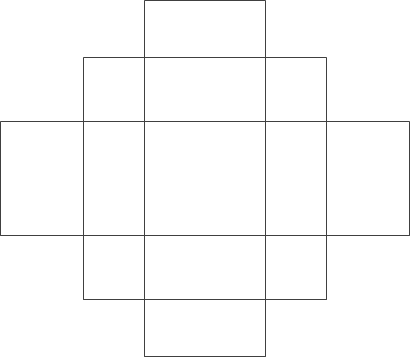
2. 而后在通过scales=(8, 16, 32)得到放大倍数后的archors。scales时,将上面的每个都直接放大对应的倍数,最终得到9个archors(每个archor为左上角和右下角的坐标)。将上面三个archors分别放大就行了,因而本文未给出该图。
之后通过tf.add(anchor_constant, shifts)得到缩放后的每个点的9个archor在原始图的矩形框。anchor_constant:1*9*4。shifts:N*1*4。N为缩放后特征图的像素数。将维度从N*9*4变换到(N*9)*4,得到缩放后的图像每个点在原始图像中的archors。
_anchor_component如下:
 1 def _anchor_component(self):
 2     with tf.variable_scope('ANCHOR_' + self._tag) as scope:
 3         height = tf.to_int32(tf.ceil(self._im_info[0] / np.float32(self._feat_stride[0])))  # 图像经过vgg16得到特征图的宽高
 4         width = tf.to_int32(tf.ceil(self._im_info[1] / np.float32(self._feat_stride[0])))
 5         if cfg.USE_E2E_TF:
 6             # 通过特征图宽高、_feat_stride(特征图相对原始图缩小的比例)及_anchor_scales、_anchor_ratios得到原始图像上
 7             # 所有可能的archors(坐标可能超出原始图像边界)和archor的数量
 8             anchors, anchor_length = generate_anchors_pre_tf(height, width, self._feat_stride, self._anchor_scales, self._anchor_ratios )
 9         else:
10             anchors, anchor_length = tf.py_func(generate_anchors_pre,
11                 [height, width, self._feat_stride, self._anchor_scales, self._anchor_ratios], [tf.float32, tf.int32], name="generate_anchors")
12         anchors.set_shape([None, 4])   # 起点坐标,终点坐标,共4个值
13         anchor_length.set_shape([])
14         self._anchors = anchors
15         self._anchor_length = anchor_length
16
17 def generate_anchors_pre_tf(height, width, feat_stride=16, anchor_scales=(8, 16, 32), anchor_ratios=(0.5, 1, 2)):
18     shift_x = tf.range(width) * feat_stride  # 得到所有archors在原始图像的起始x坐标:(0,feat_stride,2*feat_stride...)
19     shift_y = tf.range(height) * feat_stride  # 得到所有archors在原始图像的起始y坐标:(0,feat_stride,2*feat_stride...)
20     shift_x, shift_y = tf.meshgrid(shift_x, shift_y) # shift_x:height个(0,feat_stride,2*feat_stride...);shift_y:width个(0,feat_stride,2*feat_stride...)'
21     sx = tf.reshape(shift_x, shape=(-1,)) # 0,feat_stride,2*feat_stride...0,feat_stride,2*feat_stride...0,feat_stride,2*feat_stride...
22     sy = tf.reshape(shift_y, shape=(-1,)) # 0,0,0...feat_stride,feat_stride,feat_stride...2*feat_stride,2*feat_stride,2*feat_stride..
23     shifts = tf.transpose(tf.stack([sx, sy, sx, sy])) # width*height个四位矩阵
24     K = tf.multiply(width, height)  # 特征图总共像素数
25     shifts = tf.transpose(tf.reshape(shifts, shape=[1, K, 4]), perm=(1, 0, 2)) # 增加一维,变成1*(width*height)*4矩阵,而后变换维度为(width*height)*1*4矩阵
26
27     anchors = generate_anchors(ratios=np.array(anchor_ratios), scales=np.array(anchor_scales))  #得到9个archors的在原始图像中的四个坐标(放大比例默认为16)
28     A = anchors.shape[0]   # A=9
29     anchor_constant = tf.constant(anchors.reshape((1, A, 4)), dtype=tf.int32) # anchors增加维度为1*9*4
30
31     length = K * A  # 总共的archors的个数(每个点对应A=9个archor,共K=height*width个点)
32     # 1*9*4的base archors和(width*height)*1*4的偏移矩阵进行broadcast相加,得到(width*height)*9*4,并改变形状为(width*height*9)*4,得到所有的archors的四个坐标
33     anchors_tf = tf.reshape(tf.add(anchor_constant, shifts), shape=(length, 4))
34
35     return tf.cast(anchors_tf, dtype=tf.float32), length
36
37 def generate_anchors(base_size=16, ratios=[0.5, 1, 2], scales=2 ** np.arange(3, 6)):
38     """Generate anchor (reference) windows by enumerating aspect ratios X scales wrt a reference (0, 0, 15, 15) window."""
39     base_anchor = np.array([1, 1, base_size, base_size]) - 1  # base archor的四个坐标
40     ratio_anchors = _ratio_enum(base_anchor, ratios)  # 通过ratio得到3个archors的坐标(3*4矩阵)
41     anchors = np.vstack([_scale_enum(ratio_anchors[i, :], scales) for i in range(ratio_anchors.shape[0])]) # 3*4矩阵变成9*4矩阵,得到9个archors的坐标
42     return anchors
43
44
45 def _whctrs(anchor):
46     """ Return width, height, x center, and y center for an anchor (window). """
47     w = anchor[2] - anchor[0] + 1  # 宽
48     h = anchor[3] - anchor[1] + 1  # 高
49     x_ctr = anchor[0] + 0.5 * (w - 1)  # 中心x
50     y_ctr = anchor[1] + 0.5 * (h - 1)  # 中心y
51     return w, h, x_ctr, y_ctr
52
53
54 def _mkanchors(ws, hs, x_ctr, y_ctr):
55     """ Given a vector of widths (ws) and heights (hs) around a center (x_ctr, y_ctr), output a set of anchors (windows)."""
56     ws = ws[:, np.newaxis]  # 3维向量变成3*1矩阵
57     hs = hs[:, np.newaxis]  # 3维向量变成3*1矩阵
58     anchors = np.hstack((x_ctr - 0.5 * (ws - 1), y_ctr - 0.5 * (hs - 1), x_ctr + 0.5 * (ws - 1), y_ctr + 0.5 * (hs - 1)))  # 3*4矩阵
59     return anchors
60
61
62 def _ratio_enum(anchor, ratios):  # 缩放比例为像素总数的比例,而非单独宽或者高的比例
63     """ Enumerate a set of anchors for each aspect ratio wrt an anchor. """
64     w, h, x_ctr, y_ctr = _whctrs(anchor)  # 得到中心位置和宽高
65     size = w * h    # 总共像素数
66     size_ratios = size / ratios  # 缩放比例
67     ws = np.round(np.sqrt(size_ratios))  # 缩放后的宽,3维向量(值由大到小)
68     hs = np.round(ws * ratios)     # 缩放后的高,两个3维向量对应元素相乘,为3维向量(值由小到大)
69     anchors = _mkanchors(ws, hs, x_ctr, y_ctr)  # 根据中心及宽高得到3个archors的四个坐标
70     return anchors
71
72
73 def _scale_enum(anchor, scales):
74     """ Enumerate a set of anchors for each scale wrt an anchor. """
75     w, h, x_ctr, y_ctr = _whctrs(anchor)    # 得到中心位置和宽高
76     ws = w * scales    # 得到宽的放大倍数
77     hs = h * scales    # 得到宽的放大倍数
78     anchors = _mkanchors(ws, hs, x_ctr, y_ctr)  # 根据中心及宽高得到3个archors的四个坐标
79     return anchors
1.5 _region_proposal
_region_proposal用于将vgg16的conv5的特征通过3*3的滑动窗得到rpn特征,进行两条并行的线路,分别送入cls和reg网络。cls网络判断通过1*1的卷积得到archors是正样本还是负样本(由于archors过多,还有可能有不关心的archors,使用时只使用正样本和负样本),用于二分类rpn_cls_score;reg网络对通过1*1的卷积回归出archors的坐标偏移rpn_bbox_pred。这两个网络共用3*3 conv(rpn)。由于每个位置有k个archor,因而每个位置均有2k个soores和4k个coordinates。
cls(将输入的512维降低到2k维):3*3 conv + 1*1 conv(2k个scores,k为每个位置archors个数,如9)
在第一次使用_reshape_layer时,由于输入bottom为1*?*?*2k,先得到caffe中的数据顺序(tf为batchsize*height*width*channels,caffe中为batchsize*channels*height*width)to_caffe:1*2k*?*?,而后reshape后得到reshaped为1*2*?*?,最后在转回tf的顺序to_tf为1*?*?*2,得到rpn_cls_score_reshape。之后通过rpn_cls_prob_reshape(softmax的值,只针对最后一维,即2计算softmax),得到概率rpn_cls_prob_reshape(其最大值,即为预测值rpn_cls_pred),再次_reshape_layer,得到1*?*?*2k的rpn_cls_prob,为原始的概率。
reg(将输入的512维降低到4k维):3*3 conv + 1*1 conv(4k个coordinates,k为每个位置archors个数,如9)。
_region_proposal定义如下:
 1 def _region_proposal(self, net_conv, is_training, initializer):  # 对输入特征图进行处理
 2     rpn = slim.conv2d(net_conv, cfg.RPN_CHANNELS, [3, 3], trainable=is_training, weights_initializer=initializer, scope="rpn_conv/3x3")  #3*3的conv,作为rpn网络
 3     self._act_summaries.append(rpn)
 4     rpn_cls_score = slim.conv2d(rpn, self._num_anchors * 2, [1, 1], trainable=is_training, weights_initializer=initializer,  # _num_anchors为9
 5                                 padding='VALID', activation_fn=None, scope='rpn_cls_score')    #1*1的conv,得到每个位置的9个archors分类特征1*?*?*(9*2)(二分类),判断当前archors是正样本还是负样本
 6     rpn_cls_score_reshape = self._reshape_layer(rpn_cls_score, 2, 'rpn_cls_score_reshape') # 1*?*?*18==>1*(?*9)*?*2
 7     rpn_cls_prob_reshape = self._softmax_layer(rpn_cls_score_reshape, "rpn_cls_prob_reshape")  # 以最后一维为特征长度,得到所有特征的概率1*(?*9)*?*2
 8     rpn_cls_pred = tf.argmax(tf.reshape(rpn_cls_score_reshape, [-1, 2]), axis=1, name="rpn_cls_pred")  # 得到每个位置的9个archors预测的类别,(1*?*9*?)的列向量
 9     rpn_cls_prob = self._reshape_layer(rpn_cls_prob_reshape, self._num_anchors * 2, "rpn_cls_prob")  # 变换会原始维度1*(?*9)*?*2==>1*?*?*(9*2)
10     rpn_bbox_pred = slim.conv2d(rpn, self._num_anchors * 4, [1, 1], trainable=is_training, weights_initializer=initializer,
11                                 padding='VALID', activation_fn=None, scope='rpn_bbox_pred')    #1*1的conv,每个位置的9个archors回归位置偏移1*?*?*(9*4)
12     if is_training:
13         # 每个位置的9个archors的类别概率和每个位置的9个archors的回归位置偏移得到post_nms_topN=2000个archors的位置(包括全0的batch_inds)及为1的概率
14         rois, roi_scores = self._proposal_layer(rpn_cls_prob, rpn_bbox_pred, "rois")
15         rpn_labels = self._anchor_target_layer(rpn_cls_score, "anchor")   # rpn_labels:特征图中每个位置对应的是正样本、负样本还是不关注
16         with tf.control_dependencies([rpn_labels]):  # Try to have a deterministic order for the computing graph, for reproducibility
17             rois, _ = self._proposal_target_layer(rois, roi_scores, "rpn_rois")  #通过post_nms_topN个archors的位置及为1(正样本)的概率得到256个rois(第一列的全0更新为每个archors对应的类别)及对应信息
18     else:
19         if cfg.TEST.MODE == 'nms':
20             # 每个位置的9个archors的类别概率和每个位置的9个archors的回归位置偏移得到post_nms_topN=300个archors的位置(包括全0的batch_inds)及为1的概率
21             rois, _ = self._proposal_layer(rpn_cls_prob, rpn_bbox_pred, "rois")
22         elif cfg.TEST.MODE == 'top':
23             rois, _ = self._proposal_top_layer(rpn_cls_prob, rpn_bbox_pred, "rois")
24         else:
25             raise NotImplementedError
26
27     self._predictions["rpn_cls_score"] = rpn_cls_score  # 每个位置的9个archors是正样本还是负样本
28     self._predictions["rpn_cls_score_reshape"] = rpn_cls_score_reshape  # 每个archors是正样本还是负样本
29     self._predictions["rpn_cls_prob"] = rpn_cls_prob   # 每个位置的9个archors是正样本和负样本的概率
30     self._predictions["rpn_cls_pred"] = rpn_cls_pred   # 每个位置的9个archors预测的类别,(1*?*9*?)的列向量
31     self._predictions["rpn_bbox_pred"] = rpn_bbox_pred  # 每个位置的9个archors回归位置偏移
32     self._predictions["rois"] = rois   # 256个archors的类别(第一维)及位置(后四维)
33
34     return rois  # 返回256个archors的类别(第一维,训练时为每个archors的类别,测试时全0)及位置(后四维)
35
36 def _reshape_layer(self, bottom, num_dim, name):
37     input_shape = tf.shape(bottom)
38     with tf.variable_scope(name) as scope:
39         to_caffe = tf.transpose(bottom, [0, 3, 1, 2])  # NHWC(TF数据格式)变成NCHW(caffe格式)
40         reshaped = tf.reshape(to_caffe, tf.concat(axis=0, values=[[1, num_dim, -1], [input_shape[2]]]))  # 1*(num_dim*9)*?*?==>1*num_dim*(9*?)*?  或 1*num_dim*(9*?)*?==>1*(num_dim*9)*?*?
41         to_tf = tf.transpose(reshaped, [0, 2, 3, 1])
42         return to_tf
43
44
45 def _softmax_layer(self, bottom, name):
46     if name.startswith('rpn_cls_prob_reshape'):    # bottom:1*(?*9)*?*2
47         input_shape = tf.shape(bottom)
48         bottom_reshaped = tf.reshape(bottom, [-1, input_shape[-1]])   # 只保留最后一维,用于计算softmax的概率,其他的全合并:1*(?*9)*?*2==>(1*?*9*?)*2
49         reshaped_score = tf.nn.softmax(bottom_reshaped, name=name)  # 得到所有特征的概率
50         return tf.reshape(reshaped_score, input_shape)   # (1*?*9*?)*2==>1*(?*9)*?*2
51     return tf.nn.softmax(bottom, name=name)
1.6 _proposal_layer
_proposal_layer调用proposal_layer_tf,通过(N*9)*4个archors,计算估计后的坐标(bbox_transform_inv_tf),并对坐标进行裁剪(clip_boxes_tf)及非极大值抑制(tf.image.non_max_suppression,可得到符合条件的索引indices)的archors:rois及这些archors为正样本的概率:rpn_scores。rois为m*5维,rpn_scores为m*4维,其中m为经过非极大值抑制后得到的候选区域个数(训练时2000个,测试时300个)。m*5的第一列为全为0的batch_inds,后4列为坐标(坐上+右下)
_proposal_layer如下
 1 def _proposal_layer(self, rpn_cls_prob, rpn_bbox_pred, name):  #每个位置的9个archors的类别概率和每个位置的9个archors的回归位置偏移得到post_nms_topN个archors的位置及为1的概率
 2     with tf.variable_scope(name) as scope:
 3         if cfg.USE_E2E_TF:  # post_nms_topN*5的rois(第一列为全0的batch_inds,后4列为坐标);rpn_scores:post_nms_topN*1个对应的为1的概率
 4             rois, rpn_scores = proposal_layer_tf(rpn_cls_prob, rpn_bbox_pred, self._im_info, self._mode, self._feat_stride, self._anchors, self._num_anchors)
 5         else:
 6             rois, rpn_scores = tf.py_func(proposal_layer, [rpn_cls_prob, rpn_bbox_pred, self._im_info, self._mode,
 7                 self._feat_stride, self._anchors, self._num_anchors], [tf.float32, tf.float32], name="proposal")
 8
 9         rois.set_shape([None, 5])
10         rpn_scores.set_shape([None, 1])
11
12     return rois, rpn_scores
13
14 def proposal_layer_tf(rpn_cls_prob, rpn_bbox_pred, im_info, cfg_key, _feat_stride, anchors, num_anchors):  #每个位置的9个archors的类别概率和每个位置的9个archors的回归位置偏移
15     if type(cfg_key) == bytes:
16         cfg_key = cfg_key.decode('utf-8')
17     pre_nms_topN = cfg[cfg_key].RPN_PRE_NMS_TOP_N
18     post_nms_topN = cfg[cfg_key].RPN_POST_NMS_TOP_N  # 训练时为2000,测试时为300
19     nms_thresh = cfg[cfg_key].RPN_NMS_THRESH   # nms的阈值,为0.7
20
21     scores = rpn_cls_prob[:, :, :, num_anchors:]    # 1*?*?*(9*2)取后9个:1*?*?*9。应该是前9个代表9个archors为背景景的概率,后9个代表9个archors为前景的概率(二分类,只有背景和前景)
22     scores = tf.reshape(scores, shape=(-1,))        # 所有的archors为1的概率
23     rpn_bbox_pred = tf.reshape(rpn_bbox_pred, shape=(-1, 4))     # 所有的archors的四个坐标
24
25     proposals = bbox_transform_inv_tf(anchors, rpn_bbox_pred)   # 已知archor和偏移求预测的坐标
26     proposals = clip_boxes_tf(proposals, im_info[:2])    # 限制预测坐标在原始图像上
27
28     indices = tf.image.non_max_suppression(proposals, scores, max_output_size=post_nms_topN, iou_threshold=nms_thresh)    # 通过nms得到分值最大的post_nms_topN个坐标的索引
29
30     boxes = tf.gather(proposals, indices)   # 得到post_nms_topN个对应的坐标
31     boxes = tf.to_float(boxes)
32     scores = tf.gather(scores, indices)    # 得到post_nms_topN个对应的为1的概率
33     scores = tf.reshape(scores, shape=(-1, 1))
34
35     batch_inds = tf.zeros((tf.shape(indices)[0], 1), dtype=tf.float32)    # Only support single image as input
36     blob = tf.concat([batch_inds, boxes], 1)  # post_nms_topN*1个batch_inds和post_nms_topN*4个坐标concat,得到post_nms_topN*5的blob
37
38     return blob, scores
39
40 def bbox_transform_inv_tf(boxes, deltas):    # 已知archor和偏移求预测的坐标
41     boxes = tf.cast(boxes, deltas.dtype)
42     widths = tf.subtract(boxes[:, 2], boxes[:, 0]) + 1.0     # 宽
43     heights = tf.subtract(boxes[:, 3], boxes[:, 1]) + 1.0     # 高
44     ctr_x = tf.add(boxes[:, 0], widths * 0.5)             # 中心x
45     ctr_y = tf.add(boxes[:, 1], heights * 0.5)            # 中心y
46
47     dx = deltas[:, 0]      # 预测的dx
48     dy = deltas[:, 1]      # 预测的dy
49     dw = deltas[:, 2]      # 预测的dw
50     dh = deltas[:, 3]      # 预测的dh
51
52     pred_ctr_x = tf.add(tf.multiply(dx, widths), ctr_x)      # 公式2已知xa,wa,tx反过来求预测的x中心坐标
53     pred_ctr_y = tf.add(tf.multiply(dy, heights), ctr_y)     # 公式2已知ya,ha,ty反过来求预测的y中心坐标
54     pred_w = tf.multiply(tf.exp(dw), widths)         # 公式2已知wa,tw反过来求预测的w
55     pred_h = tf.multiply(tf.exp(dh), heights)        # 公式2已知ha,th反过来求预测的h
56
57     pred_boxes0 = tf.subtract(pred_ctr_x, pred_w * 0.5)  # 预测的框的起始和终点四个坐标
58     pred_boxes1 = tf.subtract(pred_ctr_y, pred_h * 0.5)
59     pred_boxes2 = tf.add(pred_ctr_x, pred_w * 0.5)
60     pred_boxes3 = tf.add(pred_ctr_y, pred_h * 0.5)
61
62     return tf.stack([pred_boxes0, pred_boxes1, pred_boxes2, pred_boxes3], axis=1)
63
64
65 def clip_boxes_tf(boxes, im_info):   # 限制预测坐标在原始图像上
66     b0 = tf.maximum(tf.minimum(boxes[:, 0], im_info[1] - 1), 0)
67     b1 = tf.maximum(tf.minimum(boxes[:, 1], im_info[0] - 1), 0)
68     b2 = tf.maximum(tf.minimum(boxes[:, 2], im_info[1] - 1), 0)
69     b3 = tf.maximum(tf.minimum(boxes[:, 3], im_info[0] - 1), 0)
70     return tf.stack([b0, b1, b2, b3], axis=1)
1.7 _anchor_target_layer
通过_anchor_target_layer首先去除archors中边界超出图像的archors。而后通过bbox_overlaps计算archors(N*4)和gt_boxes(M*4)的重叠区域的值overlaps(N*M),并得到每个archor对应的最大的重叠ground_truth的值max_overlaps(1*N),以及ground_truth的背景对应的最大重叠archors的值gt_max_overlaps(1*M)和每个背景对应的archor的位置gt_argmax_overlaps。之后通过_compute_targets计算anchors和最大重叠位置的gt_boxes的变换后的坐标bbox_targets(见公式2后四个)。最后通过_unmap在变换回和原始的archors一样大小的rpn_labels(archors是正样本、负样本还是不关注),rpn_bbox_targets, rpn_bbox_inside_weights, rpn_bbox_outside_weights。
_anchor_target_layer定义:
  1 def _anchor_target_layer(self, rpn_cls_score, name):  # rpn_cls_score:每个位置的9个archors分类特征1*?*?*(9*2)
  2     with tf.variable_scope(name) as scope:
  3         # rpn_labels; 特征图中每个位置对应的是正样本、负样本还是不关注(去除了边界在图像外面的archors)
  4         # rpn_bbox_targets:# 特征图中每个位置和对应的正样本的坐标偏移(很多为0)
  5         # rpn_bbox_inside_weights:  正样本的权重为1(去除负样本和不关注的样本,均为0)
  6         # rpn_bbox_outside_weights:  正样本和负样本(不包括不关注的样本)归一化的权重
  7         rpn_labels, rpn_bbox_targets, rpn_bbox_inside_weights, rpn_bbox_outside_weights = tf.py_func(
  8             anchor_target_layer, [rpn_cls_score, self._gt_boxes, self._im_info, self._feat_stride, self._anchors, self._num_anchors],
  9             [tf.float32, tf.float32, tf.float32, tf.float32], name="anchor_target")
 10
 11         rpn_labels.set_shape([1, 1, None, None])
 12         rpn_bbox_targets.set_shape([1, None, None, self._num_anchors * 4])
 13         rpn_bbox_inside_weights.set_shape([1, None, None, self._num_anchors * 4])
 14         rpn_bbox_outside_weights.set_shape([1, None, None, self._num_anchors * 4])
 15
 16         rpn_labels = tf.to_int32(rpn_labels, name="to_int32")
 17         self._anchor_targets['rpn_labels'] = rpn_labels  # 特征图中每个位置对应的是正样本、负样本还是不关注(去除了边界在图像外面的archors)
 18         self._anchor_targets['rpn_bbox_targets'] = rpn_bbox_targets  # 特征图中每个位置和对应的正样本的坐标偏移(很多为0)
 19         self._anchor_targets['rpn_bbox_inside_weights'] = rpn_bbox_inside_weights  #  正样本的权重为1(去除负样本和不关注的样本,均为0)
 20         self._anchor_targets['rpn_bbox_outside_weights'] = rpn_bbox_outside_weights  #   正样本和负样本(不包括不关注的样本)归一化的权重
 21
 22         self._score_summaries.update(self._anchor_targets)
 23
 24     return rpn_labels
 25
 26 def anchor_target_layer(rpn_cls_score, gt_boxes, im_info, _feat_stride, all_anchors, num_anchors):# 1*?*?*(9*2); ?*5; 3; [16], ?*4; [9]
 27     """Same as the anchor target layer in original Fast/er RCNN """
 28     A = num_anchors   # [9]
 29     total_anchors = all_anchors.shape[0]   # 所有archors的个数,9*特征图宽*特征图高 个
 30     K = total_anchors / num_anchors
 31
 32     _allowed_border = 0  # allow boxes to sit over the edge by a small amount
 33     height, width = rpn_cls_score.shape[1:3]  # rpn网络得到的特征的高宽
 34
 35     inds_inside = np.where(  # 所有archors边界可能超出图像,取在图像内部的archors的索引
 36         (all_anchors[:, 0] >= -_allowed_border) & (all_anchors[:, 1] >= -_allowed_border) &
 37         (all_anchors[:, 2] < im_info[1] + _allowed_border) &  # width
 38         (all_anchors[:, 3] < im_info[0] + _allowed_border)  # height
 39         )[0]
 40
 41     anchors = all_anchors[inds_inside, :]   # 得到在图像内部archors的坐标
 42
 43     labels = np.empty((len(inds_inside),), dtype=np.float32)  # label: 1 正样本, 0 负样本, -1 不关注
 44     labels.fill(-1)
 45
 46     # 计算每个anchors:n*4和每个真实位置gt_boxes:m*4的重叠区域的比的矩阵:n*m
 47     overlaps = bbox_overlaps(np.ascontiguousarray(anchors, dtype=np.float), np.ascontiguousarray(gt_boxes, dtype=np.float))
 48     argmax_overlaps = overlaps.argmax(axis=1)  # 找到每行最大值的位置,即每个archors对应的正样本的位置,得到n维的行向量
 49     max_overlaps = overlaps[np.arange(len(inds_inside)), argmax_overlaps]  # 取出每个archors对应的正样本的重叠区域,n维向量
 50     gt_argmax_overlaps = overlaps.argmax(axis=0)  # 找到每列最大值的位置,即每个真实位置对应的archors的位置,得到m维的行向量
 51     gt_max_overlaps = overlaps[gt_argmax_overlaps, np.arange(overlaps.shape[1])]  # 取出每个真实位置对应的archors的重叠区域,m维向量
 52     gt_argmax_overlaps = np.where(overlaps == gt_max_overlaps)[0]  # 得到从小到大顺序的位置
 53
 54     if not cfg.TRAIN.RPN_CLOBBER_POSITIVES:   # assign bg labels first so that positive labels can clobber them first set the negatives
 55         labels[max_overlaps < cfg.TRAIN.RPN_NEGATIVE_OVERLAP] = 0  # 将archors对应的正样本的重叠区域中小于阈值的置0
 56
 57     labels[gt_argmax_overlaps] = 1  # fg label: for each gt, anchor with highest overlap 每个真实位置对应的archors置1
 58     labels[max_overlaps >= cfg.TRAIN.RPN_POSITIVE_OVERLAP] = 1 # fg label: above threshold IOU 将archors对应的正样本的重叠区域中大于阈值的置1
 59
 60     if cfg.TRAIN.RPN_CLOBBER_POSITIVES:  # assign bg labels last so that negative labels can clobber positives
 61         labels[max_overlaps < cfg.TRAIN.RPN_NEGATIVE_OVERLAP] = 0
 62
 63     # 如果有过多的正样本,则只随机选择num_fg=0.5*256=128个正样本
 64     num_fg = int(cfg.TRAIN.RPN_FG_FRACTION * cfg.TRAIN.RPN_BATCHSIZE)  # subsample positive labels if we have too many
 65     fg_inds = np.where(labels == 1)[0]
 66     if len(fg_inds) > num_fg:
 67         disable_inds = npr.choice(fg_inds, size=(len(fg_inds) - num_fg), replace=False)
 68         labels[disable_inds] = -1   # 将多于的正样本设置为不关注
 69
 70     # 如果有过多的负样本,则只随机选择 num_bg=256-正样本个数 个负样本
 71     num_bg = cfg.TRAIN.RPN_BATCHSIZE - np.sum(labels == 1)  # subsample negative labels if we have too many
 72     bg_inds = np.where(labels == 0)[0]
 73     if len(bg_inds) > num_bg:
 74         disable_inds = npr.choice(bg_inds, size=(len(bg_inds) - num_bg), replace=False)
 75         labels[disable_inds] = -1   # 将多于的负样本设置为不关注
 76
 77     bbox_targets = np.zeros((len(inds_inside), 4), dtype=np.float32)
 78     bbox_targets = _compute_targets(anchors, gt_boxes[argmax_overlaps, :])  # 通过archors和archors对应的正样本计算坐标的偏移
 79
 80     bbox_inside_weights = np.zeros((len(inds_inside), 4), dtype=np.float32)
 81     bbox_inside_weights[labels == 1, :] = np.array(cfg.TRAIN.RPN_BBOX_INSIDE_WEIGHTS)  # 正样本的四个坐标的权重均设置为1
 82
 83     bbox_outside_weights = np.zeros((len(inds_inside), 4), dtype=np.float32)
 84     if cfg.TRAIN.RPN_POSITIVE_WEIGHT < 0:  # uniform weighting of examples (given non-uniform sampling)
 85         num_examples = np.sum(labels >= 0)   # 正样本和负样本的总数(去除不关注的样本)
 86         positive_weights = np.ones((1, 4)) * 1.0 / num_examples   # 归一化的权重
 87         negative_weights = np.ones((1, 4)) * 1.0 / num_examples   # 归一化的权重
 88     else:
 89         assert ((cfg.TRAIN.RPN_POSITIVE_WEIGHT > 0) & (cfg.TRAIN.RPN_POSITIVE_WEIGHT < 1))
 90         positive_weights = (cfg.TRAIN.RPN_POSITIVE_WEIGHT / np.sum(labels == 1))
 91         negative_weights = ((1.0 - cfg.TRAIN.RPN_POSITIVE_WEIGHT) / np.sum(labels == 0))
 92     bbox_outside_weights[labels == 1, :] = positive_weights     # 归一化的权重
 93     bbox_outside_weights[labels == 0, :] = negative_weights     # 归一化的权重
 94
 95     # 由于上面使用了inds_inside,此处将labels,bbox_targets,bbox_inside_weights,bbox_outside_weights映射到原始的archors(包含未知
 96     # 参数超出图像边界的archors)对应的labels,bbox_targets,bbox_inside_weights,bbox_outside_weights,同时将不需要的填充fill的值
 97     labels = _unmap(labels, total_anchors, inds_inside, fill=-1)
 98     bbox_targets = _unmap(bbox_targets, total_anchors, inds_inside, fill=0)
 99     bbox_inside_weights = _unmap(bbox_inside_weights, total_anchors, inds_inside, fill=0)  # 所有archors中正样本的四个坐标的权重均设置为1,其他为0
100     bbox_outside_weights = _unmap(bbox_outside_weights, total_anchors, inds_inside, fill=0)
101
102     labels = labels.reshape((1, height, width, A)).transpose(0, 3, 1, 2)   # (1*?*?)*9==>1*?*?*9==>1*9*?*?
103     labels = labels.reshape((1, 1, A * height, width))  # 1*9*?*?==>1*1*(9*?)*?
104     rpn_labels = labels  # 特征图中每个位置对应的是正样本、负样本还是不关注(去除了边界在图像外面的archors)
105
106     bbox_targets = bbox_targets.reshape((1, height, width, A * 4))  # 1*(9*?)*?*4==>1*?*?*(9*4)
107
108     rpn_bbox_targets = bbox_targets  # 特征图中每个位置和对应的正样本的坐标偏移(很多为0)
109     bbox_inside_weights = bbox_inside_weights.reshape((1, height, width, A * 4))  # 1*(9*?)*?*4==>1*?*?*(9*4)
110     rpn_bbox_inside_weights = bbox_inside_weights
111     bbox_outside_weights = bbox_outside_weights.reshape((1, height, width, A * 4))  # 1*(9*?)*?*4==>1*?*?*(9*4)
112     rpn_bbox_outside_weights = bbox_outside_weights    #   归一化的权重
113     return rpn_labels, rpn_bbox_targets, rpn_bbox_inside_weights, rpn_bbox_outside_weights
114
115
116 def _unmap(data, count, inds, fill=0):
117     """ Unmap a subset of item (data) back to the original set of items (of size count) """
118     if len(data.shape) == 1:
119         ret = np.empty((count,), dtype=np.float32)   # 得到1维矩阵
120         ret.fill(fill)   # 默认填充fill的值
121         ret[inds] = data   # 有效位置填充具体数据
122     else:
123         ret = np.empty((count,) + data.shape[1:], dtype=np.float32)  # 得到对应维数的矩阵
124         ret.fill(fill)    # 默认填充fill的值
125         ret[inds, :] = data   # 有效位置填充具体数据
126     return ret
127
128
129 def _compute_targets(ex_rois, gt_rois):
130     """Compute bounding-box regression targets for an image."""
131     assert ex_rois.shape[0] == gt_rois.shape[0]
132     assert ex_rois.shape[1] == 4
133     assert gt_rois.shape[1] == 5
134
135     # 通过公式2后四个,结合archor和对应的正样本的坐标计算坐标的偏移
136     return bbox_transform(ex_rois, gt_rois[:, :4]).astype(np.float32, copy=False)  # 由于gt_rois是5列,去掉最后一列的batch_inds
137
138 def bbox_transform(ex_rois, gt_rois):
139     ex_widths = ex_rois[:, 2] - ex_rois[:, 0] + 1.0  # archor的宽
140     ex_heights = ex_rois[:, 3] - ex_rois[:, 1] + 1.0  # archor的高
141     ex_ctr_x = ex_rois[:, 0] + 0.5 * ex_widths  #archor的中心x
142     ex_ctr_y = ex_rois[:, 1] + 0.5 * ex_heights  #archor的中心y
143
144     gt_widths = gt_rois[:, 2] - gt_rois[:, 0] + 1.0  # 真实正样本w
145     gt_heights = gt_rois[:, 3] - gt_rois[:, 1] + 1.0   # 真实正样本h
146     gt_ctr_x = gt_rois[:, 0] + 0.5 * gt_widths      # 真实正样本中心x
147     gt_ctr_y = gt_rois[:, 1] + 0.5 * gt_heights     # 真实正样本中心y
148
149     targets_dx = (gt_ctr_x - ex_ctr_x) / ex_widths    # 通过公式2后四个的x*,xa,wa得到dx
150     targets_dy = (gt_ctr_y - ex_ctr_y) / ex_heights   # 通过公式2后四个的y*,ya,ha得到dy
151     targets_dw = np.log(gt_widths / ex_widths)        # 通过公式2后四个的w*,wa得到dw
152     targets_dh = np.log(gt_heights / ex_heights)      # 通过公式2后四个的h*,ha得到dh
153
154     targets = np.vstack((targets_dx, targets_dy, targets_dw, targets_dh)).transpose()
155     return targets
1.8 bbox_overlaps
bbox_overlaps用于计算archors和ground truth box重叠区域的面积。具体可见参考网址https://www.cnblogs.com/darkknightzh/p/9043395.html,程序中的代码如下:
 1 def bbox_overlaps(
 2         np.ndarray[DTYPE_t, ndim=2] boxes,
 3         np.ndarray[DTYPE_t, ndim=2] query_boxes):
 4     """
 5     Parameters
 6     ----------
 7     boxes: (N, 4) ndarray of float
 8     query_boxes: (K, 4) ndarray of float
 9     Returns
10     -------
11     overlaps: (N, K) ndarray of overlap between boxes and query_boxes
12     """
13     cdef unsigned int N = boxes.shape[0]
14     cdef unsigned int K = query_boxes.shape[0]
15     cdef np.ndarray[DTYPE_t, ndim=2] overlaps = np.zeros((N, K), dtype=DTYPE)
16     cdef DTYPE_t iw, ih, box_area
17     cdef DTYPE_t ua
18     cdef unsigned int k, n
19     for k in range(K):
20         box_area = (
21             (query_boxes[k, 2] - query_boxes[k, 0] + 1) *
22             (query_boxes[k, 3] - query_boxes[k, 1] + 1)
23         )
24         for n in range(N):
25             iw = (
26                 min(boxes[n, 2], query_boxes[k, 2]) -
27                 max(boxes[n, 0], query_boxes[k, 0]) + 1
28             )
29             if iw > 0:
30                 ih = (
31                     min(boxes[n, 3], query_boxes[k, 3]) -
32                     max(boxes[n, 1], query_boxes[k, 1]) + 1
33                 )
34                 if ih > 0:
35                     ua = float(
36                         (boxes[n, 2] - boxes[n, 0] + 1) *
37                         (boxes[n, 3] - boxes[n, 1] + 1) +
38                         box_area - iw * ih
39                     )
40                     overlaps[n, k] = iw * ih / ua
41     return overlaps
1.9 _proposal_target_layer
_proposal_target_layer调用proposal_target_layer,并进一步调用_sample_rois从之前_proposal_layer中选出的2000个archors筛选出256个archors。_sample_rois将正样本数量固定为最大64(小于时补负样本),并根据公式2对坐标归一化,通过_get_bbox_regression_labels得到bbox_targets。用于rcnn的分类及回归。该层只在训练时使用;测试时,直接选择了300个archors,不需要该层了。
=============================================================
190901更新:
说明:感谢@ pytf 的说明(见第19楼和20楼),此处注释有误,146行的注释:
# rois:从post_nms_topN个archors中选择256个archors(第一列的全0更新为每个archors对应的类别)
rois第一列解释错误。由于每次只有一张图像输入,因而rois第一列全为0.此处并没有更新rois第一列为每个archors对应的类别。
另一方面,第139行,是将bbox_target_data第一列更新为每个archors对应的类别。该行解释不太清晰。
190901更新结束
=============================================================
_proposal_target_layer定义如下
  1 def _proposal_target_layer(self, rois, roi_scores, name):  # post_nms_topN个archors的位置及为1(正样本)的概率
  2     # 只在训练时使用该层,从post_nms_topN个archors中选择256个archors
  3     with tf.variable_scope(name) as scope:
  4         # labels:正样本和负样本对应的真实的类别
  5         # rois:从post_nms_topN个archors中选择256个archors(第一列的全0更新为每个archors对应的类别)
  6         # roi_scores:256个archors对应的为正样本的概率
  7         # bbox_targets:256*(4*21)的矩阵,只有为正样本时,对应类别的坐标才不为0,其他类别的坐标全为0
  8         # bbox_inside_weights:256*(4*21)的矩阵,正样本时,对应类别四个坐标的权重为1,其他全为0
  9         # bbox_outside_weights:256*(4*21)的矩阵,正样本时,对应类别四个坐标的权重为1,其他全为0
 10         rois, roi_scores, labels, bbox_targets, bbox_inside_weights, bbox_outside_weights = tf.py_func(
 11             proposal_target_layer, [rois, roi_scores, self._gt_boxes, self._num_classes],
 12             [tf.float32, tf.float32, tf.float32, tf.float32, tf.float32, tf.float32], name="proposal_target")
 13
 14         rois.set_shape([cfg.TRAIN.BATCH_SIZE, 5])
 15         roi_scores.set_shape([cfg.TRAIN.BATCH_SIZE])
 16         labels.set_shape([cfg.TRAIN.BATCH_SIZE, 1])
 17         bbox_targets.set_shape([cfg.TRAIN.BATCH_SIZE, self._num_classes * 4])
 18         bbox_inside_weights.set_shape([cfg.TRAIN.BATCH_SIZE, self._num_classes * 4])
 19         bbox_outside_weights.set_shape([cfg.TRAIN.BATCH_SIZE, self._num_classes * 4])
 20
 21         self._proposal_targets['rois'] = rois
 22         self._proposal_targets['labels'] = tf.to_int32(labels, name="to_int32")
 23         self._proposal_targets['bbox_targets'] = bbox_targets
 24         self._proposal_targets['bbox_inside_weights'] = bbox_inside_weights
 25         self._proposal_targets['bbox_outside_weights'] = bbox_outside_weights
 26
 27         self._score_summaries.update(self._proposal_targets)
 28
 29         return rois, roi_scores
 30
 31 def proposal_target_layer(rpn_rois, rpn_scores, gt_boxes, _num_classes):
 32     """Assign object detection proposals to ground-truth targets. Produces proposal classification labels and bounding-box regression targets."""
 33     # Proposal ROIs (0, x1, y1, x2, y2) coming from RPN (i.e., rpn.proposal_layer.ProposalLayer), or any other source
 34     all_rois = rpn_rois  # rpn_rois为post_nms_topN*5的矩阵
 35     all_scores = rpn_scores  # rpn_scores为post_nms_topN的矩阵,代表对应的archors为正样本的概率
 36
 37     if cfg.TRAIN.USE_GT:    # Include ground-truth boxes in the set of candidate rois;  USE_GT=False,未使用这段代码
 38         zeros = np.zeros((gt_boxes.shape[0], 1), dtype=gt_boxes.dtype)
 39         all_rois = np.vstack((all_rois, np.hstack((zeros, gt_boxes[:, :-1]))))
 40         all_scores = np.vstack((all_scores, zeros))   # not sure if it a wise appending, but anyway i am not using it
 41
 42     num_images = 1  # 该程序只能一次处理一张图片
 43     rois_per_image = cfg.TRAIN.BATCH_SIZE / num_images  # 每张图片中最终选择的rois
 44     fg_rois_per_image = np.round(cfg.TRAIN.FG_FRACTION * rois_per_image)   # 正样本的个数:0.25*rois_per_image
 45
 46     # Sample rois with classification labels and bounding box regression targets
 47     # labels:正样本和负样本对应的真实的类别
 48     # rois:从post_nms_topN个archors中选择256个archors(第一列的全0更新为每个archors对应的类别)
 49     # roi_scores:256个archors对应的为正样本的概率
 50     # bbox_targets:256*(4*21)的矩阵,只有为正样本时,对应类别的坐标才不为0,其他类别的坐标全为0
 51     # bbox_inside_weights:256*(4*21)的矩阵,正样本时,对应类别四个坐标的权重为1,其他全为0
 52     labels, rois, roi_scores, bbox_targets, bbox_inside_weights = _sample_rois(all_rois, all_scores, gt_boxes, fg_rois_per_image, rois_per_image, _num_classes) # 选择256个archors
 53
 54     rois = rois.reshape(-1, 5)
 55     roi_scores = roi_scores.reshape(-1)
 56     labels = labels.reshape(-1, 1)
 57     bbox_targets = bbox_targets.reshape(-1, _num_classes * 4)
 58     bbox_inside_weights = bbox_inside_weights.reshape(-1, _num_classes * 4)
 59     bbox_outside_weights = np.array(bbox_inside_weights > 0).astype(np.float32) # 256*(4*21)的矩阵,正样本时,对应类别四个坐标的权重为1,其他全为0
 60
 61     return rois, roi_scores, labels, bbox_targets, bbox_inside_weights, bbox_outside_weights
 62
 63
 64 def _get_bbox_regression_labels(bbox_target_data, num_classes):
 65     """Bounding-box regression targets (bbox_target_data) are stored in a compact form N x (class, tx, ty, tw, th)
 66     This function expands those targets into the 4-of-4*K representation used by the network (i.e. only one class has non-zero targets).
 67     Returns:
 68         bbox_target (ndarray): N x 4K blob of regression targets
 69         bbox_inside_weights (ndarray): N x 4K blob of loss weights
 70     """
 71     clss = bbox_target_data[:, 0]  # 第1列,为类别
 72     bbox_targets = np.zeros((clss.size, 4 * num_classes), dtype=np.float32)   # 256*(4*21)的矩阵
 73     bbox_inside_weights = np.zeros(bbox_targets.shape, dtype=np.float32)
 74     inds = np.where(clss > 0)[0]   # 正样本的索引
 75     for ind in inds:
 76         cls = clss[ind]  # 正样本的类别
 77         start = int(4 * cls)  # 每个正样本的起始坐标
 78         end = start + 4       # 每个正样本的终止坐标(由于坐标为4)
 79         bbox_targets[ind, start:end] = bbox_target_data[ind, 1:]   # 对应的坐标偏移赋值给对应的类别
 80         bbox_inside_weights[ind, start:end] = cfg.TRAIN.BBOX_INSIDE_WEIGHTS   # 对应的权重(1.0, 1.0, 1.0, 1.0)赋值给对应的类别
 81
 82     # bbox_targets:256*(4*21)的矩阵,只有为正样本时,对应类别的坐标才不为0,其他类别的坐标全为0
 83     # bbox_inside_weights:256*(4*21)的矩阵,正样本时,对应类别四个坐标的权重为1,其他全为0
 84     return bbox_targets, bbox_inside_weights
 85
 86
 87 def _compute_targets(ex_rois, gt_rois, labels):
 88     """Compute bounding-box regression targets for an image."""
 89     assert ex_rois.shape[0] == gt_rois.shape[0]
 90     assert ex_rois.shape[1] == 4
 91     assert gt_rois.shape[1] == 4
 92
 93     targets = bbox_transform(ex_rois, gt_rois)  # 通过公式2后四个,结合256个archor和对应的正样本的坐标计算坐标的偏移
 94     if cfg.TRAIN.BBOX_NORMALIZE_TARGETS_PRECOMPUTED:  # Optionally normalize targets by a precomputed mean and stdev
 95         targets = ((targets - np.array(cfg.TRAIN.BBOX_NORMALIZE_MEANS)) / np.array(cfg.TRAIN.BBOX_NORMALIZE_STDS))   # 坐标减去均值除以标准差,进行归一化
 96     return np.hstack((labels[:, np.newaxis], targets)).astype(np.float32, copy=False)  # 之前的bbox第一列为全0,此处第一列为对应的类别
 97
 98
 99 def _sample_rois(all_rois, all_scores, gt_boxes, fg_rois_per_image, rois_per_image, num_classes):  # all_rois第一列全0,后4列为坐标;gt_boxes前4列为坐标,最后一列为类别
100     """Generate a random sample of RoIs comprising foreground and background examples."""
101     # 计算archors和gt_boxes重叠区域面积的比值
102     overlaps = bbox_overlaps(np.ascontiguousarray(all_rois[:, 1:5], dtype=np.float), np.ascontiguousarray(gt_boxes[:, :4], dtype=np.float)) # overlaps: (rois x gt_boxes)
103     gt_assignment = overlaps.argmax(axis=1)  # 得到每个archors对应的gt_boxes的索引
104     max_overlaps = overlaps.max(axis=1)   # 得到每个archors对应的gt_boxes的重叠区域的值
105     labels = gt_boxes[gt_assignment, 4]   # 得到每个archors对应的gt_boxes的类别
106
107     # 每个archors对应的gt_boxes的重叠区域的值大于阈值的作为正样本,得到正样本的索引
108     fg_inds = np.where(max_overlaps >= cfg.TRAIN.FG_THRESH)[0]  # Select foreground RoIs as those with >= FG_THRESH overlap
109     # Guard against the case when an image has fewer than fg_rois_per_image. Select background RoIs as those within [BG_THRESH_LO, BG_THRESH_HI)
110     # 每个archors对应的gt_boxes的重叠区域的值在给定阈值内的作为负样本,得到负样本的索引
111     bg_inds = np.where((max_overlaps < cfg.TRAIN.BG_THRESH_HI) & (max_overlaps >= cfg.TRAIN.BG_THRESH_LO))[0]
112
113     # Small modification to the original version where we ensure a fixed number of regions are sampled
114     # 最终选择256个archors
115     if fg_inds.size > 0 and bg_inds.size > 0: # 正负样本均存在,则选择最多fg_rois_per_image个正样本,不够的话,补充负样本
116         fg_rois_per_image = min(fg_rois_per_image, fg_inds.size)
117         fg_inds = npr.choice(fg_inds, size=int(fg_rois_per_image), replace=False)
118         bg_rois_per_image = rois_per_image - fg_rois_per_image
119         to_replace = bg_inds.size < bg_rois_per_image
120         bg_inds = npr.choice(bg_inds, size=int(bg_rois_per_image), replace=to_replace)
121     elif fg_inds.size > 0:  # 只有正样本,选择rois_per_image个正样本
122         to_replace = fg_inds.size < rois_per_image
123         fg_inds = npr.choice(fg_inds, size=int(rois_per_image), replace=to_replace)
124         fg_rois_per_image = rois_per_image
125     elif bg_inds.size > 0: # 只有负样本,选择rois_per_image个负样本
126         to_replace = bg_inds.size < rois_per_image
127         bg_inds = npr.choice(bg_inds, size=int(rois_per_image), replace=to_replace)
128         fg_rois_per_image = 0
129     else:
130         import pdb
131         pdb.set_trace()
132
133     keep_inds = np.append(fg_inds, bg_inds)  # 正样本和负样本的索引
134     labels = labels[keep_inds]  # 正样本和负样本对应的真实的类别
135     labels[int(fg_rois_per_image):] = 0  # 负样本对应的类别设置为0
136     rois = all_rois[keep_inds]    # 从post_nms_topN个archors中选择256个archors
137     roi_scores = all_scores[keep_inds]  # 256个archors对应的为正样本的概率
138
139     # 通过256个archors的坐标和每个archors对应的gt_boxes的坐标及这些archors的真实类别得到坐标偏移(将rois第一列的全0更新为每个archors对应的类别)
140     bbox_target_data = _compute_targets(rois[:, 1:5], gt_boxes[gt_assignment[keep_inds], :4], labels)
141     # bbox_targets:256*(4*21)的矩阵,只有为正样本时,对应类别的坐标才不为0,其他类别的坐标全为0
142     # bbox_inside_weights:256*(4*21)的矩阵,正样本时,对应类别四个坐标的权重为1,其他全为0
143     bbox_targets, bbox_inside_weights = _get_bbox_regression_labels(bbox_target_data, num_classes)
144
145     # labels:正样本和负样本对应的真实的类别
146     # rois:从post_nms_topN个archors中选择256个archors(第一列的全0更新为每个archors对应的类别)
147     # roi_scores:256个archors对应的为正样本的概率
148     # bbox_targets:256*(4*21)的矩阵,只有为正样本时,对应类别的坐标才不为0,其他类别的坐标全为0
149     # bbox_inside_weights:256*(4*21)的矩阵,正样本时,对应类别四个坐标的权重为1,其他全为0
150     return labels, rois, roi_scores, bbox_targets, bbox_inside_weights
1.10 _crop_pool_layer
_crop_pool_layer用于将256个archors从特征图中裁剪出来缩放到14*14,并进一步max pool到7*7的固定大小,得到特征,方便rcnn网络分类及回归坐标。
该函数先得到特征图对应的原始图像的宽高,而后将原始图像对应的rois进行归一化,并使用tf.image.crop_and_resize(该函数需要归一化的坐标信息)缩放到[cfg.POOLING_SIZE * 2, cfg.POOLING_SIZE * 2],最后通过slim.max_pool2d进行pooling,输出大小依旧一样(256*7*7*512)。
tf.slice(rois, [0, 0], [-1, 1])是对输入进行切片。其中第二个参数为起始的坐标,第三个参数为切片的尺寸。注意,对于二维输入,后两个参数均为y,x的顺序;对于三维输入,后两个均为z,y,x的顺序。当第三个参数为-1时,代表取整个该维度。上面那句是将roi的从0,0开始第一列的数据(y为-1,代表所有行,x为1,代表第一列)
_crop_pool_layer定义如下:
 1 def _crop_pool_layer(self, bottom, rois, name):
 2     with tf.variable_scope(name) as scope:
 3         batch_ids = tf.squeeze(tf.slice(rois, [0, 0], [-1, 1], name="batch_id"), [1])   # 得到第一列,为类别
 4         bottom_shape = tf.shape(bottom)  # Get the normalized coordinates of bounding boxes
 5         height = (tf.to_float(bottom_shape[1]) - 1.) * np.float32(self._feat_stride[0])
 6         width = (tf.to_float(bottom_shape[2]) - 1.) * np.float32(self._feat_stride[0])
 7         x1 = tf.slice(rois, [0, 1], [-1, 1], name="x1") / width  # 由于crop_and_resize的bboxes范围为0-1,得到归一化的坐标
 8         y1 = tf.slice(rois, [0, 2], [-1, 1], name="y1") / height
 9         x2 = tf.slice(rois, [0, 3], [-1, 1], name="x2") / width
10         y2 = tf.slice(rois, [0, 4], [-1, 1], name="y2") / height
11         bboxes = tf.stop_gradient(tf.concat([y1, x1, y2, x2], axis=1))  # Won't be back-propagated to rois anyway, but to save time
12         pre_pool_size = cfg.POOLING_SIZE * 2
13
14         # 根据bboxes裁剪出256个特征,并缩放到14*14(channels和bottom的channels一样),batchsize为256
15         crops = tf.image.crop_and_resize(bottom, bboxes, tf.to_int32(batch_ids), [pre_pool_size, pre_pool_size], name="crops")
16
17     return slim.max_pool2d(crops, [2, 2], padding='SAME') # amx pool后得到7*7的特征
1.11 _head_to_tail
_head_to_tail用于将上面得到的256个archors的特征增加两个fc层(ReLU)和两个dropout(train时有,test时无),降维到4096维,用于_region_classification的分类及回归。
_head_to_tail位于vgg16.py中,定义如下
 1 def _head_to_tail(self, pool5, is_training, reuse=None):
 2     with tf.variable_scope(self._scope, self._scope, reuse=reuse):
 3         pool5_flat = slim.flatten(pool5, scope='flatten')
 4         fc6 = slim.fully_connected(pool5_flat, 4096, scope='fc6')
 5         if is_training:
 6             fc6 = slim.dropout(fc6, keep_prob=0.5, is_training=True, scope='dropout6')
 7         fc7 = slim.fully_connected(fc6, 4096, scope='fc7')
 8         if is_training:
 9             fc7 = slim.dropout(fc7, keep_prob=0.5, is_training=True, scope='dropout7')
10
11     return fc7
1.12 _region_classification
fc7通过_region_classification进行分类及回归。fc7先通过fc层(无ReLU)降维到21层(类别数,得到cls_score),得到概率cls_prob及预测值cls_pred(用于rcnn的分类)。另一方面fc7通过fc层(无ReLU),降维到21*4,得到bbox_pred(用于rcnn的回归)。
_region_classification定义如下:
 1 def _region_classification(self, fc7, is_training, initializer, initializer_bbox):
 2     # 增加fc层,输出为总共类别的个数,进行分类
 3     cls_score = slim.fully_connected(fc7, self._num_classes, weights_initializer=initializer, trainable=is_training, activation_fn=None, scope='cls_score')
 4     cls_prob = self._softmax_layer(cls_score, "cls_prob")  # 得到每一类别的概率
 5     cls_pred = tf.argmax(cls_score, axis=1, name="cls_pred")  # 得到预测的类别
 6     # 增加fc层,预测位置信息的偏移
 7     bbox_pred = slim.fully_connected(fc7, self._num_classes * 4, weights_initializer=initializer_bbox, trainable=is_training, activation_fn=None, scope='bbox_pred')
 8
 9     self._predictions["cls_score"] = cls_score   # 用于rcnn分类的256个archors的特征
10     self._predictions["cls_pred"] = cls_pred
11     self._predictions["cls_prob"] = cls_prob
12     self._predictions["bbox_pred"] = bbox_pred
13
14     return cls_prob, bbox_pred
通过以上步骤,完成了网络的创建rois, cls_prob, bbox_pred = self._build_network(training)。
rois:256*5
cls_prob:256*21(类别数)
bbox_pred:256*84(类别数*4)
2. 损失函数_add_losses
faster rcnn包括两个损失:rpn网络的损失+rcnn网络的损失。其中每个损失又包括分类损失和回归损失。分类损失使用的是交叉熵,回归损失使用的是smooth L1 loss。
程序通过_add_losses增加对应的损失函数。其中rpn_cross_entropy和rpn_loss_box是RPN网络的两个损失,cls_score和bbox_pred是rcnn网络的两个损失。前两个损失用于判断archor是否是ground truth(二分类);后两个损失的batchsize是256。
将rpn_label(1,?,?,2)中不是-1的index取出来,之后将rpn_cls_score(1,?,?,2)及rpn_label中对应于index的取出,计算sparse_softmax_cross_entropy_with_logits,得到rpn_cross_entropy。
计算rpn_bbox_pred(1,?,?,36)和rpn_bbox_targets(1,?,?,36)的_smooth_l1_loss,得到rpn_loss_box。
计算cls_score(256*21)和label(256)的sparse_softmax_cross_entropy_with_logits:cross_entropy。
计算bbox_pred(256*84)和bbox_targets(256*84)的_smooth_l1_loss:loss_box。
最终将上面四个loss相加,得到总的loss(还需要加上regularization_loss)。
至此,损失构造完毕。
程序中通过_add_losses增加损失:
 1 def _add_losses(self, sigma_rpn=3.0):
 2     with tf.variable_scope('LOSS_' + self._tag) as scope:
 3         rpn_cls_score = tf.reshape(self._predictions['rpn_cls_score_reshape'], [-1, 2])  # 每个archors是正样本还是负样本
 4         rpn_label = tf.reshape(self._anchor_targets['rpn_labels'], [-1])  # 特征图中每个位置对应的是正样本、负样本还是不关注(去除了边界在图像外面的archors)
 5         rpn_select = tf.where(tf.not_equal(rpn_label, -1))    # 不关注的archor到的索引
 6         rpn_cls_score = tf.reshape(tf.gather(rpn_cls_score, rpn_select), [-1, 2])    # 去除不关注的archor
 7         rpn_label = tf.reshape(tf.gather(rpn_label, rpn_select), [-1])        # 去除不关注的label
 8         rpn_cross_entropy = tf.reduce_mean(tf.nn.sparse_softmax_cross_entropy_with_logits(logits=rpn_cls_score, labels=rpn_label))  # rpn二分类的损失
 9
10         rpn_bbox_pred = self._predictions['rpn_bbox_pred']  #  每个位置的9个archors回归位置偏移
11         rpn_bbox_targets = self._anchor_targets['rpn_bbox_targets']   # 特征图中每个位置和对应的正样本的坐标偏移(很多为0)
12         rpn_bbox_inside_weights = self._anchor_targets['rpn_bbox_inside_weights']  # 正样本的权重为1(去除负样本和不关注的样本,均为0)
13         rpn_bbox_outside_weights = self._anchor_targets['rpn_bbox_outside_weights']   #   正样本和负样本(不包括不关注的样本)归一化的权重
14         rpn_loss_box = self._smooth_l1_loss(rpn_bbox_pred, rpn_bbox_targets, rpn_bbox_inside_weights, rpn_bbox_outside_weights, sigma=sigma_rpn, dim=[1, 2, 3])
15
16         cls_score = self._predictions["cls_score"]  # 用于rcnn分类的256个archors的特征
17         label = tf.reshape(self._proposal_targets["labels"], [-1])   # 正样本和负样本对应的真实的类别
18         cross_entropy = tf.reduce_mean(tf.nn.sparse_softmax_cross_entropy_with_logits(logits=cls_score, labels=label))   # rcnn分类的损失
19
20         bbox_pred = self._predictions['bbox_pred']   # RCNN, bbox loss
21         bbox_targets = self._proposal_targets['bbox_targets']    # 256*(4*21)的矩阵,只有为正样本时,对应类别的坐标才不为0,其他类别的坐标全为0
22         bbox_inside_weights = self._proposal_targets['bbox_inside_weights']  # 256*(4*21)的矩阵,正样本时,对应类别四个坐标的权重为1,其他全为0
23         bbox_outside_weights = self._proposal_targets['bbox_outside_weights']   # 256*(4*21)的矩阵,正样本时,对应类别四个坐标的权重为1,其他全为0
24         loss_box = self._smooth_l1_loss(bbox_pred, bbox_targets, bbox_inside_weights, bbox_outside_weights)
25
26         self._losses['cross_entropy'] = cross_entropy
27         self._losses['loss_box'] = loss_box
28         self._losses['rpn_cross_entropy'] = rpn_cross_entropy
29         self._losses['rpn_loss_box'] = rpn_loss_box
30
31         loss = cross_entropy + loss_box + rpn_cross_entropy + rpn_loss_box  # 总共的损失
32         regularization_loss = tf.add_n(tf.losses.get_regularization_losses(), 'regu')
33         self._losses['total_loss'] = loss + regularization_loss
34
35         self._event_summaries.update(self._losses)
36
37     return loss
smooth L1 loss定义如下(见fast rcnn论文):
${{L}_{loc}}({{t}^{u}},v)=sumlimits_{iin {x,y,w,h}}{smoot{{h}_{{{L}_{1}}}}(t_{i}^{u}-{{v}_{i}})} ext{ (2)}$
in which

程序中先计算pred和target的差box_diff,而后得到正样本的差in_box_diff(通过乘以权重bbox_inside_weights将负样本设置为0)及绝对值abs_in_box_diff,之后计算上式(3)中的符号smoothL1_sign,并得到的smooth L1 loss:in_loss_box,乘以bbox_outside_weights权重,并得到最终的loss:loss_box。
其中_smooth_l1_loss定义如下:
 1 def _smooth_l1_loss(self, bbox_pred, bbox_targets, bbox_inside_weights, bbox_outside_weights, sigma=1.0, dim=[1]):
 2     sigma_2 = sigma ** 2
 3     box_diff = bbox_pred - bbox_targets   # 预测的和真实的相减
 4     in_box_diff = bbox_inside_weights * box_diff  # 乘以正样本的权重1(rpn:去除负样本和不关注的样本,rcnn:去除负样本)
 5     abs_in_box_diff = tf.abs(in_box_diff)  # 绝对值
 6     smoothL1_sign = tf.stop_gradient(tf.to_float(tf.less(abs_in_box_diff, 1. / sigma_2)))   # 小于阈值的截断的标志位
 7     in_loss_box = tf.pow(in_box_diff, 2) * (sigma_2 / 2.) * smoothL1_sign + (abs_in_box_diff - (0.5 / sigma_2)) * (1. - smoothL1_sign)   # smooth l1 loss
 8     out_loss_box = bbox_outside_weights * in_loss_box   # rpn:除以有效样本总数(不考虑不关注的样本),进行归一化;rcnn:正样本四个坐标权重为1,负样本为0
 9     loss_box = tf.reduce_mean(tf.reduce_sum(out_loss_box, axis=dim))
10     return loss_box
3. 测试阶段:
测试时,预测得到的bbox_pred需要乘以(0.1, 0.1, 0.2, 0.2),(而后在加上(0.0, 0.0, 0.0, 0.0))。create_architecture中
1 if testing:
2     stds = np.tile(np.array(cfg.TRAIN.BBOX_NORMALIZE_STDS), (self._num_classes))
3     means = np.tile(np.array(cfg.TRAIN.BBOX_NORMALIZE_MEANS), (self._num_classes))
4     self._predictions["bbox_pred"] *= stds   # 训练时_region_proposal中预测的位置偏移减均值除标准差,因而测试时需要反过来。
5     self._predictions["bbox_pred"] += means
具体可参见demo.py中的函数demo(调用test.py中的im_detect)。直接在python中调用该函数时,不需要先乘后加,模型freeze后,得到self._predictions["bbox_pred"]时,结果不对,调试后发现,先乘后加之后结果一致。
_im_info