建立神经网络模型,下面要建立的模型如下:
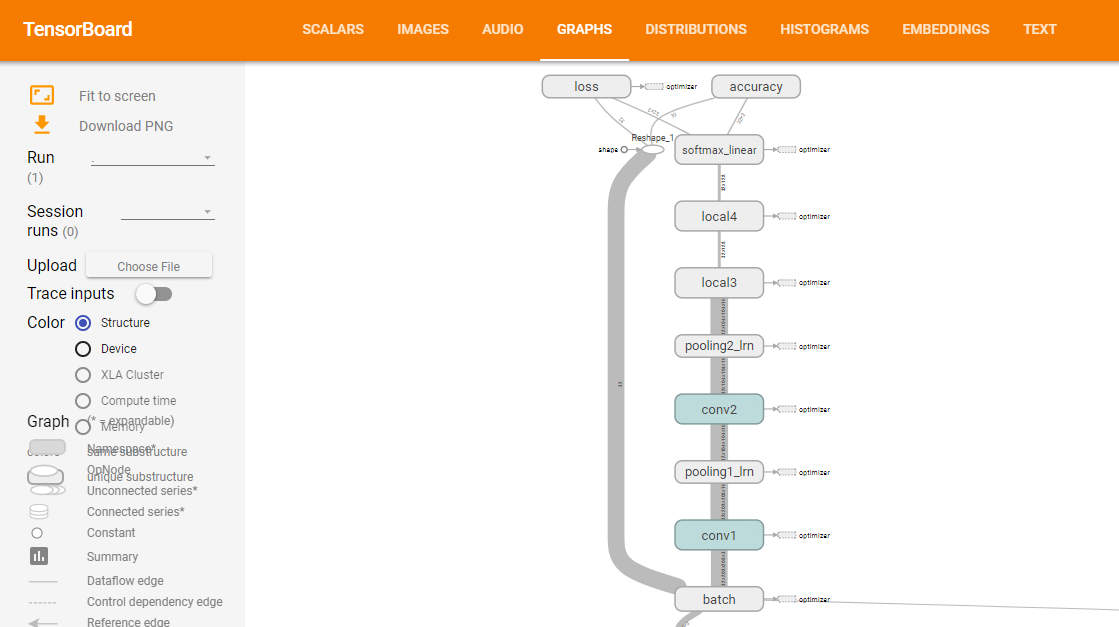
(上图来源:训练网络时,打开tensorboard即可观察网络结构,在下一节模型训练的时候会讲到)
下面为具体步骤:
Step 0:导入相关库
import tensorflow as tf
Step 1:定义网络结构
def inference(images, batch_size, n_classes):
    '''Build the model
    Args:
        images: image batch, 4D tensor, tf.float32, [batch_size, width, height, channels]
    Returns:
        output tensor with the computed logits, float, [batch_size, n_classes]
    '''
    #conv1, shape = [kernel size, kernel size, channels, kernel numbers]
    #卷积层1
    with tf.variable_scope('conv1') as scope:
        #变量初始化
        weights = tf.get_variable('weights',
                                  shape = [3,3,3, 16],
                                  dtype = tf.float32,
                                  initializer=tf.truncated_normal_initializer(stddev=0.1,dtype=tf.float32))
        biases = tf.get_variable('biases',
                                 shape=[16],
                                 dtype=tf.float32,
                                 initializer=tf.constant_initializer(0.1))
        conv = tf.nn.conv2d(images, weights, strides=[1,1,1,1], padding='SAME')
        pre_activation = tf.nn.bias_add(conv, biases)#加上偏置
        conv1 = tf.nn.relu(pre_activation, name= scope.name)#relu激活函数

    #pool1 and norm1
    with tf.variable_scope('pooling1_lrn') as scope:
        pool1 = tf.nn.max_pool(conv1, ksize=[1,3,3,1],strides=[1,2,2,1],
                               padding='SAME', name='pooling1')
        norm1 = tf.nn.lrn(pool1, depth_radius=4, bias=1.0, alpha=0.001/9.0,
                          beta=0.75,name='norm1')

    #conv2
    with tf.variable_scope('conv2') as scope:
        weights = tf.get_variable('weights',
                                  shape=[3,3,16,16],
                                  dtype=tf.float32,
                                  initializer=tf.truncated_normal_initializer(stddev=0.1,dtype=tf.float32))
        biases = tf.get_variable('biases',
                                 shape=[16],
                                 dtype=tf.float32,
                                 initializer=tf.constant_initializer(0.1))
        conv = tf.nn.conv2d(norm1, weights, strides=[1,1,1,1],padding='SAME')
        pre_activation = tf.nn.bias_add(conv, biases)
        conv2 = tf.nn.relu(pre_activation, name='conv2')


    #pool2 and norm2
    with tf.variable_scope('pooling2_lrn') as scope:
        norm2 = tf.nn.lrn(conv2, depth_radius=4, bias=1.0, alpha=0.001/9.0,
                          beta=0.75,name='norm2')
        pool2 = tf.nn.max_pool(norm2, ksize=[1,3,3,1], strides=[1,1,1,1],
                               padding='SAME',name='pooling2')


    #local3 #全连接层1
    with tf.variable_scope('local3') as scope:
        reshape = tf.reshape(pool2, shape=[batch_size, -1])#转换为一维
        dim = reshape.get_shape()[1].value#获取第二维的长度
        weights = tf.get_variable('weights',
                                  shape=[dim,128],
                                  dtype=tf.float32,
                                  initializer=tf.truncated_normal_initializer(stddev=0.005,dtype=tf.float32))
        biases = tf.get_variable('biases',
                                 shape=[128],
                                 dtype=tf.float32,
                                 initializer=tf.constant_initializer(0.1))
        local3 = tf.nn.relu(tf.matmul(reshape, weights) + biases, name=scope.name)

    #local4
    with tf.variable_scope('local4') as scope:
        weights = tf.get_variable('weights',
                                  shape=[128,128],
                                  dtype=tf.float32,
                                  initializer=tf.truncated_normal_initializer(stddev=0.005,dtype=tf.float32))
        biases = tf.get_variable('biases',
                                 shape=[128],
                                 dtype=tf.float32,
                                 initializer=tf.constant_initializer(0.1))
        local4 = tf.nn.relu(tf.matmul(local3, weights) + biases, name='local4')


    # softmax
    with tf.variable_scope('softmax_linear') as scope:
        weights = tf.get_variable('softmax_linear',
                                  shape=[128, n_classes],
                                  dtype=tf.float32,
                                  initializer=tf.truncated_normal_initializer(stddev=0.005,dtype=tf.float32))
        biases = tf.get_variable('biases',
                                 shape=[n_classes],
                                 dtype=tf.float32,
                                 initializer=tf.constant_initializer(0.1))
        softmax_linear = tf.add(tf.matmul(local4, weights), biases, name='softmax_linear')

    return softmax_linear
函数介绍:
1)tf.variable_scope
通过 tf.get_variable()为变量名指定命名空间。
2)tf.get_variable
通过所给的名字,创建或者返回一个变量。
以上两个函数详情参考:共享变量:http://wiki.jikexueyuan.com/project/tensorflow-zh/how_tos/variable_scope.html
3)tf.nn.conv2d
conv2d(
input,
filter,
strides,
padding,
use_cudnn_on_gpu=True,
data_format='NHWC',
name=None
)
作用:对给定的4-D输入和卷积核(filter)做2-D的卷积。
输入的张量(tensor)大小为[batch, in_height, in_width, in_channels],卷积核(filter/kernel)的大小为[filter_height, filter_width, in_channels, out_channels]。
Strides一般为[1, stride, stride,
1];padding,取值"SAME", "VALID"。
4)tf.nn.bias_add
bias_add(

    value,

    bias,

    data_format=None,

    name=None

)
作用:将bias添加至value。
tf.nn.bias_add 是 tf.add 的一个特例,也即 tf.add 支持的操作比 tf.nn.bias_add 更多。二者均支持 broadcasting(广播机制),也即两个操作数最后一个维度保持一致。除了支持最后一个维度保持一致的两个操作数相加外,tf.add 还支持第二个操作数是一维的情况。
5)tf.nn.relu
relu(

    features,

    name=None

)
作用:是计算激活函数relu,即max(features, 0)。
6)tf.nn.max_pool
max_pool(

    value,

    ksize,

    strides,

    padding,

    data_format='NHWC',

    name=None

)
作用:计算池化区域中元素的最大值
输入参数:
value: 一个四维的Tensor。数据维度是 [batch, height, width, channels]。数据类型是float32,float64,qint8,quint8,qint32。
ksize: 一个长度不小于4的整型数组。每一位上面的值对应于输入数据张量中每一维的窗口对应值。
strides: 一个长度不小于4的整型数组。该参数指定滑动窗口在输入数据张量每一维上面的步长。
padding: 一个字符串,取值为 SAME 或者 VALID 。
name: (可选)为这个操作取一个名字。
7)tf.nn.lrn
作用:局部响应归一化
Step 2:定义损失函数
def losses(logits, labels):
    '''Compute loss from logits and labels
    Args:
        logits: logits tensor, float, [batch_size, n_classes]
        labels: label tensor, tf.int32, [batch_size]

    Returns:
        loss tensor of float type
    '''
    with tf.variable_scope('loss') as scope:#sparse  不需要one hot encoding
        cross_entropy = tf.nn.sparse_softmax_cross_entropy_with_logits
                        (logits=logits, labels=labels, name='xentropy_per_example')
        loss = tf.reduce_mean(cross_entropy, name='loss')
        tf.summary.scalar(scope.name+'/loss', loss)
    return loss
函数介绍:
1) tf.nn.sparse_softmax_cross_entropy_with_logits
sparse_softmax_cross_entropy_with_logits(

    _sentinel=None,

    labels=None,

    logits=None,

    name=None

)
作用:计算logits和labels之间的softmax交叉熵。
第一个参数logits:就是神经网络最后一层的输出,如果有batch的话,它的大小就是[batchsize,num_classes],单样本的话,大小就是num_classes。
第二个参数labels以前也必须是[batch_size, num_classes]否则无法做Cross Entropy(softmax_cross_entropy_with_logits的用法),这个函数改为限制更强的[batch_size],而值必须是从0开始编码的int32或int64,而且值范围是[0, num_class)。
2) tf.reduce_mean
作用:计算输入tensor的均值
3)tf.summary.scalar
scalar(

    name,

    tensor,

    collections=None,

    family=None

)
作用:输出一个包含单个标量值的Summary protocol buffer 。
Step 3:定义训练方法
def trainning(loss, learning_rate):
    '''Training ops, the Op returned by this function is what must be passed to
        'sess.run()' call to cause the model to train.

    Args:
        loss: loss tensor, from losses()

    Returns:
        train_op: The op for trainning
    '''
    with tf.name_scope('optimizer'):
        optimizer = tf.train.AdamOptimizer(learning_rate= learning_rate)
        global_step = tf.Variable(0, name='global_step', trainable=False)
        train_op = optimizer.minimize(loss, global_step= global_step)
    return train_op
函数介绍:
1)tf.train.AdamOptimizer
__init__(

    learning_rate=0.001,

    beta1=0.9,

    beta2=0.999,

    epsilon=1e-08,

    use_locking=False,

    name='Adam'

)
作用:利用Adam algorithm来
2)optimizer.minimize
minimize(

    loss,

    global_step=None,

    var_list=None,

    gate_gradients=GATE_OP,

    aggregation_method=None,

    colocate_gradients_with_ops=False,

    name=None,

    grad_loss=None

)
作用:最小化loss。
global_step: Optional Variable to increment by one after the variables have been updated.
Step4:定义评估方法
def evaluation(logits, labels):
  """Evaluate the quality of the logits at predicting the label.
  Args:
    logits: Logits tensor, float - [batch_size, NUM_CLASSES].
    labels: Labels tensor, int32 - [batch_size], with values in the
      range [0, NUM_CLASSES).
  Returns:
    A scalar int32 tensor with the number of examples (out of batch_size)
    that were predicted correctly.
  """
  with tf.variable_scope('accuracy') as scope:
      correct = tf.nn.in_top_k(logits, labels, 1)
      correct = tf.cast(correct, tf.float16)
      accuracy = tf.reduce_mean(correct)
      tf.summary.scalar(scope.name+'/accuracy', accuracy)
  return accuracy
函数介绍:
1)tf.nn.in_top_k
in_top_k(

    predictions,

    targets,

    k,

    name=None

)
作用:返回targets是否位于前K个predictions中,True或者False。
Predictions:float32类型的Tensor,大小为batch_size x classes
Targets:必须是int32或者int64的Tensor。类id组成的batch_size大小的向量。
说明:
代码来自:https://github.com/kevin28520/My-TensorFlow-tutorials,略有修改
函数作用主要参考tensorflow官网。https://www.tensorflow.org/versions/master/api_docs/