伪随机(preundorandom):通过算法产生的随机数都是伪随机!!
只有通过真实的随机事件产生的随机数才是真随机!!比如,通过机器的硬件噪声产生随机数、通过大气噪声产生随机数
Random生成的随机数都是伪随机数!!!
是由可确定的函数(常用线性同余),通过一个种子(常用时钟),产生的伪随机数。这意味着:如果知道了种子,或者已经产生的随机数,都可能获得接下来随机数序列的信息(可预测性)
Random类拥有两个构造方法,用于实现随机数生成器:
| Random( ) | 构造一个随机数生成器 |
| Random(long seed) | 用种子seed构造一个随机数生成器 |
一、无参构造方法(不设置种子)
虽然表面上看我们未设置种子,但Random构造方法里有一套自己的种子生成机制,源码如下:
 1 /**
 2      * Creates a new random number generator. This constructor sets
 3      * the seed of the random number generator to a value very likely
 4      * to be distinct from any other invocation of this constructor.
 5      */
 6     public Random() {
 7         this(seedUniquifier() ^ System.nanoTime());
 8     }
 9
10     private static long seedUniquifier() {
11         // L'Ecuyer, "Tables of Linear Congruential Generators of
12         // Different Sizes and Good Lattice Structure", 1999
13         for (;;) {
14             long current = seedUniquifier.get();
15             long next = current * 181783497276652981L;
16             if (seedUniquifier.compareAndSet(current, next))
17                 return next;
18         }
19     }
20
21     private static final AtomicLong seedUniquifier
22         = new AtomicLong(8682522807148012L);
生成种子过程:(参考解密随机数生成器(二)——从java源码看线性同余算法)
1、获得一个长整形数作为“初始种子”(系统默认的是8682522807148012L)
2、不断与一个变态的数——181783497276652981L相乘(天知道这些数是不是工程师随便滚键盘滚出来的-.-)得到一个不能预测的值,直到 能把这个不能事先预期的值 赋给Random对象的静态常量seedUniquifier 。因为多线程环境下赋值操作可能失败,就for(;;)来保证一定要赋值成功
3、与系统随机出来的nanotime值作异或运算,得到最终的种子
nanotime算是一个随机性比较强的参数,用于描述代码的执行时间。源码中关于nanotime的描述(部分):
/**
     * Returns the current value of the running Java Virtual Machine's
     * high-resolution time source, in nanoseconds.
     *
     * <p>This method can only be used to measure elapsed time and is
     * not related to any other notion of system or wall-clock time.
二、有参构造方法(设置种子)
语法:Random ran = Random(long seed)
有参构造方法的源码如下:
 1 /**
 2      * Creates a new random number generator using a single {@code long} seed.
 3      * The seed is the initial value of the internal state of the pseudorandom
 4      * number generator which is maintained by method {@link #next}.
 5      *
 6      * <p>The invocation {@code new Random(seed)} is equivalent to:
 7      *  <pre> {@code
 8      * Random rnd = new Random();
 9      * rnd.setSeed(seed);}</pre>
10      *
11      * @param seed the initial seed
12      * @see   #setSeed(long)
13      */
14     public Random(long seed) {
15         if (getClass() == Random.class)
16             this.seed = new AtomicLong(initialScramble(seed));
17         else {
18             // subclass might have overriden setSeed
19             this.seed = new AtomicLong();
20             setSeed(seed);
21         }
22     }
23
24     private static long initialScramble(long seed) {
25         return (seed ^ multiplier) & mask;
26     }
其中的multiplier和mask都是定值:
1  private static final long multiplier = 0x5DEECE66DL;
2
3  private static final long mask = (1L << 48) - 1;
三、代码测试
分别采用有参和无参两种方法,生成[0, 100)内的随机整数,各生成五组,每组十个随机数:
 1 import java.util.Random;
 2
 3 public class RandomTest {
 4     public static void main(String[] args) {
 5         RandomTest rt = new RandomTest();
 6         rt.testRandom();
 7     }
 8
 9     public void testRandom(){
10         System.out.println("Random不设置种子:");
11         for (int i = 0; i < 5; i++) {
12             Random random = new Random();
13             for (int j = 0; j < 10; j++) {
14                 System.out.print(" " + random.nextInt(100) + ", ");
15             }
16             System.out.println("");
17         }
18
19         System.out.println("");
20
21         System.out.println("Random设置种子:");
22         for (int i = 0; i < 5; i++) {
23             Random random = new Random();
24             random.setSeed(100);
25             for (int j = 0; j < 10; j++) {
26                 System.out.print(" " + random.nextInt(100) + ", ");
27             }
28             System.out.println("");
29         }
30     }
31 }
运行结果如下:
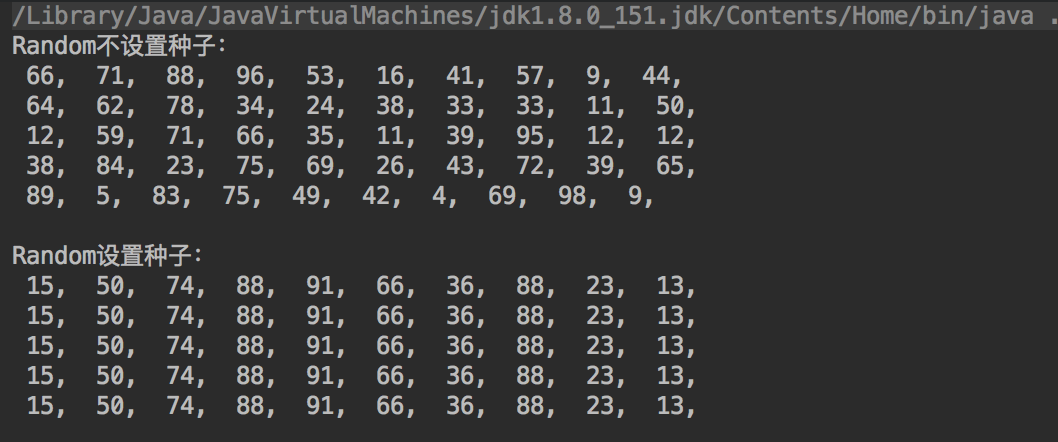
结论:
虽然二者都是伪随机,但是,无参数构造方法(不设置种子)具有更强的随机性,能够满足一般统计上的随机数要求。使用有参的构造方法(设置种子)无论你生成多少次,每次生成的随机序列都相同,名副其实的伪随机!!