1. 什么是Task?
在前面的章节里描述过几个角色,Driver(Client),Master,Worker(Executor),Driver会提交Application到Master进行Worker上的Executor上的调度,显然这些都不是Task.
Spark上的几个关系可以这样理解:
- Application: Application是Driver在构建SparkContent的上下文的时候创建的,就像申报员,现在要构建一个能完成任务的集群,需要申报的是这次需要多少个Executor(可以简单理解为虚拟的机器),每个Executor需要多少CPU,多少内存。
- Job: 这是Driver在调用Action的时候生成的Job,让DAGScheduler线程进行最后的调度,代表着这时候RDD的状态分析完了,需要进行最后的Stage分析了,Job并不是提交给Executor运行的,一个Application存在多个Job
- Task: 一个Job可以分成多个Task, 相当于这些Task分到了一个Group里,这个Group的ID就是Job ID
2. Task的类型
Task的类型和Stage相关,关于Stage,以及Stage之间的相关依赖构成任务的不同提交,就不在这篇描述了
ShuffleMapStage 转化成 ShuffleMapTask
ResultStage 转化成为 ResultTask
当Spark上的action算子,通过DAG进行提交任务的时候,会通过Stage来决定提交什么类型的任务,具体的实现都在DAGScheduler.scala 的submitMissingTasks方法中。
3. 同一个Stage的Task数量
Spark是一个分布式的执行任务的框架,那么同一个Stage的并行任务的拆分就非常的重要,在任务的分解中并不只是stage的步骤的分解,同时也是对同一个Stage中的要分析的数据分解,而对数据的分解直接决定对同一个Stage所提交的任务的数量。对Stage的任务拆解决定着任务的之间的关系,而对同一个Stage的分析数据进行拆解控制着任务的数量。
比如基于拆解的分析数据的而执行的算子象map,这些任务都是独立的,并没有对数据进行最后的归并和整理,这些task是完全可以进行并行计算的,对同一个Stage的task的数量在Spark上是可以控制的。
在这里以ParallelCollectionRDD为简单的例子,先看DAGScheduler.submitMissingTasks的方法
private def submitMissingTasks(stage: Stage, jobId: Int) {
   logDebug("submitMissingTasks(" + stage + ")")
   // Get our pending tasks and remember them in our pendingTasks entry
   stage.pendingPartitions.clear()

   // First figure out the indexes of partition ids to compute.
   val partitionsToCompute: Seq[Int] = stage.findMissingPartitions()
   。。。。。。。。。。。
   val tasks: Seq[Task[_]] = try {
     stage match {
       case stage: ShuffleMapStage =>
         partitionsToCompute.map { id =>
           val locs = taskIdToLocations(id)
           val part = stage.rdd.partitions(id)
           new ShuffleMapTask(stage.id, stage.latestInfo.attemptId,
             taskBinary, part, locs, stage.latestInfo.taskMetrics, properties, Option(jobId),
             Option(sc.applicationId), sc.applicationAttemptId)
         }

       case stage: ResultStage =>
         partitionsToCompute.map { id =>
           val p: Int = stage.partitions(id)
           val part = stage.rdd.partitions(p)
           val locs = taskIdToLocations(id)
           new ResultTask(stage.id, stage.latestInfo.attemptId,
             taskBinary, part, locs, id, properties, stage.latestInfo.taskMetrics,
             Option(jobId), Option(sc.applicationId), sc.applicationAttemptId)
         }
     }
   } catch {
     case NonFatal(e) =>
       abortStage(stage, s"Task creation failed: $e
${Utils.exceptionString(e)}", Some(e))
       runningStages -= stage
       return
   }
生产task的数量是由val partitionsToCompute: Seq[Int] = stage.findMissingPartitions()来决定的,在ShuffleMapStage里
override def findMissingPartitions(): Seq[Int] = {
    val missing = (0 until numPartitions).filter(id => outputLocs(id).isEmpty)
    assert(missing.size == numPartitions - _numAvailableOutputs,
      s"${missing.size} missing, expected ${numPartitions - _numAvailableOutputs}")
    missing
  }
可以看到具体是由numPartitions来决定的,在来看numPartitions
val numPartitions = rdd.partitions.length
由rdd.partitions来决定的,对ShuffleMapStage来说rdd就是最后一个value类型的transformation 的RDD,比如常见的MapPartitionsRDD
在MapPartitionsRDD来说的partitions
override def getPartitions: Array[Partition] = firstParent[T].partitions
是transformation的算子链中的第一个,我们以ParallelCollectionRDD为例子,比如常见的对应的例子:
sparkcontext.parallelize(exampleApacheLogs)
在ParallelCollectionRDD中
override def getPartitions: Array[Partition] = {
    val slices = ParallelCollectionRDD.slice(data, numSlices).toArray
    slices.indices.map(i => new ParallelCollectionPartition(id, i, slices(i))).toArray
  }
在ParallelCollectionRDD中数据的Partitions是由numSlices来决定的
def parallelize[T: ClassTag](
    seq: Seq[T],
    numSlices: Int = defaultParallelism): RDD[T] = withScope {
  assertNotStopped()
  new ParallelCollectionRDD[T](this, seq, numSlices, Map[Int, Seq[String]]())
}
numSlices 是可以在parallelize函数中传入,而默认使用defaultParallelism的参数控制
def defaultParallelism: Int = {
    assertNotStopped()
    taskScheduler.defaultParallelism
  }
override def defaultParallelism(): Int = backend.defaultParallelism()
在CoarseGrainedSchedulerBackend.scala 的类中:
override def defaultParallelism(): Int = {
  conf.getInt("spark.default.parallelism", math.max(totalCoreCount.get(), 2))
}
默认的值是受以下控制:
- 配置文件spark.default.parallelism
- totalCoreCount 的值: CoarseGrainedSchedulerBackend是一个executor管理的backend,里面维护着executor的信息,totalCoreCount就是executor汇报上来的核数,注意因为executor汇报自己是在application分配好后发生的,汇报的信息和获取totalCoreCount的线程是异步的,也就是如果executor没有汇报上来,totalCoreCount.get()的值并不准确(根据Master对executor的分配策略,是无法保证分配多少个executor, 在这里spark更依赖executor主动的向driver汇报),这里的策略是无法保证准确的获取executor的核数。
- 如果没有设置spark.default.parallelism,最小值是2
依赖于rdd.partitions的策略,最后决定task的分配数量。
4. Task的提交和调度分配
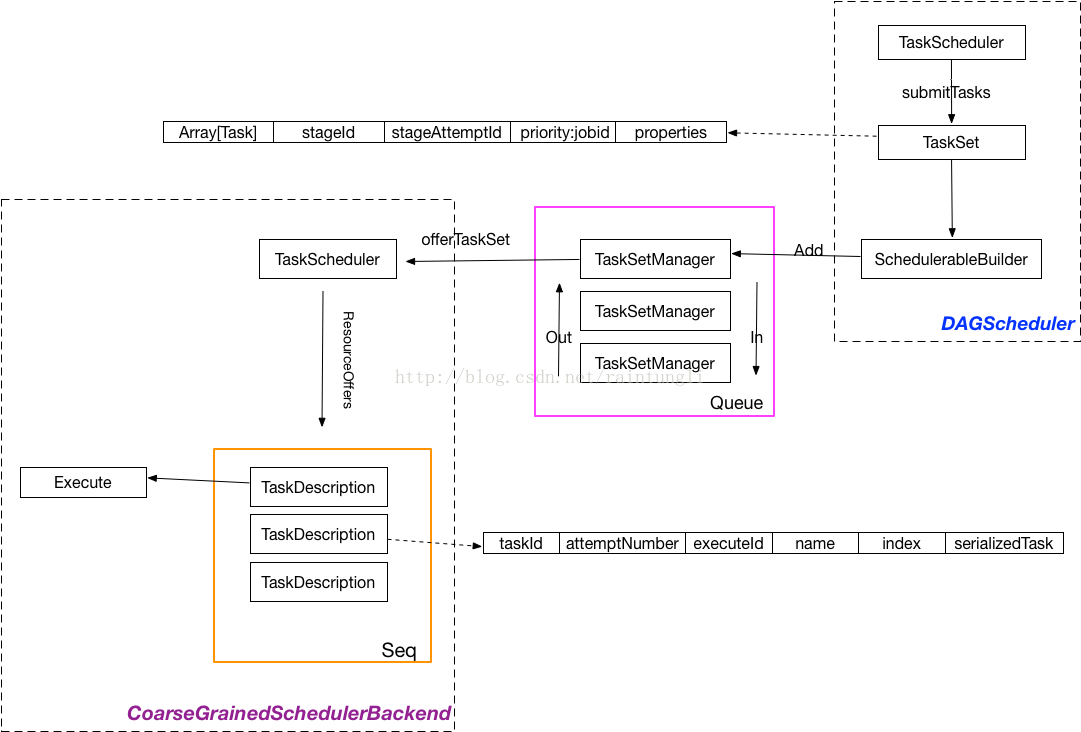
在本篇中主要描述集群下的任务调度
4.1 Task的提交
在DAGScheduler将一个Stage中所分配的Task形成一个TaskSet进行提交,在TaskSet里所保存的是Task的集合,还有Stage的Id,以及JobId,注意在这里JobId是作为一个优先级的参数,作为后序队列调度的参数。
在TaskSchedulerImpl.scala中
override def submitTasks(taskSet: TaskSet) {
  val tasks = taskSet.tasks
  logInfo("Adding task set " + taskSet.id + " with " + tasks.length + " tasks")
  this.synchronized {
    val manager = createTaskSetManager(taskSet, maxTaskFailures)
    val stage = taskSet.stageId
    val stageTaskSets =
      taskSetsByStageIdAndAttempt.getOrElseUpdate(stage, new HashMap[Int, TaskSetManager])
    stageTaskSets(taskSet.stageAttemptId) = manager
    val conflictingTaskSet = stageTaskSets.exists { case (_, ts) =>
      ts.taskSet != taskSet && !ts.isZombie
    }
    if (conflictingTaskSet) {
      throw new IllegalStateException(s"more than one active taskSet for stage $stage:" +
        s" ${stageTaskSets.toSeq.map{_._2.taskSet.id}.mkString(",")}")
    }
    schedulableBuilder.addTaskSetManager(manager, manager.taskSet.properties)

    if (!isLocal && !hasReceivedTask) {
      starvationTimer.scheduleAtFixedRate(new TimerTask() {
        override def run() {
          if (!hasLaunchedTask) {
            logWarning("Initial job has not accepted any resources; " +
              "check your cluster UI to ensure that workers are registered " +
              "and have sufficient resources")
          } else {
            this.cancel()
          }
        }
      }, STARVATION_TIMEOUT_MS, STARVATION_TIMEOUT_MS)
    }
    hasReceivedTask = true
  }
  backend.reviveOffers()
}
将TaskSet 封装成TaskSetManager,通过schedulableBuilder去添加TaskSetManager到队列中,在Spark中,有两种形态
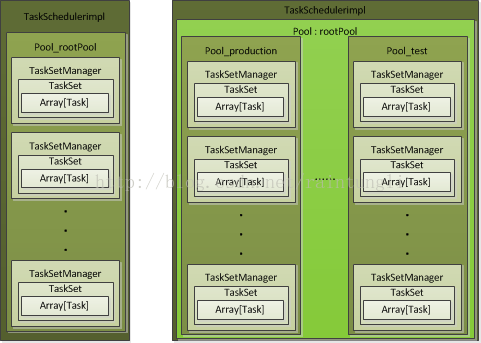
- FIFOSchedulableBuilder: 单一pool
- FairSchedulableBuilder: 多个pool
4.1.1 FairSchedulableBuilder pool池
通过fairscheduler.xml的模版来设置参数来控制pool的调度
<allocations>
  <pool name="production">
    <schedulingMode>FAIR</schedulingMode>
    <weight>1</weight>
    <minShare>2</minShare>
  </pool>
  <pool name="test">
    <schedulingMode>FIFO</schedulingMode>
    <weight>2</weight>
    <minShare>3</minShare>
  </pool>
</allocations>
参数的定义:
- name: 调度池的名称,可根据该参数使用指定pool,EX: sc.setLocalProperty("spark.scheduler.pool", "production1")
- weight: 调度池的权重,调度池根据该参数分配资源。
- minShare: 调度池需要的最小资源数(CPU核数),公平调度器首先会尝试为每个调度池分配最少minShare资源,然后剩余资源才会按照weight大小继续分配
- schedulingMode: 调度池内的调度模式
TaskSchedulerImpl在submitTasks添加TaskSetManager到pool后,调用了backend.reviveOffers();
override def reviveOffers() {
  driverEndpoint.send(ReviveOffers)
}
是向driver的endpoint发送了reviveoffers的消息,Spark中的许多操作都是通过消息来传递的,哪怕DAGScheduler的线程和endpoint的线程都是同一个Driver进程
4.2 Task的分配
Netty 的dispatcher线程接受到revievoffers的消息后,CoarseGrainedSchedulerBackend
case ReviveOffers =>
  makeOffers()
调用了makeoffers函数
private def makeOffers() {
      // Filter out executors under killing
      val activeExecutors = executorDataMap.filterKeys(executorIsAlive)
      val workOffers = activeExecutors.map { case (id, executorData) =>
        new WorkerOffer(id, executorData.executorHost, executorData.freeCores)
      }.toIndexedSeq
      launchTasks(scheduler.resourceOffers(workOffers))
    }
makeOffers里进行了资源的调度,netty中接收所有的信息,同时也在CoarseGrainedSchedulerBackend中维护着executor的状态map:executorDataMap,executor的状态是executor主动汇报的。
通过scheduler.resourceOffers来进行task的资源分配到executor中
def resourceOffers(offers: IndexedSeq[WorkerOffer]): Seq[Seq[TaskDescription]] = synchronized {
   // Mark each slave as alive and remember its hostname
   // Also track if new executor is added
   var newExecAvail = false
   for (o <- offers) {
     if (!hostToExecutors.contains(o.host)) {
       hostToExecutors(o.host) = new HashSet[String]()
     }
     if (!executorIdToRunningTaskIds.contains(o.executorId)) {
       hostToExecutors(o.host) += o.executorId
       executorAdded(o.executorId, o.host)
       executorIdToHost(o.executorId) = o.host
       executorIdToRunningTaskIds(o.executorId) = HashSet[Long]()
       newExecAvail = true
     }
     for (rack <- getRackForHost(o.host)) {
       hostsByRack.getOrElseUpdate(rack, new HashSet[String]()) += o.host
     }
   }

   // Randomly shuffle offers to avoid always placing tasks on the same set of workers.
   val shuffledOffers = Random.shuffle(offers)
   // Build a list of tasks to assign to each worker.
   val tasks = shuffledOffers.map(o => new ArrayBuffer[TaskDescription](o.cores))
   val availableCpus = shuffledOffers.map(o => o.cores).toArray
   val sortedTaskSets = rootPool.getSortedTaskSetQueue
   for (taskSet <- sortedTaskSets) {
     logDebug("parentName: %s, name: %s, runningTasks: %s".format(
       taskSet.parent.name, taskSet.name, taskSet.runningTasks))
     if (newExecAvail) {
       taskSet.executorAdded()
     }
   }

   // Take each TaskSet in our scheduling order, and then offer it each node in increasing order
   // of locality levels so that it gets a chance to launch local tasks on all of them.
   // NOTE: the preferredLocality order: PROCESS_LOCAL, NODE_LOCAL, NO_PREF, RACK_LOCAL, ANY
   for (taskSet <- sortedTaskSets) {
     var launchedAnyTask = false
     var launchedTaskAtCurrentMaxLocality = false
     for (currentMaxLocality <- taskSet.myLocalityLevels) {
       do {
         launchedTaskAtCurrentMaxLocality = resourceOfferSingleTaskSet(
           taskSet, currentMaxLocality, shuffledOffers, availableCpus, tasks)
         launchedAnyTask |= launchedTaskAtCurrentMaxLocality
       } while (launchedTaskAtCurrentMaxLocality)
     }
     if (!launchedAnyTask) {
       taskSet.abortIfCompletelyBlacklisted(hostToExecutors)
     }
   }

   if (tasks.size > 0) {
     hasLaunchedTask = true
   }
   return tasks
 }
- 随机化了有效的executor的列表,为了均匀的分配
- 获取池里(前面已经提过有两种池)的排好序的taskSetManager的队列
- 对taskSetManager里面的task集合进行调度分配
4.2.1 taskSetManager队列的排序
这里的排序是对单个Pool里的taskSetManager进行排序,Spark有两种排序算法
var taskSetSchedulingAlgorithm: SchedulingAlgorithm = {
  schedulingMode match {
    case SchedulingMode.FAIR =>
      new FairSchedulingAlgorithm()
    case SchedulingMode.FIFO =>
      new FIFOSchedulingAlgorithm()
    case _ =>
      val msg = "Unsupported scheduling mode: $schedulingMode. Use FAIR or FIFO instead."
      throw new IllegalArgumentException(msg)
  }
}
在这里就简单介绍FIFOSchedulingAlgorithm的算法
private[spark] class FIFOSchedulingAlgorithm extends SchedulingAlgorithm {
  override def comparator(s1: Schedulable, s2: Schedulable): Boolean = {
    val priority1 = s1.priority
    val priority2 = s2.priority
    var res = math.signum(priority1 - priority2)
    if (res == 0) {
      val stageId1 = s1.stageId
      val stageId2 = s2.stageId
      res = math.signum(stageId1 - stageId2)
    }
    res < 0
  }
}
这里的priority 就是前面说到的JobID, 也就是JobID越小的排序在前面,在相通JobId下的StageId越小的排序在前面
4.2.2 单个TaskSetManager的task调度
private def resourceOfferSingleTaskSet(
      taskSet: TaskSetManager,
      maxLocality: TaskLocality,
      shuffledOffers: Seq[WorkerOffer],
      availableCpus: Array[Int],
      tasks: IndexedSeq[ArrayBuffer[TaskDescription]]) : Boolean = {
    var launchedTask = false
    for (i <- 0 until shuffledOffers.size) {
      val execId = shuffledOffers(i).executorId
      val host = shuffledOffers(i).host
      if (availableCpus(i) >= CPUS_PER_TASK) {
        try {
          for (task <- taskSet.resourceOffer(execId, host, maxLocality)) {
            tasks(i) += task
            val tid = task.taskId
            taskIdToTaskSetManager(tid) = taskSet
            taskIdToExecutorId(tid) = execId
            executorIdToRunningTaskIds(execId).add(tid)
            availableCpus(i) -= CPUS_PER_TASK
            assert(availableCpus(i) >= 0)
            launchedTask = true
          }
        } catch {
          case e: TaskNotSerializableException =>
            logError(s"Resource offer failed, task set ${taskSet.name} was not serializable")
            // Do not offer resources for this task, but don't throw an error to allow other
            // task sets to be submitted.
            return launchedTask
        }
      }
    }
    return launchedTask
  }
在这里,我们看到了一个参数CPUS_PER_TASK
val CPUS_PER_TASK = conf.getInt("spark.task.cpus", 1)
在spark里,我们可以设置task所使用的cpu的数量,默认是1个,一个task任务在executor中是启动一个线程来执行的
通过计算每个executor的剩余资源,决定是否需要从tasksetmanager里分配出task.
def resourceOffer(
    execId: String,
    host: String,
    maxLocality: TaskLocality.TaskLocality)
  : Option[TaskDescription] =
{
    .....

    dequeueTask(execId, host, allowedLocality).map { case ((index, taskLocality, speculative)) =>
      ......
      new TaskDescription(taskId = taskId, attemptNumber = attemptNum, execId,
        taskName, index, serializedTask)
    }
  } else {
    None
  }
}
核心函数dequeueTask
private def dequeueTask(execId: String, host: String, maxLocality: TaskLocality.Value)
  : Option[(Int, TaskLocality.Value, Boolean)] =
{
  for (index <- dequeueTaskFromList(execId, host, getPendingTasksForExecutor(execId))) {
    return Some((index, TaskLocality.PROCESS_LOCAL, false))
  }

  if (TaskLocality.isAllowed(maxLocality, TaskLocality.NODE_LOCAL)) {
    for (index <- dequeueTaskFromList(execId, host, getPendingTasksForHost(host))) {
      return Some((index, TaskLocality.NODE_LOCAL, false))
    }
  }

  if (TaskLocality.isAllowed(maxLocality, TaskLocality.NO_PREF)) {
    // Look for noPref tasks after NODE_LOCAL for minimize cross-rack traffic
    for (index <- dequeueTaskFromList(execId, host, pendingTasksWithNoPrefs)) {
      return Some((index, TaskLocality.PROCESS_LOCAL, false))
    }
  }

  if (TaskLocality.isAllowed(maxLocality, TaskLocality.RACK_LOCAL)) {
    for {
      rack <- sched.getRackForHost(host)
      index <- dequeueTaskFromList(execId, host, getPendingTasksForRack(rack))
    } {
      return Some((index, TaskLocality.RACK_LOCAL, false))
    }
  }

  if (TaskLocality.isAllowed(maxLocality, TaskLocality.ANY)) {
    for (index <- dequeueTaskFromList(execId, host, allPendingTasks)) {
      return Some((index, TaskLocality.ANY, false))
    }
  }

  // find a speculative task if all others tasks have been scheduled
  dequeueSpeculativeTask(execId, host, maxLocality).map {
    case (taskIndex, allowedLocality) => (taskIndex, allowedLocality, true)}
}
在Spark中为了尽量分配任务到task所需的资源的本地,依据task里的preferredLocations所保存的需要资源的位置进行分配
- 尽量分配到task到task所需资源相同的executor里执行,比如ExecutorCacheTaskLocation,HDFSCacheTaskLocation
- 尽量分配到task里task所需资源相通的host里执行
- task的数组从最后向前开始分配
分配完生成TaskDescription,里面记录着taskId, execId, task在数组的位置,和task的整个序列化的内容
4.2.3 Launch Tasks
private def launchTasks(tasks: Seq[Seq[TaskDescription]]) {
      for (task <- tasks.flatten) {
        val serializedTask = ser.serialize(task)
        if (serializedTask.limit >= maxRpcMessageSize) {
          scheduler.taskIdToTaskSetManager.get(task.taskId).foreach { taskSetMgr =>
            try {
              var msg = "Serialized task %s:%d was %d bytes, which exceeds max allowed: " +
                "spark.rpc.message.maxSize (%d bytes). Consider increasing " +
                "spark.rpc.message.maxSize or using broadcast variables for large values."
              msg = msg.format(task.taskId, task.index, serializedTask.limit, maxRpcMessageSize)
              taskSetMgr.abort(msg)
            } catch {
              case e: Exception => logError("Exception in error callback", e)
            }
          }
        }
        else {
          val executorData = executorDataMap(task.executorId)
          executorData.freeCores -= scheduler.CPUS_PER_TASK

          logDebug(s"Launching task ${task.taskId} on executor id: ${task.executorId} hostname: " +
            s"${executorData.executorHost}.")

          executorData.executorEndpoint.send(LaunchTask(new SerializableBuffer(serializedTask)))
        }
      }
    }
/** Returns the configured max message size for messages in bytes. */
  def maxMessageSizeBytes(conf: SparkConf): Int = {
    val maxSizeInMB = conf.getInt("spark.rpc.message.maxSize", 128)
    if (maxSizeInMB > MAX_MESSAGE_SIZE_IN_MB) {
      throw new IllegalArgumentException(
        s"spark.rpc.message.maxSize should not be greater than $MAX_MESSAGE_SIZE_IN_MB MB")
    }
    maxSizeInMB * 1024 * 1024
  }
可以看到最大的消息大小是128M,可以通过spark.rpc.message.maxSize进行配置