一、前言
前面学习了Scala的Class,下面接着学习Method(方法)。
二、Method
Scala的方法与Java的方法类似,都是添加至类中的行为,但是在具体的实现细节上差异很大,下面展示一个参数为整形,返回值为String的方法定义
// java
public String doSomething(int x) {
    // code here
}

// scala
def doSomething(x: Int): String = {
    // code here
}
Scala中的方法可以写的更为简洁,如下
def plusOne(i: Int) = i + 1
将参数值加1后返回,不用显示定义返回值类型,除了已经给出的差别,还有其他差别如下
· 指定方法访问控制(可见性)
· 为方法参数设置默认值的能力
· 调用方法时指定方法参数名称的能力
· 声明方法抛出的异常
· 在方法中使用var类型的字段
2.1 控制方法的范围
1. 问题描述
Scala的方法默认为public的,你需要像Java一样控制方法的范围
2. 解决方案
Scala提供了如下范围控制选项
· 对象私有范围的
· 私有的
· 受保护的
· 包级别的
· 指定包级别的
· 公有的
最严格的访问就是将方法定义为对象私有的,其只能在当前对象上被调用,其他同类型对象无法访问,在方法前面添加private[this]即可
private[this] def isFoo = true
在如下示例中,doFoo的参数为Foo实例,但是isFoo被定义为对象私有方法,如下代码编译不成功

这是因为other无法访问isFoo方法,该方法被定义为只有this(当前对象)可以访问
可以将方法定义为private,这样当前对象可以访问,并且同类型的其他对象也可以访问

当定义为private时,子类无法访问,如下示例编译不会通过

将heartBeat定义为protected之后则可通过编译

Scala中的protected含义与Java不太相同,其在同一个包的其他类无法访问该protected方法,如下示例
package world {
    class Animal {
        protected def breathe {}
    }

    class Jungle {
        val a = new Animal
        a.breathe // error: this line won't compile
    }
}
编译时报错如下

表示Jungle类无法访问同包下的Animal类的方法
为了是方法对于同包下的其他类可见,可以使用private[packageName]来修饰方法
package model {
    class Foo {
        private[model] def doX {}
        private def doY {}
    }

    class Bar {
        val f = new Foo
        f.doX // compiles
        f.doY // won't compile
    }
}
运行结果如下

除了让方法在同包下可见,Scala还可以让包在类继承结构中的不同层级下可见
package com.hust.grid.model {
    class Foo {
        private[model] def doX {}
        private[grid] def doY {}
        private[hust] def doZ {}
    }
}


import com.hust.grid.model._
package com.hust.grid.view {
    class Bar {
        val f = new Foo
        f.doX // won't compile
        f.doY
        f.doZ
    }
}

package com.hust.common {
    class Bar {
        val f = new Foo
        f.doX // won't compile
        f.doY // won't compile
        f.doZ
    }
}
其中doX在model包下其他类中可见,doY在grid包下其他类中可见,doZ在hust包下其他类中可见
如果方法没有修饰符,其就是public的,下面示例中任何类都可以调用doX方法
package com.hust.grid.model {
    class Foo {
        def doX {}
    }
}

package org.xyz.bar {
    class Bar {
        val f = new com.hust.grid.model.Foo
        f.doX
    }
}
3. 讨论
Scala中的访问控制符比Java的要稍微复杂点,需要不断体会和使用
2.2 调用超类的方法
1. 问题描述
为了保持代码的简洁性,你需要调用父类定义的方法
2. 解决方案
在基础使用上,Scala与Java一样,使用super指代超类,然后使用方法名指代具体方法
class WelcomeActivity extends Activity {
    override def onCreate(bundle: Bundle) {
        super.onCreate(bundle)
        // more code here ...
    }
}
如果类继承了多个traits,并且这些traits实现了相同的方法,这时你不仅可以选择方法,并且还可以选择哪个traits
trait Human {
    def hello = "the Human trait"
}

trait Mother extends Human {
    override def hello = "Mother"
}

trait Father extends Human {
    override def hello = "Father"
}
你可以使用如下不同的方法调用hello方法
class Child extends Human with Mother with Father {
    def printSuper = super.hello
    def printMother = super[Mother].hello
    def printFather = super[Father].hello
    def printHuman = super[Human].hello
}
可以进行如下测试
object Test extends App {
    val c = new Child
    println(s"c.printSuper = ${c.printSuper}")
    println(s"c.printMother = ${c.printMother}")
    println(s"c.printFather = ${c.printFather}")
    println(s"c.printHuman = ${c.printHuman}")
}
运行结果如下
c.printSuper = Father
c.printMother = Mother
c.printFather = Father
c.printHuman = the Human trait
当类继承多traits并且有多个相同方法时,可以使用super[traitName].methodName 来调用不同父类中的相同方法
值得注意的是,其无法使用到父类的继承结构(如父类的父类),其只能调用其直接继承的父类的方法,如下例所示,super[Animal].walk编译报错
trait Animal {
    def walk { println("Animal is walking") }
}

class FourLeggedAnimal extends Animal {
    override def walk { println("I'm walking on all fours") }
}

class Dog extends FourLeggedAnimal {
    def walkThenRun {
        super.walk // works
        super[FourLeggedAnimal].walk // works
        super[Animal].walk // error: won't compile
    }
}
由于Dog并为直接继承Animal,因此不能使用super[Animal].walk来调用Animal的方法
2.3 设置方法参数的默认值
1. 问题描述
你想要定义方法参数值的默认值,以便在调用方法时不用显示定义该方法参数
2. 解决方案
在方法签名中指定默认值,如下所示
class Connection {
    def makeConnection(timeout: Int = 5000, protocol: = "http") {
        println("timeout = %d, protocol = %s".format(timeout, protocol))
        // more code here
    }
}
timeout的默认值为5000,protocal的默认值为"http",可以通过如下方法调用该方法
c.makeConnection()
c.makeConnection(2000)
c.makeConnection(3000, "https")
如果你喜欢指定参数名时,可以使用如下方式
c.makeConnection(timeout=10000)
c.makeConnection(protocol="https")
c.makeConnection(timeout=10000, protocol="https")
3. 讨论
如同构造函数参数一样,你可以为方法参数设置默认值,方法中参数的赋值从左到右,使用如下方法可以使用timeout和protocal的默认值
c.makeConnection()
可以设置timeout值为2000,而protocal使用默认值
c.makeConnection(2000)
可以设置同时设置timeout和protocal的值
c.makeConnection(2000, "https")
但是通过上述方法无法单独设置protocal的值,可以这样单独设置protocal的值,而timeout默认为5000
c.makeConnection(protocol="https")
当你的方法中既有默认值也有非默认值,你需要将由默认值的参数放在最后

可以上述调用都会报错,重新调整参数位置即可

2.4 调用方法时使用参数名
1. 问题描述
当调用方法时,你更喜欢使用参数名
2. 解决方案
常用的指定参数来调用方法格式如下
methodName(param1=value1, param2=value2, ...)
有如下类
class Pizza {
    var crustSize = 12
    var crustType = "Thin"
    def update(crustSize: Int, crustType: String) {
        this.crustSize = crustSize
        this.crustType = crustType
    }

    override def toString = {
        "A %d inch %s crust pizza.".format(crustSize, crustType)
    }
}
可以使用如下方法调用
p.update(crustSize = 16, crustType = "Thick")
p.update(crustType = "Pan", crustSize = 14)
3. 讨论
使用参数名调用方法显得冗长,但是具有更好的可读性,当参数类型相同时,其显得尤为有用,可比较如下两种调用
engage(true, true, true, false)
engage(speedIsSet = true,
        directionIsSet = true,
        picardSaidMakeItSo = true,
        turnedOffParkingBrake = false)
显然第二种具有更好的可读性
2.5 定义返回多项(元组)的方法
1. 问题描述
你想要从一个方法中返回多个值,但是你不想将这些值封装在类中
2. 解决方案
Scala可以使用tuple,让你从方法中返回多个值,如下返回三元组
def getStockInfo = {
    // other code here ...
    ("NFLX", 100.00, 101.00) // this is a Tuple3
}
然后调用该方法并将返回值赋值给变量
val (symbol, currentPrice, bidPrice) = getStockInfo
3. 讨论
在Java中也可以从方法中返回多个值,但是其是将多个值封装在类中而并非使用tuple
getStockInfo方法返回的是三元组tuple3,tuple最多可以容纳22个变量,即22元组tuple22,如下定义的是二元组

当然也可以直接使用一个val变量来存储方法返回值,然后通过._1、._2符号来访问对应的值

2.6 强制调用者不使用括号调用方法
1. 问题描述
你想强调如下编程风格,在调用访问方法时不使用括号
2. 解决方案
在定义访问方法名后不使用括号,如下例所示
class Pizza {
    // no parentheses after crustSize
    def crustSize = 12
}
此时,调用者调用方法时不能使用括号,否则会报错
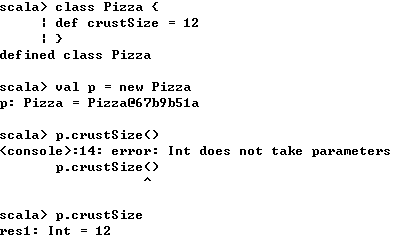
3. 讨论
在调用访问方法时不适用括号并没有任何副作用,并且可以强制调用者不适用括号进行调用
2.7 创建接受可变参数的方法
1. 问题描述
为了使方法更为灵活,你想要定义一个接受可变参数的方法
2. 解决方案
在参数字段类型后面添加*即可表示方法接受可变个参数
def printAll(strings: String*) {
    strings.foreach(println)
}
针对以上方法,可以有如下调用
printAll()
printAll("foo")
printAll("foo", "bar")
printAll("foo", "bar", "baz")
可以使用_*操作符来适应序列(Array、List、Seq、Vector等),所以其也可被用作实参调用方法
// a sequence of strings
val fruits = List("apple", "banana", "cherry")
// pass the sequence to the varargs field
printAll(fruits: _*)
3. 讨论
当定义一个包含可变参数的方法时,其必须要放在方法签名的最后,在可变参数后面定义一个参数是非法的

并且一个方法中只能有一个可变参数,当一个参数为可变参数,调用时你不需要提供任何参数,如下

当定义一个接受可变个整形的参数的方法时,当使用(a)参数调用(b)无参数调用,其结果不相同

当使用一个或多个参数调用时,其是第一个种情况,当不使用参数调用时,其是第二种情况,是空列表,这样可以防止抛出异常
2.8 定义可抛出异常的方法
1. 问题描述
你想要定义一个可以抛出异常的方法,这样可以警告调用者,或者是你的代码将会被Java代码调用
2. 解决方案
使用@throws注释来声明可能抛出的异常,将注释放在方法之前
@throws(classOf[Exception])
override def play {
    // exception throwing code here ...
}
当一个方法可能抛出多个异常时,将其一一列出
@throws(classOf[IOException])
@throws(classOf[LineUnavailableException])
@throws(classOf[UnsupportedAudioFileException])
def playSoundFileWithJavaAudio {
    // exception throwing code here ...
}
3. 讨论
Scala使用注释声明异常与Java的以下处理方式相同
public void play() throws FooException {
    // code here ...
}
Scala的受检查异常与Java的不相同,Scala不需要方法声明会抛出的异常,并且不需要调用者捕捉异常

即便Scala不需要异常时受检查的,如果不进行测试,也会出现Java中的结果,在下面的代码中,第二个println永远不会被调用
object BoomTest extends App {
    def boom { throw new Exception }

    println("Before boom")

    boom

    // this line is never reached
    println("After boom")
}
2.9 支持流式编程风格
1. 问题描述
你想要创建一个调用可以使用流式风格编程的API,其也被称为方法链
2. 解决方案
流式编程风格可以让你的方法调用聚合在一起,如下所示
person.setFirstName("LEE")
.setLastName("SF")
.setAge(25)
.setCity("WH")
.setState("HB")
为了支持这种风格,做法如下
· 如果类可以被继承,可将方法的返回类型定义为this.type
· 如果类不能被继承,可将方法的返回类型定义为this
下面示例展示了this.type作为set*方法的返回类型
class Person {
    protected var fname = ""
    protected var lname = ""
    def setFirstName(firstName: String): this.type = {
        fname = firstName
        this
    }

    def setLastName(lastName: String): this.type = {
        lname = lastName
        this
    }
}

class Employee extends Person {
    protected var role = ""

    def setRole(role: String): this.type = {
        this.role = role
        this
    }

    override def toString = {
        "%s, %s, %s".format(fname, lname, role)
    }
}
使用如下
object Main extends App {
    val employee = new Employee
    // use the fluent methods
    employee.setFirstName("Al")
    .setLastName("Alexander")
    .setRole("Developer")
    println(employee)
}
3. 讨论
如果确定类不会被继承,则将返回类型定义为this.type毫无意义,可以直接返回this即可,如下例所示
final class Pizza {
    import scala.collection.mutable.ArrayBuffer

    private val toppings = ArrayBuffer[String]()
    private var crustSize = 0
    private var crustType = ""

    def addTopping(topping: String) = {
        toppings += topping
        this
    }

    def setCrustSize(crustSize: Int) = {
        this.crustSize = crustSize
        this
    }

    def setCrustType(crustType: String) = {
        this.crustType = crustType
        this
    }

    def print() {
        println(s"crust size: $crustSize")
        println(s"crust type: $crustType")
        println(s"toppings: $toppings")
    }
}
使用如下
object FluentPizzaTest extends App {
    val p = new Pizza
    p.setCrustSize(14)
    .setCrustType("thin")
    .addTopping("cheese")
    .addTopping("green olives")
    .print()
}
当类能够被继承时,则需要将返回类型定义为this.type,这使得流式风格在子类中也可以使用
三、总结
本篇主要讲解了Scala中方法的一些使用技巧,谢谢各位园友的观看~