1 #include <stdio.h>
  2 #include <stdlib.h>
  3
  4 #define OK 1
  5 #define ERR 2
  6 #define TRUE 1
  7 #define FALSE 0
  8 #define MAXSIZE 4 //定义队列的最大长度
  9
 10 typedef int status; //定义函数返回的状态,OK & ERR
 11 typedef char datatype; //定义队列中每个元素的数据类型,这里暂定为字符型
 12
 13 typedef struct {
 14     datatype data[MAXSIZE]; //存储着队列中的每个元素
 15     int front, rear; //头指针和尾指针
 16     /*
 17     假设用于模拟队列的数组长度为8,规定入队和出队方向都向左(即下标0的元素始终用于出队),有一个指针end永远标识队尾元素的下标,当end=0时表示队列只有一个元素,当end=-1时标识队列为空,类似于栈的top指针,
 18     现在入队3个元素,数组如下,
 19     A B C _ _ _ _ _ 指针end=2
 20     出队1个元素,即下标是0的元素出队,也就是A,
 21     _ B C _ _ _ _ _ 指针end=2
 22     这时下标0的元素为空,需要将后面的元素都前移,然后将指针end-1,如果队列很长,这个操作会带来很大开销,所以我们不应该用栈的固定思维去思考队列,也就是说队头不一定要在下标为0的位置,
 23     这样一来我们定义一个指针front用来表示队头所在元素的下标,再定义一个指针rear用来表示队尾所在元素的下一个元素的下标,当front=rear时表示队列为空,这就是队列的初始状态,
 24     现在我们用上述队列的存储结构来创建一个新队列,
 25     _ _ _ _ _ _ _ _ 指针front=0 指针rear=0
 26     入队3个元素,
 27     A B C _ _ _ _ _ 指针front=0 指针rear=3
 28     出队1个元素,
 29     _ B C _ _ _ _ _ 指针front=1 指针rear=3
 30     再入队3个元素,
 31     _ B C D E F _ _ 指针front=1 指针rear=6
 32     再出队3个元素,
 33     _ _ _ _ E F _ _ 指针front=4 指针rear=6
 34     可见新定义的队列的存储结构不需要大量前移元素了(因为队头元素由指针front唯一确定),这样,入队只需要rear+1,出队只需要front+1,
 35     但是又出现了个很严重的问题:当继续入队2个(G和H)元素,H元素便成为数组的最后一个元素,此时rear=8,而下标为8的位置是越界的,而数组最前面的下标(0~3,共4个)却空着,就造成了浪费,这种现象叫做假溢出,
 36     要解决上述问题,可将队列的头和尾相连,使之成为循环队列,
 37     当数组的最后一个元素也被使用了,此时可将rear等于0而不是8,
 38     _ _ _ _ E F G H 指针front=4 指针rear=0
 39     这时,再入队3个元素,数组如下,
 40     I J K _ E F G H 指针front=4 指针rear=3
 41     我们将循环队列的这种情况称为队列已满(rear和front之间空一个元素),不然再入队一个元素(L),那么rear=4,和front相等了,这时是空队列呢还是满队列呢?
 42     循环队列已满的条件:(rear+1)%QueueSize == front
 43     循环队列长度公式:(rear-front+QueueSize)%QueueSize
 44     入队(rear后移一位):rear=(rear+1)%QueueSize
 45     出队(front后移一位):front=(front+1)%QueueSize
 46     其中QueueSize是队列的最大长度(数组的长度),比如上面演示的队列的QueueSize就是8
 47     循环队列长度公式的由来,(以下讨论的数都是整数)
 48     当rear>front时,队列的长度:rear-front,其中rear-front必然是正数
 49     当rear<front时,队列的长度由两部分组成,
 50         第一部分是(空元素的后面):QueueSize-front
 51         第二部分是(空元素的前面):0+rear
 52         综上,队列的长度:rear-front+QueueSize,其中rear-front必然是负数
 53     如果rear-front+QueueSize这个公式用于rear>front的队列,那么得到的队列长度就大于数组的最大长度(QueueSize),
 54     那到底大了多少呢,其实就是大了QueueSize,但我们又不能减去QueueSize,这样就不能计算rear<front的队列长度,
 55     正确解决方法是对rear-front+QueueSize取余,模数是QueueSize,即(rear-front+QueueSize)%QueueSize,
 56     这样,
 57     对于rear>front,虽然先加上了QueueSize,但最后的结果模上了QueueSize,相当于抵消了之前加的QueueSize
 58     对于rear<front,由于rear-front必然是负数,但这个负数是大于-QueueSize的(这个负数的最小值是-QueueSize+1),所以rear-front+QueueSize的范围是[1,QueueSize-1],对这个区间里的任何一个数模上QueueSize还是这个数本身
 59     其实对rear-front+QueueSize模上QueueSize是为了兼容rear>front的队列
 60
 61     */
 62 } SequenceQueue;
 63
 64 /* 函数原型,队列的基本操作,与栈相同 */
 65 SequenceQueue *createSequenceQueue(void);
 66 status isEmpty(SequenceQueue *L);
 67 void clear(SequenceQueue *L);
 68 datatype getTop(SequenceQueue *L);
 69 int getLength(SequenceQueue *L);
 70 status push(SequenceQueue *L, datatype node_to_push);
 71 datatype pop(SequenceQueue *L);
 72 void showQueue(SequenceQueue *L);
 73
 74 int main(){
 75     /* 测试 */
 76     SequenceQueue *root; //指向一个通过createSequenceQueue函数创建的栈
 77     root=createSequenceQueue();
 78     printf("isEmpty = %d
",isEmpty(root));
 79     printf("Length = %d
",getLength(root));
 80     push(root,'1');
 81     push(root,'2');
 82     push(root,'3');
 83     printf("isEmpty = %d
",isEmpty(root));
 84     printf("Length = %d
",getLength(root));
 85     showQueue(root);
 86     putchar('
');
 87     printf("can continue to push? %d
",push(root,'4'));
 88     printf("getTop = %c
",getTop(root));
 89     printf("pop = %c
",pop(root));
 90     printf("pop = %c
",pop(root));
 91     printf("isEmpty = %d
",isEmpty(root));
 92     printf("Length = %d
",getLength(root));
 93     push(root,'5');
 94     showQueue(root);
 95     putchar('
');
 96     clear(root);
 97     printf("isEmpty = %d
",isEmpty(root));
 98     printf("Length = %d
",getLength(root));
 99
100     return 0;
101 }
102
103 SequenceQueue *createSequenceQueue(void){
104     SequenceQueue *tmp;
105     tmp=malloc(sizeof(SequenceQueue)); //void*类型指针能自动转为其他类型的指针
106     tmp->front=tmp->rear=0; //初始化队列的头尾指针
107     return tmp;
108 }
109 status isEmpty(SequenceQueue *L){
110     if (L->front==L->rear) //front=rear表示队列是空的
111         return TRUE;
112     else
113         return FALSE;
114 }
115 void clear(SequenceQueue *L){
116     L->front=L->rear=0;
117 }
118 datatype getTop(SequenceQueue *L){
119     //返回队头元素的值
120     return L->data[L->front];
121 }
122 int getLength(SequenceQueue *L){
123     return (L->rear-L->front+MAXSIZE)%MAXSIZE;
124 }
125 status push(SequenceQueue *L, datatype node_to_push){
126     //node_to_insert表示想要入队的元素
127     if ((L->rear+1)%MAXSIZE == L->front) return ERR; //队列已满
128     L->data[L->rear]=node_to_push; //将新元素入队
129     L->rear=(L->rear+1)%MAXSIZE; //指针rear后移
130     return OK;
131 }
132 datatype pop(SequenceQueue *L){
133     datatype q;
134     if (isEmpty(L)) return ERR; //队列是空
135     q=L->data[L->front]; //将要出队的元素先赋值给临时变量s
136     L->front=(L->front+1)%MAXSIZE; //指针front后移
137     return q; //返回出队的元素的值
138 }
139 void showQueue(SequenceQueue *L){
140     int i;
141     int total=getLength(L);
142     for (i=0; i<total; i++){
143         printf("%c	",L->data[ (L->front+i)%MAXSIZE ]);
144     }
145 }
146 /*
147     队列的定义:只允许在一端进行插入,另一端进行删除的线性表,也是一种操作受限的线性表
148     一般,把允许插入的一端叫做队尾,允许删除的一端叫做队头
149     不含任何元素的队列就是空队
150     所以,队列又称先进先出(First in First out)的线性表
151 */
152 /* 环境: Code::Blocks with GCC 5.1 */
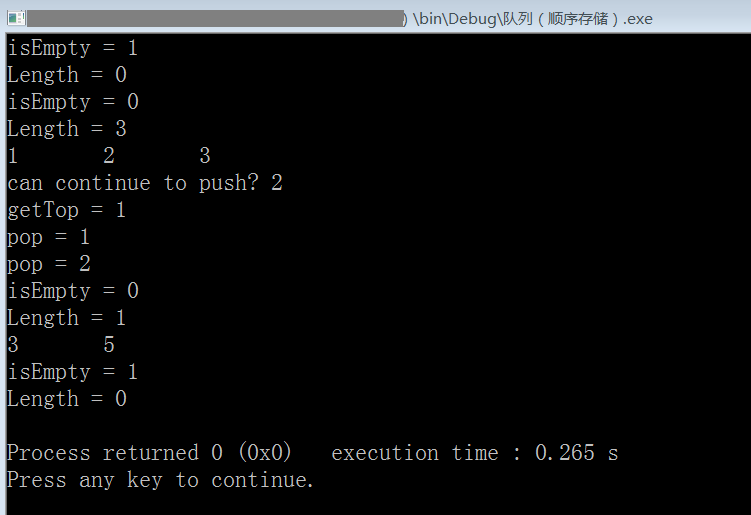
运行截图: