deepwalk、node2vec的高性能优化
转自知乎: https://zhuanlan.zhihu.com/p/348778146
原作者:马东什么
首先是graph的存储问题,看了很多实现node2vec或deepwalk的library,大都是以networkx或是类似的python class对象为graph的存储形式进行开发,首先我们需要知道目前单机版的deepwalk和node2vec的主要的性能瓶颈在random walk部分,因为底层的word2vec基本上都是直接调用的gensim的word2vec(gensim的word2vec基于c++开发,目前新版的gensim的word2vec的fast version使用了cython代替了原来的一些逻辑实现,个人感觉从word2vec层面再去做优化太复杂了,也很难比gensim做的更好,除此之外另一个思路就是用tf.keras或torch来实现word2vec,借用gpu的算力来试图击败gensim,然而看完这几篇,我心灰意冷了:
Word2vec on GPU slower than CPU · Issue #13048 · tensorflow/tensorflow[github.comDoes Gensim library support GPU acceleration?stackoverflow.com
graph通常以相互引用的内存指针的方式存储在内存中,这意味着每个节点在内存中都位于不同的位置,这种基于基于链表的思想,使得内存访问的速度成为了主要的瓶颈,因为每次从一个节点移动到另一个节点,都需要在内存中寻址和查询,一种更好的方式是把节点都打包到数组中,因为数据的内存地址一般是连续的,在内存访问上的开销要小很多;(这里还没有提到networkx本身用纯python编写导致的较低效的编译效率问题,具体可见:
马东什么:为什么python这么慢?numba解决了什么问题?
)
一个较好的解决方案就是使用scipy.sparse.csr_matrix对graph进行存储和后续的访问等,
csr_matrix可见下:
马东什么:scipy sparse 中稀疏矩阵的常见存储方式zhuanlan.zhihu.com
可以看到,通过将graph转化为csr_matrix,利用其巧妙地存储方式,可以大大提高节点和节点之间的访问效率。
下面就来看一个非常nice的小众的graph library,csr_graph和nodevectors,nodevectors基本上是对csr_graph做的封装,底层的逻辑直接使用了csr_graph的接口api,所以直接研究csr_graph即可。
VHRanger/CSRGraphgithub.com
class csrgraph():
    """
    This top level python class either calls external JIT'ed methods
        or methods from the JIT'ed internal graph
    """
    def __init__(self, data, nodenames=None, copy=True, threads=0):
        """
        A class for larger graphs.

        NOTE: this class tends to "steal data" by default.
            If you pass a numpy array/scipy matrix/csr graph
            Chances are this object will point to the same instance of data

        Parameters:
        -------------------

        data : The graph data. Can be one of:
            **NetworkX Graph**
            **Numpy dense matrix**
            **CSR Matrix**
            **(data, indices, indptr)**
            **CSRGraph object**

        nodenames (array of str or int) : Node names
            The position in this array should correspond with the node ID
            So if passing a CSR Matrix or raw data, it should be co-indexed
            with the matrix/raw data arrays

        copy : bool
            Wether to copy passed data to create new object
            Default behavior is to point to underlying ctor passed data
            For networkX graphs and numpy dense matrices we create a new object anyway
        threads : int
            number of threads to leverage for methods in this graph.
            WARNING: changes the numba environment variable to do it.
            Recompiles methods and changes it when changed.
            0 is numba default (usually all threads)

        TODO: add numpy mmap support for very large on-disk graphs
            Should be in a different class
            This also requires routines to read/write edgelists, etc. from disk

        TODO: subclass scipy.csr_matrix???
        """
        # If input is a CSRGraph, same object
        if isinstance(data, csrgraph):
            if copy:
                self.mat = data.mat.copy()
                self.names = deepcopy(data.names)
            else:
                self.mat = data.mat
                self.names = data.names
            if not nodenames:
                nodenames = self.names
            else:
                self.names = nodenames
        # NetworkX Graph input
        elif isinstance(data, (nx.Graph, nx.DiGraph)):
            mat = nx.adj_matrix(data)
            mat.data = mat.data.astype(np.float32)
            self.mat = mat
            nodenames = list(data)
        # CSR Matrix Input
        elif isinstance(data, sparse.csr_matrix):
            if copy: self.mat = data.copy()
            else: self.mat = data
        # Numpy Array Input
        elif isinstance(data, np.ndarray):
            self.mat = sparse.csr_matrix(data)
        else:
            raise ValueError(f"Incorrect input data type: {type(data).__name__}")
        # Now that we have the core csr_matrix, alias underlying arrays
        assert hasattr(self, 'mat')
        self.weights = self.mat.data
        self.src = self.mat.indptr
        self.dst = self.mat.indices
        # indptr has one more element than nnodes
        self.nnodes = self.src.size - 1
        # node name -> node ID
        if nodenames is not None:
            self.names = pd.Series(nodenames)
        else:
            self.names = pd.Series(np.arange(self.nnodes))
        # Bounds check once here otherwise there be dragons later
        max_idx = np.max(self.dst)
        if self.nnodes < max_idx:
            raise ValueError(f"""
                Out of bounds node: {max_idx}, nnodes: {self.nnodes}
            """)
        self.set_threads(threads)


    def set_threads(self, threads):
        self.threads = threads
        # Manage threading through Numba hack
        if type(threads) is not int:
            raise ValueError("Threads argument must be an int!")
        if threads == 0:
            threads = numba.config.NUMBA_DEFAULT_NUM_THREADS
        threads = str(threads)
        # If we change the number of threads, recompile
        try:
            prev_numba_value = os.environ['NUMBA_NUM_THREADS']
        except KeyError:
            prev_numba_value = threads
        if threads != prev_numba_value:
            os.environ['NUMBA_NUM_THREADS'] = threads
            _random_walk.recompile()
            _row_norm.recompile()
            _node2vec_walks.recompile()
            _node_degrees.recompile()
            _src_multiply.recompile()
            _dst_multiply.recompile()

    def __getitem__(self, node):
        """
        [] operator
        like networkX, gets names of neighbor nodes
        """
        # Get node ID from names array
        # This is O(n) by design -- we more often get names from IDs
        #    than we get IDs from names and we don't want to hold 2 maps
        # TODO : replace names with a pd.Index and use get_loc
        node_id = self.names[self.names == node].index[0]
        edges = self.dst[
            self.src[node_id] : self.src[node_id+1]
        ]
        return self.names.iloc[edges].values

    def nodes(self):
        """
        Returns the graph's nodes, in order
        """
        if self.names is not None:
            return self.names
        else:
            return np.arange(self.nnodes)

    def normalize(self, return_self=True):
        """
        Normalizes edge weights per node

        For any node in the Graph, the new edges' weights will sum to 1

        return_self : bool
            whether to change the graph's values and return itself
            this lets us call `G.normalize()` directly
        """
        new_weights = _row_norm(self.weights, self.src)
        if return_self:
            self.mat = sparse.csr_matrix((new_weights, self.dst, self.src))
            # Point objects to the correct places
            self.weights = self.mat.data
            self.src = self.mat.indptr
            self.dst = self.mat.indices
            gc.collect()
            return self
        else:
            return csrgraph(sparse.csr_matrix(
                (new_weights, self.dst, self.src)),
                nodenames=self.names)

    def random_walks(self,
                walklen=10,
                epochs=1,
                start_nodes=None,
                normalize_self=False,
                return_weight=1.,
                neighbor_weight=1.):
        """
        Create random walks from the transition matrix of a graph
            in CSR sparse format

        Parameters
        ----------
        T : scipy.sparse.csr matrix
            Graph transition matrix in CSR sparse format
        walklen : int
            length of the random walks
        epochs : int
            number of times to start a walk from each nodes
        return_weight : float in (0, inf]
            Weight on the probability of returning to node coming from
            Having this higher tends the walks to be
            more like a Breadth-First Search.
            Having this very high  (> 2) makes search very local.
            Equal to the inverse of p in the Node2Vec paper.
        explore_weight : float in (0, inf]
            Weight on the probability of visitng a neighbor node
            to the one we're coming from in the random walk
            Having this higher tends the walks to be
            more like a Depth-First Search.
            Having this very high makes search more outward.
            Having this very low makes search very local.
            Equal to the inverse of q in the Node2Vec paper.
        threads : int
            number of threads to use.  0 is full use

        Returns
        -------
        out : 2d np.array (n_walks, walklen)
            A matrix where each row is a random walk,
            and each entry is the ID of the node
        """
        # Make csr graph
        if normalize_self:
            self.normalize(return_self=True)
            T = self
        else:
            T = self.normalize(return_self=False)
        n_rows = T.nnodes
        if start_nodes is None:
            start_nodes = np.arange(n_rows)
        sampling_nodes = np.tile(start_nodes, epochs)
        # Node2Vec Biased walks if parameters specified
        if (return_weight > 1. or return_weight < 1.
                or neighbor_weight < 1. or neighbor_weight > 1.):
            walks = _node2vec_walks(T.weights, T.src, T.dst,
                                    sampling_nodes=sampling_nodes,
                                    walklen=walklen,
                                    return_weight=return_weight,
                                    neighbor_weight=neighbor_weight)
        # much faster implementation for regular walks
        else:
            walks = _random_walk(T.weights, T.src, T.dst,
                                 sampling_nodes, walklen)
        return walks
初始化init部分的逻辑很简单,就是把graph用scipy.sparse.csr_matrix的方式存储,需要注意的是,csr matrix仅支持有向/无向+有权/无权的简单图的表示,如果是复杂的属性图,例如存在多重的边关系或者是多个节点类型,则表示起来比较困难,不过常见的非GNN的graph embedding(以及排除了matapath2vec)之外大部分的graph embedding算法都是在简单图上运行的。
首先注意一个细节部分就是,我们要对边的权重做标准化norm,
new_weights = _row_norm(self.weights, self.src)
其实现逻辑为:
@jit(nopython=True, parallel=True, nogil=True, fastmath=True)
def _row_norm(weights, src):
    """
    Returns the weights for normalized rows in a CSR Matrix.

    Parameters
    ----------
    weights : array[float]
        The data array from a CSR Matrix.
        For a scipy.csr_matrix, is accessed by M.data

    src : array[int]
        The index pointer array from a CSR Matrix.
        For a scipy.csr_matrix, is accessed by M.indptr

    ----------------
    returns : array[float32]
        The normalized data array for the CSR Matrix
    """
    n_nodes = src.size - 1
    res = np.empty(weights.size, dtype=np.float32)
    for i in numba.prange(n_nodes):
        s1 = src[i]
        s2 = src[i+1]
        rowsum = np.sum(weights[s1:s2])
        res[s1:s2] = weights[s1:s2] / rowsum
    return res
可以看到,这里的逻辑就是把每一个节点的权重进行归一化,即每一个节点的和它连接的边的权重的权重之和为1,这里的实现就是每一行所有非零值初一这一行的非0值的总和。
可以看到,这里使用了numba和numba.prange进行了加速,需要注意的是,numba目前对于numpy的支持是最完善的,但是numba不支持scipy sparse!因此,我们将csr matrix的三要素:
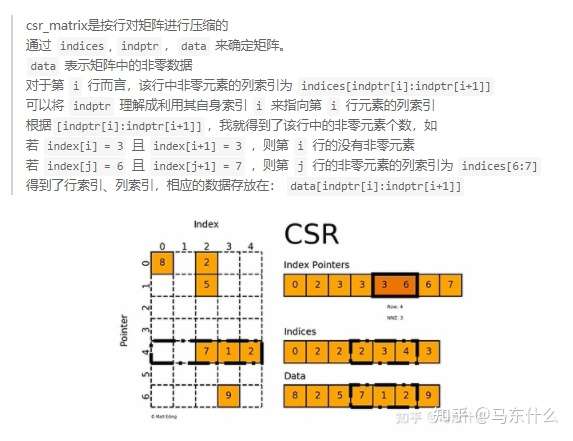
indices,indtpr,data用三个numpy array来存储,从而使用numba来间接优化scipy sparse,代码中的src是indtpr,
这里还是说明一下,如上图,index pointers即indptr,第i个节点具有的邻节点个数就是indptr[i+1]-indptr[1],第i个节点的邻节点的集合的列索引就是 indptr[i:i+1],例如对于节点4来说,indptr[4:5]=3:6=[3,4,5],然后去indices中查找,indices[3,4,5]=[2,3,4],此时我们就知道了 第四行的第2,3,4列(注意,初始都是从0开始的)是有值的,因此节点4的邻节点就是节点2和节点3(节点4和本身存在自环self loop),通过这种方式可以非常迅速地找到某个节点的邻节点,如果要找寻二阶邻节点,我们可以通过numba.prange再写一个循环,比如对于节点4的邻节点[2,3],我们循环对csr matrix矩阵的第二行和第三行进行同样的查询就可以了,访问非常的迅速,主要原因在于csr matrix本质上三个连续内存地址的数组,内存访问的效率很高。
对于numba,这里的装饰器设置:
@jit(nopython=True, parallel=True, nogil=True, fastmath=True)
比较固定,一般设置成这样就行,如果不涉及到并行则parallel可以不设置。
然后是核心的random walk部分:
    def random_walks(self,
                walklen=10,
                epochs=1,
                start_nodes=None,
                normalize_self=False,
                return_weight=1.,
                neighbor_weight=1.):
        """
        Create random walks from the transition matrix of a graph
            in CSR sparse format

        Parameters
        ----------
        T : scipy.sparse.csr matrix
            Graph transition matrix in CSR sparse format
        walklen : int
            length of the random walks
        epochs : int
            number of times to start a walk from each nodes
        return_weight : float in (0, inf]
            Weight on the probability of returning to node coming from
            Having this higher tends the walks to be
            more like a Breadth-First Search.
            Having this very high  (> 2) makes search very local.
            Equal to the inverse of p in the Node2Vec paper.
        explore_weight : float in (0, inf]
            Weight on the probability of visitng a neighbor node
            to the one we're coming from in the random walk
            Having this higher tends the walks to be
            more like a Depth-First Search.
            Having this very high makes search more outward.
            Having this very low makes search very local.
            Equal to the inverse of q in the Node2Vec paper.
        threads : int
            number of threads to use.  0 is full use

        Returns
        -------
        out : 2d np.array (n_walks, walklen)
            A matrix where each row is a random walk,
            and each entry is the ID of the node
        """
        # Make csr graph
        if normalize_self:
            self.normalize(return_self=True)
            T = self
        else:
            T = self.normalize(return_self=False)
        n_rows = T.nnodes
        if start_nodes is None:
            start_nodes = np.arange(n_rows)
        sampling_nodes = np.tile(start_nodes, epochs)
        # Node2Vec Biased walks if parameters specified
        if (return_weight > 1. or return_weight < 1.
                or neighbor_weight < 1. or neighbor_weight > 1.):
            walks = _node2vec_walks(T.weights, T.src, T.dst,
                                    sampling_nodes=sampling_nodes,
                                    walklen=walklen,
                                    return_weight=return_weight,
                                    neighbor_weight=neighbor_weight)
        # much faster implementation for regular walks
        else:
            walks = _random_walk(T.weights, T.src, T.dst,
                                 sampling_nodes, walklen)
        return walks
可以看到,为了实现使用numba加速,基本上需要把所有的变量都以numpy形式存储,例如range使用np.arange,sampling_nodes = np.tile(start_nodes, epochs)等,numba目前也勉强支持list,dict这类的python数据结构,但是本身numpy的性能和扩展性都要好很多,而且也更加成熟,所以还是建议走numpy不容易各种bug。
最后就进入核心的核心了:
        if (return_weight > 1. or return_weight < 1.
                or neighbor_weight < 1. or neighbor_weight > 1.):
            walks = _node2vec_walks(T.weights, T.src, T.dst,
                                    sampling_nodes=sampling_nodes,
                                    walklen=walklen,
                                    return_weight=return_weight,
                                    neighbor_weight=neighbor_weight)
        # much faster implementation for regular walks
        else:
            walks = _random_walk(T.weights, T.src, T.dst,
                                 sampling_nodes, walklen)
首先来看下_random_walk
@(nopython=True, parallel=True, nogil=True, fastmath=True)
def _random_walk(weights, indptr, dst,
                 sampling_nodes, walklen):
    """
    Create random walks from the transition matrix of a graph
        in CSR sparse format

    Parameters
    ----------
    weights : 1d np.array  weights表示的是csr matrix的直接取值,使用csr matrix
存储的话,会有3个id array矩阵,分别是indices,indptr,data,含义在之前关于scipy的文章里
这里的weights对应的是data。
        CSR data vector from a sparse matrix. Can be accessed by M.data
    indptr : 1d np.array  这里的indptr对应的是csr matrix的indptr
        CSR index pointer vector from a sparse matrix.
        Can be accessed by M.indptr
    dst : 1d np.array 这里的dst对应的是csr matrix的indices
        CSR column vector from a sparse matrix.
        Can be accessed by M.indices
    sampling_nodes : 1d np.array of int  samling nodes为我们要采样的节点,如果没有指定需要采样的
特定的节点则默认是对整个graph的所有节点进行采样
        List of node IDs to start random walks from.
        If doing sampling from walks, is equal to np.arrange(n_nodes)
            repeated for each epoch
    walklen : int   random walks的长度,游走的次数在更上层的函数里,用epochs来表示,这里实际上是

        length of the random walks

    Returns
    -------
    out : 2d np.array (n_walks, walklen)
        A matrix where each row is a random walk,
        and each entry is the ID of the node
    """
    n_walks = len(sampling_nodes) ##游走的次数
    res = np.empty((n_walks, walklen), dtype=np.uint32) #用于存放游走的结果序列
    n_nodes = indptr.size #节点数量
    n_edges = weights.size #边数量
    for i in numba.prange(n_walks):#对每个节点实施下面的逻辑,这里对每个节点的游走采样
#是完全独立可并行的,所以用numba的prange来自动实现对循环的并行,非常的直观方便
        # Current node (each element is one walk's state)
        state = sampling_nodes[i]
        for k in range(walklen-1): #游走n次则进行n次循环,这里的循环时顺序执行的,所以无法并行
            # Write state
            res[i, k] = state # 初始节点,即start node
            # Find row in csr indptr
            start = indptr[state] #通过indptr来找到start node的邻节点
# 前面已经提到过csr matrix的indptr如何访问邻节点的问题了
            end = indptr[state+1]
            # If there are edges in the node, find next step
            if start != end:#如果start!=end,这里用于判断是否无法继续游走(即游走到的节点没有邻
节点或者其邻节点在上一步已经游走过了),如果
#可以继续则继续执行下面的代码
              # transition probabilities
              p = weights[start:end] #根据indptr定位start node的邻节点,通过weights
#和indptr返回的列索引定位到start node和其邻节点之间的edges的权重的具体的值
              # cumulative distribution of transition probabilities
              cdf = np.cumsum(p)
              # Random draw in [0, 1] for each row
              # Choice is where random draw falls in cumulative distribution
              draw = np.random.rand()
              # Find where draw is in cdf
              # Then use its index to update state
              next_idx = np.searchsorted(cdf, draw) #上面通过简单的三个np函数就实现了
#随机采样,注意这里实现的是deepwalk的无偏简单采样,所以逻辑很简单,searchsorted在这个
#下非常合适,其作用
#在于在数组a中插入数组v(并不执行插入操作),返回一个下标列表,
#这个列表指明了v中对应元素应该插入在a中那个位置上,通过这种方式用numpy就实现了随机采样的简单逻辑了


              # Winner points to the column index of the next node
              state = dst[start + next_idx]#此时我们的start node发生改变,这里涉及到下一个节点的
#寻址,可以看到,我们通过dst,即indices的列表可以非常方便的定位到下一个节点的行位置。

            # If there are no edges, this is the end of the walk
            else:
              res[i, k:] = state #存放采样结果
              break
        # Write final states
        res[i, -1] = state#存放最终采样结果,即最后一个采样的节点
    return res
真是越来越爱numba了。。。主要在于相对于cython来说,numba的使用更简单,你基本上用numpy的逻辑来写就行,对于numpy的死忠粉来说几乎无缝衔接。
这里的思路也不复杂,为了方便注释直接写代码里
下面i 看看node2vec的逻辑,原作者还没有实现rejective sampling有偏采样逻辑,具体在issues里面有提到过,不过这里有一个类似的版本中也是用numba实现了rejective sampling:
Accelerating node2vec with rejection samplinglouisabraham.github.io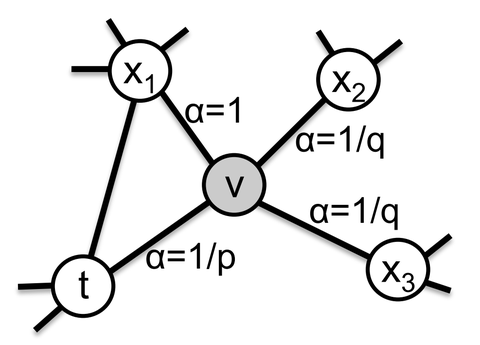 https://github.com/louisabraham/fastnode2vecgithub.com
感觉这两个library可以做一个合并了。。。
import numpy as np
from numba import jit


@jit(nogil=True,nopython=True,parallel=True,fastmath=True)
def random_walk(walk_length, p, q, t):
    """sample a random walk starting from t
    """
    # Normalize the weights to compute rejection probabilities
    max_prob = max(1 / p, 1, 1 / q)
    prob_0 = 1 / p / max_prob
    prob_1 = 1 / max_prob
    prob_2 = 1 / q / max_prob

    # Initialize the walk
    walk = np.empty(walk_length, dtype=indices.dtype)
    walk[0] = t
    walk[1] = random_neighbor(t)

    for j in numba.prange(2, walk_length):
        while True:
            new_node = random_neighbor(walk[j - 1])
            r = np.random.rand()
            if new_node == walk[j - 2]:
                # back to the previous node
                if r < prob_0:
                    break
            elif is_neighbor(walk[j - 2], new_node):
                # distance 1
                if r < prob_1:
                    break
            elif r < prob_2:
                # distance 2
                break
        walk[j] = new_node

    return walk
我们看一下node2vec的有偏采样的逻辑,csrgraph怎么写的:
@jit(nopython=True, nogil=True, parallel=True, fastmath=True)
def _node2vec_walks(Tdata, Tindptr, Tindices,
                    sampling_nodes,
                    walklen,
                    return_weight,
                    neighbor_weight):
    """
    Create biased random walks from the transition matrix of a graph
        in CSR sparse format. Bias method comes from Node2Vec paper.

    Parameters
    ----------
    Tdata : 1d np.array  casrmatrix的data
        CSR data vector from a sparse matrix. Can be accessed by M.data
    Tindptr : 1d np.array casrmatrix的indptr
        CSR index pointer vector from a sparse matrix.
        Can be accessed by M.indptr
    Tindices : 1d np.array casrmatrix的indices
        CSR column vector from a sparse matrix.
        Can be accessed by M.indices
    sampling_nodes : 1d np.array of int 采样节点,默认是全部节点
        List of node IDs to start random walks from.
        Is generally equal to np.arrange(n_nodes) repeated for each epoch
    walklen : int 随机游走的步数
        length of the random walks
    return_weight : float in (0, inf]  返回权重,对应node2vec论文中的p
        Weight on the probability of returning to node coming from
        Having this higher tends the walks to be
        more like a Breadth-First Search.
        Having this very high  (> 2) makes search very local.
        return weights如果大于2则游走非常接近局部
        Equal to the inverse of p in the Node2Vec paper.
    explore_weight : float in (0, inf] # 探索权重,对应node2vec论文中的q
        Weight on the probability of visitng a neighbor node
        to the one we're coming from in the random walk
        Having this higher tends the walks to be
        more like a Depth-First Search.
        Having this very high makes search more outward.
        Having this very low makes search very local.
        Equal to the inverse of q in the Node2Vec paper.
    Returns
    -------
    out : 2d np.array (n_walks, walklen)
        A matrix where each row is a biased random walk,
        and each entry is the ID of the node
    """
    n_walks = len(sampling_nodes)
    res = np.empty((n_walks, walklen), dtype=np.uint32)
    for i in numba.prange(n_walks):
        # Current node (each element is one walk's state)
        state = sampling_nodes[i]
        res[i, 0] = state
        # Do one normal step first
        state = _node2vec_first_step(state, Tdata, Tindices, Tindptr)
        for k in range(1, walklen-1):
            # Write state
            res[i, k] = state
            state = _node2vec_inner(
                res, i, k, state,
                Tdata, Tindices, Tindptr,
                return_weight, neighbor_weight
            )
        # Write final states
        res[i, -1] = state
    return res
这里实现了两个函数,一个是_node2vec_first_step用于有偏游走的初始化,一个是_node2vec_inner用于有偏游走后续的实现
其中:
@jit(nopython=True, nogil=True, fastmath=True)
def _node2vec_first_step(state, Tdata, Tindices, Tindptr):
    """
    Inner code for node2vec walks
    Normal random walk step
    Comments for this logic are in _random_walk
    """
    start = Tindptr[state]
    end = Tindptr[state+1]
    p = Tdata[start:end]
    cdf = np.cumsum(p)
    draw = np.random.rand()
    next_idx = np.searchsorted(cdf, draw)
    state = Tindices[start + next_idx]
    return state
这里和deepwalk的逻辑是一样的,实际上有偏的定义是从初始游走之后的第一个游走才开始的,这一点建议对照论文的图仔细看看:
马东什么:Node2vec 深入分析](https://zhuanlan.zhihu.com/p/344839298)
也就是初始先随机走一步,然后开始下面正式的有偏游走:
@jit(nopython=True, nogil=True, fastmath=True)
def _node2vec_inner(
    res, i, k, state,
    Tdata, Tindices, Tindptr,
    return_weight, neighbor_weight):
    """
    Inner loop core for node2vec walks
    Does the biased walk updating (pure function)

    All arguments are directly from the node2vec walks method
    """
    # Find rows in csr indptr
    prev = res[i, k-1]
    start = Tindptr[state] #当前节点的start和end,即得到当前节点的邻节点个数
    end = Tindptr[state+1]
    start_prev = Tindptr[prev] #当前节点的上一个节点(即从上一个节点游走到当前节点的
#上一个节点)的start和end,即得到上一个节点的邻节点个数
    end_prev = Tindptr[prev+1]
    # Find overlaps and fix weights
    this_edges = Tindices[start:end] #当前节点的邻节点确定
    prev_edges = Tindices[start_prev:end_prev] #上一个节点的邻节点确定
    p = np.copy(Tdata[start:end]) #当前节点和邻节点连接的edges的权重
    ret_idx = np.where(this_edges == prev) #确认上一个节点的index
    p[ret_idx] = np.multiply(p[ret_idx], return_weight) #计算上一个节点
#和当前节点连接的edge权重*return weight
    for pe in prev_edges:
        n_idx_v = np.where(this_edges == pe)
        n_idx = n_idx_v[0]
        p[n_idx] = np.multiply(p[n_idx], neighbor_weight) #计算深入游走的概率和对应edge的积
    # Get next state
    ## 剩下的部分就和deep walk一样了
    cdf = np.cumsum(np.divide(p, np.sum(p)))
    draw = np.random.rand()
    next_idx = np.searchsorted(cdf, draw)
    new_state = this_edges[next_idx]
    return new_state
这里 思路其实是把p和q的参数和edges的权重进行相乘然后转化为常规的deepwalk的决策过程:
    cdf = np.cumsum(np.divide(p, np.sum(p)))
    draw = np.random.rand()
    next_idx = np.searchsorted(cdf, draw)
学好numpy,做一些性能不错的开发工作还是很ok的~一些不是很复杂的需求,用numpy+numba或者numpy+numba或者numpy+numba+cython的性能并不会比c++差。