最近发现Python课器做很多事情,在监控服务器有其独特的优势,耗费资源少,开发周期短。
首先我们做一个定时或者实时脚本timedtask.py,让其定时监控目标服务器,两种方式:
第一种:
#!/usr/bin/env python
# -*- coding: utf-8 -*-
# @Time    : 2017/11/27 15:59
# @Desc    : 定时任务,以需要的时间间隔执行某个命令
# @File    : timedtask.py
# @Software: PyCharm

import time, os
from monitorserver import alltask


def roll_back(cmd, inc = 60):
    while True:
        #执行方法,函数
        alltask()
        time.sleep(inc)

roll_back("echo %time%", 5)
第二种:
#!/usr/bin/env python
# -*- coding: utf-8 -*-
# @Time    : 2017/11/27 15:59
# @Desc    : 定时任务,以需要的时间间隔执行某个命令
# @File    : timedtask.py
# @Software: PyCharm

import time, os

def roll_back(cmd, inc = 60):
    while True:
        #监控代码文件所在位置
        os.system('python  /home/../monitorserver.py');
        time.sleep(inc)

roll_back("echo %time%", 5)
做过监控应该都知道,我们主要监控服务器,负载均衡、磁盘、内存、CPU、网络接口(流量)、端口代码,主要针对这些,我做了以下远程监控,第一种和第二种监控代码一样,代码monitorserver.py如下:
#!/usr/bin/env python
# -*- coding: utf-8 -*-
# @Time    : 2017/11/27 15:59
# @Desc    : 服务器监控代码
# @File    : monitorserver.py
# @Software: PyCharm

import pexpect
import re

import time
import threading

"""
主方法
127.0.0.1#远程服务器ip地址
"""
def ssh_command(user, host, password, command):
    ssh_new_key = 'Are you sure you want to continue connecting'
    child = pexpect.spawn('ssh -l %s %s %s' % (user, host, command))
    i = child.expect([pexpect.TIMEOUT, ssh_new_key, 'password: '])
    if i == 0:
        print 'ERROR!'
        print 'SSH could not login. Here is what SSH said:'
        print child.before, child.after
        return None
    if i == 1:
        child.sendline('yes')
        child.expect('password: ')
        i = child.expect([pexpect.TIMEOUT, 'password: '])
        if i == 0:
            print 'ERROR!'
            print 'SSH could not login. Here is what SSH said:'
            print child.before, child.after
            return None
    child.sendline(password)
    return child


"""
内存监控
"""
def mem_info():

    child = ssh_command("远程服务器用户名", "127.0.0.1", "远程服务器密码", "cat /proc/meminfo")
    child.expect(pexpect.EOF)
    mem = child.before
    mem_values = re.findall("(d+) kB", mem)
    MemTotal = mem_values[0]
    MemFree = mem_values[1]
    Buffers = mem_values[2]
    Cached = mem_values[3]
    SwapCached=mem_values[4]
    SwapTotal = mem_values[13]
    SwapFree = mem_values[14]
    print '******************************内存监控*********************************'
    print "*******************时间:", time.strftime("%Y-%m-%d %H:%M:%S", time.localtime()), "******************"
    print "总内存:",MemTotal
    print "空闲内存:", MemFree
    print "给文件的缓冲大小:",Buffers
    print "高速缓冲存储器使用的大小:", Cached
    print "被高速缓冲存储用的交换空间大小:", SwapCached
    print "给文件的缓冲大小:", Buffers
    if int(SwapTotal) == 0:
        print u"交换内存总共为:0"
    else:
        Rate_Swap = 100 - 100*int(SwapFree)/float(SwapTotal)
        print u"交换内存利用率:", Rate_Swap
    Free_Mem = int(MemFree) + int(Buffers) + int(Cached)
    Used_Mem = int(MemTotal) - Free_Mem
    Rate_Mem = 100*Used_Mem/float(MemTotal)
    print u"内存利用率:", str("%.2f" % Rate_Mem), "%"


"""
内核线程、虚拟内存、磁盘、陷阱和 CPU 活动的统计信息
"""
def vm_stat_info():
    child = ssh_command("远程服务器用户名", "127.0.0.1", "远程服务器密码", "vmstat 1 2 | tail -n 1")
    child.expect(pexpect.EOF)
    vmstat_info = child.before.strip().split()
    processes_waiting = vmstat_info[0]
    processes_sleep = vmstat_info[1]
    swpd = vmstat_info[2]
    free = vmstat_info[3]
    buff = vmstat_info[4]
    cache = vmstat_info[5]
    si = vmstat_info[6]
    so = vmstat_info[7]
    io_bi = vmstat_info[8]
    io_bo = vmstat_info[9]
    system_interrupt = vmstat_info[10]
    system_context_switch = vmstat_info[11]
    cpu_user = vmstat_info[12]
    cpu_sys = vmstat_info[13]
    cpu_idle = vmstat_info[14]
    cpu_wait = vmstat_info[15]
    st=vmstat_info[16]
    print '****************************内核线程、虚拟内存、磁盘、陷阱和 CPU 活动的统计信息监控****************************'
    print "*******************时间:", time.strftime("%Y-%m-%d %H:%M:%S", time.localtime()), "******************"
    print "等待运行进程的数量:", processes_waiting
    print "处于不间断状态的进程:", processes_sleep
    print "使用虚拟内存(swap)的总量:", swpd
    print "空闲的内存总量:", free
    print "用作缓冲的内存总量:", buff
    print "用作缓存的内存总量:", cache
    print "交换出内存总量 :", si
    print "交换入内存总量 :", so
    print "从一个块设备接收:", io_bi
    print "发送到块设备:", io_bo
    print "每秒的中断数:", system_interrupt
    print "每秒的上下文切换数:", system_context_switch
    print "用户空间上进程运行的时间百分比:", cpu_user
    print "内核空间上进程运行的时间百分比:", cpu_sys
    print "闲置时间百分比:", cpu_idle
    print "等待IO的时间百分比:", cpu_wait
    print "从虚拟机偷取的时间百分比:", st


'''
cpu监控
'''
def cpu_info():
    child = ssh_command("远程服务器用户名", "127.0.0.1", "远程服务器密码", "cat /proc/cpuinfo")
    child.expect(pexpect.EOF)
    cpuinfo = child.before
    cpu_num = re.findall('processor.*?(d+)', cpuinfo)[-1]
    cpu_num = str(int(cpu_num) + 1)
    print '***************************************cpu监控***************************************'
    print "*******************时间:", time.strftime("%Y-%m-%d %H:%M:%S", time.localtime()), "******************"
    print u"CPU数目:", cpu_num
    li = cpuinfo.replace('	', '').split('
')
    CPUinfo = {}
    procinfo = {}
    nprocs = 0
    for line in li:
        if line.find("processor") > -1:
            CPUinfo['CPU%s' % nprocs] = procinfo
            nprocs = nprocs + 1
        else:
            if len(line.split(':')) == 2:
                procinfo[line.split(':')[0].strip()] = line.split(':')[1].strip()
            else:
                procinfo[line.split(':')[0].strip()] = ''
    for processor in CPUinfo.keys():
        print "CPU属于的名字及其编号、标称主频:",CPUinfo[processor]['model name']
        print "CPU属于其系列中的哪一代的代号:", CPUinfo[processor]['model']
        print "CPU制造商:", CPUinfo[processor]['vendor_id']
        print "CPU产品系列代号:", CPUinfo[processor]['cpu family']
        print "CPU的实际使用主频:", CPUinfo[processor]['cpu MHz']


"""
负载均衡
"""
def load_stat():
    child = ssh_command("远程服务器用户名", "127.0.0.1", "远程服务器密码", "cat /proc/loadavg")
    child.expect(pexpect.EOF)
    loadavgs = child.before.strip().split()
    print '************************负载均衡监控****************************'
    print "*******************时间:",time.strftime("%Y-%m-%d %H:%M:%S", time.localtime()),"******************"
    print "系统5分钟前的平均负载:", loadavgs[0]
    print "系统10分钟前的平均负载:", loadavgs[1]
    print "系统15分钟前的平均负载:", loadavgs[2]
    print "分子是正在运行的进程数,分母为总进程数:",loadavgs[3]
    print "最近运行的进程id:", loadavgs[4]


"""
获取网络接口的输入和输出
"""
def  ionetwork():
    child = ssh_command("远程服务器用户名", "127.0.0.1", "远程服务器密码", "cat /proc/net/dev")
    child.expect(pexpect.EOF)
    netdata = child.before
    li = netdata.strip().split('
')
    print '************************获取网络接口的输入和输出监控****************************'
    print "*******************时间:",time.strftime("%Y-%m-%d %H:%M:%S", time.localtime()),"******************"
    net = {}
    for line in li[2:]:
        line = line.split(":")
        eth_name = line[0].strip()
        # if eth_name != 'lo':
        net_io = {}
        net_io['Receive'] = round(float(line[1].split()[0]) / (1024.0 * 1024.0), 2)
        net_io['Transmit'] = round(float(line[1].split()[8]) / (1024.0 * 1024.0), 2)
        net[eth_name] = net_io
    print net


"""
磁盘空间监控
"""
def disk_stat():
    child = ssh_command("远程服务器用户名", "127.0.0.1", "远程服务器密码", "df -h")
    child.expect(pexpect.EOF)
    disk = child.before
    disklist = disk.strip().split('
')
    disklists=[]
    for  disk  in disklist:
        disklists.append(disk.strip().split())
    print '************************磁盘空间监控****************************'
    print "*******************时间:", time.strftime("%Y-%m-%d %H:%M:%S", time.localtime()), "******************"
    for  i in disklists[1:]:
        print "	文件系统:", i[0],
        print "	容量:", i[1],
        print "	已用:", i[2],
        print "	可用:", i[3],
        print "	已用%挂载点:", i[4]


"""
端口监控
一般是远程服务器用户名用户
"""
def getComStr():
    child = ssh_command("远程服务器用户名", "127.0.0.1", "远程服务器密码", "netstat -tpln")
    child.expect(pexpect.EOF)
    Com = child.before
    print '******************************端口监控*********************************'
    print "*******************时间:", time.strftime("%Y-%m-%d %H:%M:%S", time.localtime()), "******************"
    print Com


"""
获取网络接口的输入和输出
"""
def  cpu():
    child = ssh_command("远程服务器用户名", "127.0.0.1", "远程服务器密码", 'cat /proc/stat | grep "cpu "')
    child.expect(pexpect.EOF)
    child1 = ssh_command("远程服务器用户名", "127.0.0.1", "远程服务器密码", 'cat /proc/stat | grep "cpu "')
    child1.expect(pexpect.EOF)
    cpus = child.before.strip().split()
    cpus1 = child1.before.strip().split()
    print '************************cpu使用情况****************************'
    print "*******************时间:",time.strftime("%Y-%m-%d %H:%M:%S", time.localtime()),"******************"
    T1=int(cpus[1])+int(cpus[2])+int(cpus[3])+int(cpus[4])+int(cpus[5])+int(cpus[6])+int(cpus[8])+int(cpus[9])
    T2=int(cpus1[1]) + int(cpus1[2]) + int(cpus1[3]) + int(cpus1[4] )+ int(cpus1[5] )+int( cpus1[6] )+ int(cpus1[8] )+ int(cpus1[9])
    Tol=T2-T1
    Idle=int(cpus1[4]) - int(cpus[4])
    print '总的cpu时间1:',T1
    print '总的cpu时间2:', T2
    print '时间间隔内的所有时间片:', Tol
    print '计算空闲时间idle:', Idle
    print "计算cpu使用率:",100*(Tol-Idle)/Tol,"%"

"""
第一种执行
"""
def alltask():
    try:
        threads = []
        t1 = threading.Thread(target=mem_info)
        threads.append(t1)
        t2 = threading.Thread(target=vm_stat_info)
        threads.append(t2)
        t3 = threading.Thread(target=cpu_info)
        threads.append(t3)
        t4 = threading.Thread(target=load_stat)
        threads.append(t4)
        t5 = threading.Thread(target=ionetwork)
        threads.append(t5)
        t6 = threading.Thread(target=disk_stat)
        threads.append(t6)
        t7 = threading.Thread(target=getComStr)
        threads.append(t7)
        t8 = threading.Thread(target=cpu)
        threads.append(t8)
        for n in range(len(threads)):
            threads[n].start()
    except Exception, e:
        print str(e)

"""
第二种执行
"""
if __name__ == '__main__':
    try:
        threads = []
        t1 = threading.Thread(target=mem_info)
        threads.append(t1)
        t2 = threading.Thread(target=vm_stat_info)
        threads.append(t2)
        t3 = threading.Thread(target=cpu_info)
        threads.append(t3)
        t4 = threading.Thread(target=load_stat)
        threads.append(t4)
        t5 = threading.Thread(target=ionetwork)
        threads.append(t5)
        t6 = threading.Thread(target=disk_stat)
        threads.append(t6)
        t7 = threading.Thread(target=getComStr)
        threads.append(t7)
        t8 = threading.Thread(target=cpu)
        threads.append(t8)
        for n in range(len(threads)):
            threads[n].start()
    except Exception, e:
        print str(e)
监控结果如下:
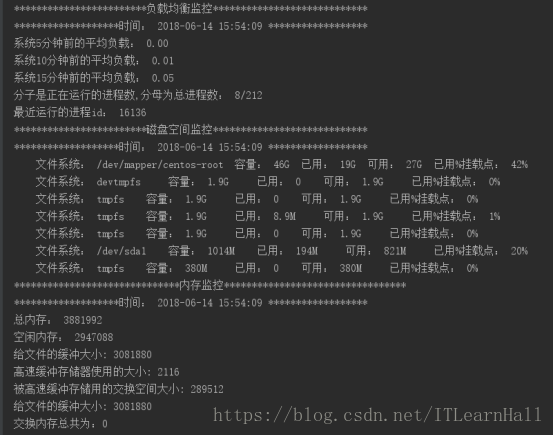
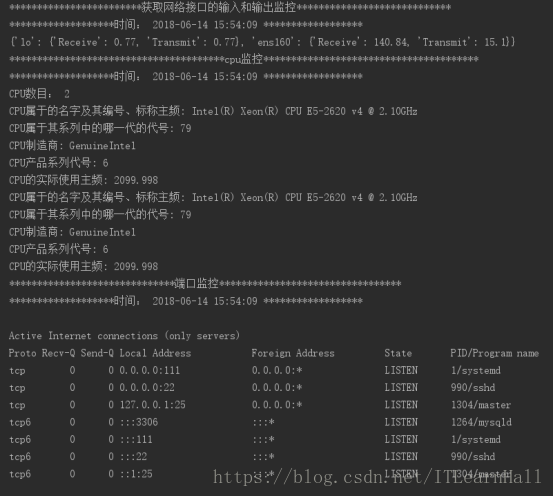
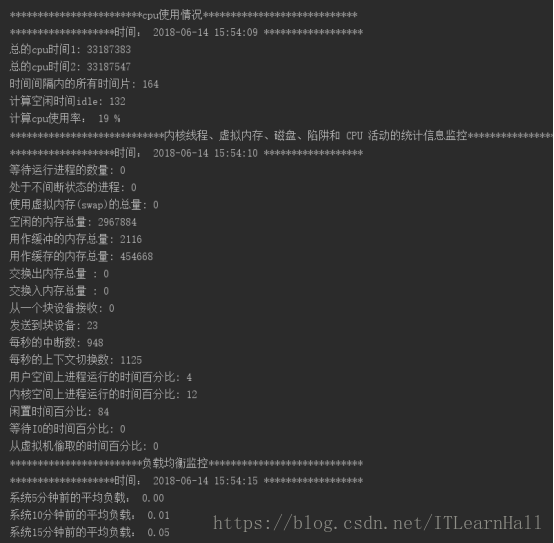
接下来做的是把监控结果可视化,即可,可惜没时间做,就交给各位了!!!
花了两天时间整理的,分享给大家,希望对各位有帮助!!!