在STM32的固件库和提供的例程中,到处都可以见到assert_param()的使用。如果打开任何一个例程中的stm32f10x_conf.h文件,就可以看到实际上assert_param是一个宏定义;
在固件库中,它的作用就是检测传递给函数的参数是否是有效的参数。
举例说明:
assert_param(IS_USART_ALL_PERIPH(USARTx));
这句代码用于检查参数USARTx是否有效,其中IS_USART_ALL_PERIPH(USARTx)是一个宏定义,如下:
#define IS_USART_ALL_PERIPH(PERIPH) (((PERIPH) == USART1) ||
                                     ((PERIPH) == USART2) ||
                                     ((PERIPH) == USART3) ||
                                     ((PERIPH) == USART4) ||
                                     ((PERIPH) == USART5) ||
                                     ((PERIPH) == USART6) ||
                                     ((PERIPH) == USART7) ||
                                     ((PERIPH) == USART8))
宏定义的功能是参数USARTx是USART1~USART8其中的一个,表示参数USARTx有效,返回true,否则返回false。
assert_param()也是一个宏,定义在stm32f0xx_conf.h中,具体如下:
/* #define USE_FULL_ASSERT    1 */

/* Exported macro ------------------------------------------------------------*/
#ifdef  USE_FULL_ASSERT

/**
  * @brief  The assert_param macro is used for function's parameters check.
  * @param  expr: If expr is false, it calls assert_failed function which reports
  *         the name of the source file and the source line number of the call
  *         that failed. If expr is true, it returns no value.
  * @retval None
  */
  #define assert_param(expr) ((expr) ? (void)0 : assert_failed((uint8_t *)__FILE__, __LINE__))
/* Exported functions ------------------------------------------------------- */
  void assert_failed(uint8_t* file, uint32_t line);
#else
  #define assert_param(expr) ((void)0)
#endif /* USE_FULL_ASSERT */
如果USE_FULL_ASSERT宏定义了,则执行下面的代码:
#define assert_param(expr) ((expr) ? (void)0 : assert_failed((uint8_t *)__FILE__, __LINE__)) //表示参数expr为false,则执行后面的assert_failed()函数,__FILE__, __LINE__是标准库函数中的宏定义,表示文件名和行号
void assert_failed(uint8_t* file, uint32_t line); //申明该函数
如果USE_FULL_ASSERT没有宏定义,则执行((void)0),即什么都不做。
assert_failed()函数的具体实现在main.c中(在任何一个例程中的main.c中都有这个函数的模板),内容如下:
 1 #ifdef  USE_FULL_ASSERT
 2
 3 /**
 4   * @brief  Reports the name of the source file and the source line number
 5   *         where the assert_param error has occurred.
 6   * @param  file: pointer to the source file name
 7   * @param  line: assert_param error line source number
 8   * @retval None
 9   */
10 void assert_failed(uint8_t* file, uint32_t line)
11 {
12   /* User can add his own implementation to report the file name and line number,
13      ex: printf("Wrong parameters value: file %s on line %d
", file, line) */
14
15   /* Infinite loop */
16   while (1)
17   {
18   }
19 }
20 #endif
assert_failed()函数给了一个框架,内部具体实现需要开发者自己去写,通常是用串口把文件名和行号打印出来。
要使assert_failed()函数生效,需要宏定义USE_FULL_ASSERT,并且包含头文件stm32f0xx_conf.h;在stm32f0xx.h文件中,有如下代码:
#ifdef USE_STDPERIPH_DRIVER
  #include "stm32f0xx_conf.h"
#endif
只要宏定义USE_STDPERIPH_DRIVER,就能包含头文件stm32f0xx_conf.h了。
宏定义可以在文件中写,也可以直接在软件中设置,如下图:
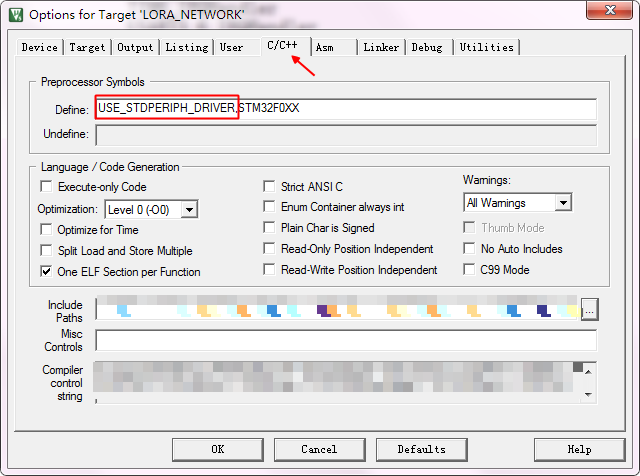
注意:assert_failed()函数一般在代码调试时使用,可以帮助开发者检查输入参数无效的错误,但由于assert_failed()函数会影响代码执行效率,在程序release时,需要屏蔽掉,将宏定义USE_FULL_ASSERT注释即可。