概念
第二个过程是BeanDefinition的载入。这个载入过程是把用户定义好的Bean表示成IoC容器内部的数据结构,而这个容器内部的数据结构就是BeanDefinition。具体来说,这个BeanDefinition实际上就是POJO对象在IoC容器中的抽象,通过这个BeanDefinition定义的数据结构,使IoC容器能够方便地对POJO对象也就是Bean进行管理。IoC容器对Bean的管理和依赖注入功能的实现,就是通过对持有的BeanDefinition进行各种相关操作完成的。
分析过程
- 整个载入和解析过程也是从refresh()启动的,该方法在FileSystemXmlApplicationContext的基类AbstractApplic-ationContext中实现,它详细的描述了整个ApplicationContext的初始化过程,比如BeanFactory的更新,Mess-ageSource和PostProcessor的注册,等等。这里看起来更像是对ApplicationContext进行初始化的模板或执行提纲,这个执行过程为Bean的生命周期管理提供了条件。
public void refresh() throws BeansException, IllegalStateException {
synchronized (this.startupShutdownMonitor) {
// Prepare this context for refreshing.
prepareRefresh();
// Tell the subclass to refresh the internal bean factory.
//这里是在子类中启动refreshBeanFactory()的地方,也就是创建实际BeanFactory的方法入口
ConfigurableListableBeanFactory beanFactory = obtainFreshBeanFactory();
// Prepare the bean factory for use in this context.
prepareBeanFactory(beanFactory);
try {
// Allows post-processing of the bean factory in context subclasses.
//设置BeanFactory的后置处理
postProcessBeanFactory(beanFactory);
// Invoke factory processors registered as beans in the context.
//调用BeanFactory的后处理器.这些后处理器是在Bean定义中向容器注册的
invokeBeanFactoryPostProcessors(beanFactory);
// Register bean processors that intercept bean creation.
//注册Bean的后处理器,在Bean创建过程中调用。
registerBeanPostProcessors(beanFactory);
// Initialize message source for this context.、
//对上下文中的消息源进行初始化
initMessageSource();
// Initialize event multicaster for this context.
//初始化上下文中的事件机制
initApplicationEventMulticaster();
// Initialize other special beans in specific context subclasses.
//初始化其他的特殊Bean
onRefresh();
// Check for listener beans and register them.
//检查监听Bean并且将这些Bean向容器注册
registerListeners();
// Instantiate all remaining (non-lazy-init) singletons.
//实例化所有的(non-lazy-init)单件
finishBeanFactoryInitialization(beanFactory);
// Last step: publish corresponding event.
//发布容器事件.结束Refresh过程
finishRefresh();
}
catch (BeansException ex) {
// Destroy already created singletons to avoid dangling resources.
//为防止Bean资源占用,在异常处理中,销毁已经在前面过程中生成的单间Bean
destroyBeans();
// Reset 'active' flag.
cancelRefresh(ex);
// Propagate exception to caller.
throw ex;
}
}
}</code></pre>
- 之后就进行资源定位过程,定位完成后就开始载入过程(见图一),因为之前创建好DefaultListBeanFactory后,将其“绑定”给XmlBeanDefinitionReader,由XmlBeanDefinitionReader继续后续的定位和载入(图二),所以这里的载入过程也由XmlBeanDefinitionReader来完成。需要注意的是,因为这里我们使用XML方式定义Bean,所以使用XmlBeanDefinitionReader来处理,如果使用了其他定义方式,就需要使用其他种类的BeanDefinitionReader来完成载入工作。
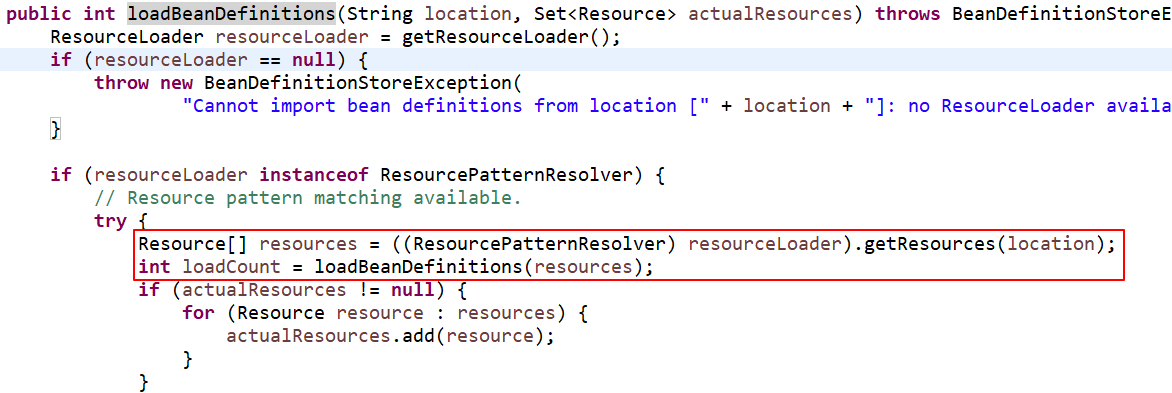
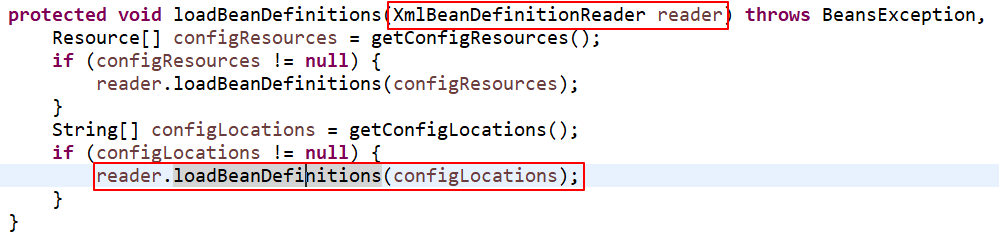
- 这里调用的是loadBeanDefinitions(Resource res)方法,但这个方法在AbstractBeanDefinitionReader类里是没有实现的,它是一个接口方法,具体的实现在XmlBeanDefinitionReader中。在读取器中,需要得到代表XML文件的Resource,因为这个Resource对象封装了对XML文件的I/O操作,所以读取器可以在打开I/O流后得到 XML的文件对象。有了这个文件对象以后,就可以按照Spring的Bean定义规则来对这个XML的文档树进行解析。
//父类AbstractBeanDefinitionReader遍历调用loadBeanDefinitions(resource)
public int loadBeanDefinitions(Resource... resources) throws BeanDefinitionStoreException {
Assert.notNull(resources, "Resource array must not be null");
int counter = 0;
for (Resource resource : resources) {
counter += loadBeanDefinitions(resource);
}
return counter;
}
//子类XmlBeanDefinitionReader对loadBeanDefinitions(Resource resource)的具体实现
public int loadBeanDefinitions(Resource resource) throws BeanDefinitionStoreException {
return loadBeanDefinitions(new EncodedResource(resource));
}
public int loadBeanDefinitions(EncodedResource encodedResource) throws BeanDefinitionStoreException {
Assert.notNull(encodedResource, "EncodedResource must not be null");
if (logger.isInfoEnabled()) {
logger.info("Loading XML bean definitions from " + encodedResource.getResource());
}
Set<EncodedResource> currentResources = this.resourcesCurrentlyBeingLoaded.get();
if (currentResources == null) {
currentResources = new HashSet<EncodedResource>(4);
this.resourcesCurrentlyBeingLoaded.set(currentResources);
}
if (!currentResources.add(encodedResource)) {
throw new BeanDefinitionStoreException(
"Detected cyclic loading of " + encodedResource + " - check your import definitions!");
}
//这里得到XML文件,并得到IO的InputSource准备进行读取
try {
InputStream inputStream = encodedResource.getResource().getInputStream();
try {
InputSource inputSource = new InputSource(inputStream);
if (encodedResource.getEncoding() != null) {
inputSource.setEncoding(encodedResource.getEncoding());
}
//具体的读取过程在doLoadBeanDefinitions中,是从特定的XML文件中实际载入的地方。
return doLoadBeanDefinitions(inputSource, encodedResource.getResource());
}
finally {
inputStream.close();
}
}
catch (IOException ex) {
throw new BeanDefinitionStoreException(
"IOException parsing XML document from " + encodedResource.getResource(), ex);
}
finally {
currentResources.remove(encodedResource);
if (currentResources.isEmpty()) {
this.resourcesCurrentlyBeingLoaded.remove();
}
}
}
//子类XmlBeanDefinitionReader的doLoadBeanDefinitions方法
protected int doLoadBeanDefinitions(InputSource inputSource, Resource resource)
throws BeanDefinitionStoreException {
try {
int validationMode = getValidationModeForResource(resource);
//这里取得XML的Document对象,如何获得可详细看源码。
Document doc = this.documentLoader.loadDocument(
inputSource, getEntityResolver(), this.errorHandler, validationMode, isNamespaceAware());
//这里启动对BeanDefinition解析的详细过程,这个解析会使用到Spring的Bean配置规则
return registerBeanDefinitions(doc, resource);
}
catch (BeanDefinitionStoreException ex) {
throw ex;
}
catch (SAXParseException ex) {
throw new XmlBeanDefinitionStoreException(resource.getDescription(),
"Line " + ex.getLineNumber() + " in XML document from " + resource + " is invalid", ex);
}
catch (SAXException ex) {
throw new XmlBeanDefinitionStoreException(resource.getDescription(),
"XML document from " + resource + " is invalid", ex);
}
catch (ParserConfigurationException ex) {
throw new BeanDefinitionStoreException(resource.getDescription(),
"Parser configuration exception parsing XML from " + resource, ex);
}
catch (IOException ex) {
throw new BeanDefinitionStoreException(resource.getDescription(),
"IOException parsing XML document from " + resource, ex);
}
catch (Throwable ex) {
throw new BeanDefinitionStoreException(resource.getDescription(),
"Unexpected exception parsing XML document from " + resource, ex);
}
}
//子类XmlBeanDefinitionReader的registerBeanDefinitions方法
public int registerBeanDefinitions(Document doc, Resource resource) throws BeanDefinitionStoreException {
//得到BeanDefinitionDocumentReader来对XML进行解析
BeanDefinitionDocumentReader documentReader = createBeanDefinitionDocumentReader();
documentReader.setEnvironment(this.getEnvironment());
int countBefore = getRegistry().getBeanDefinitionCount();
//具体的解析过程在BeanDefinitionDocumentReader的registerBeanDefinitions中完成。
//createReaderContext(resource)返回一个ReaderContext对象,里面封装了XmlBeanDefinitionReader等组件。
documentReader.registerBeanDefinitions(doc, createReaderContext(resource));
return getRegistry().getBeanDefinitionCount() - countBefore;
}
- BeanDefinition的载入分成两部分,首先通过调用XML的解析器得到document对象,但这些document对象并没有按照Spring的Bean规则进行解析。在完成通用的XML解析以后,才是按照Spring的Bean规则进行解析的地方,这个按照Spring的Bean规则进行解析的过程是在documentReader中实现的。这里使用的documentReader是默认设置好的DefaultBeanDefinitionDocumentReader。然后就完成BeanDefinition的处理,处理的结果由Bean-DefinitionHolder对象来持有。这个BeanDefinitionHolder除了持有BeanDefinition对象外,还持有其他与Bean-Definition的使用相关的信息,比如Bean的名字、别名集合等。这个BeanDefinitionHolder的生成是通过对Docu-ment文档树的内容进行解析来完成的,可以看到这个解析过程是由BeanDefinitionParserDelegate来实现(具体在processBeanDefinition方法中实现)的,同时这个解析是与Spring对BeanDefinition的配置规则紧密相关的。具体的实现原理如下代码:
//DefaultBeanDefinitionDocumentReader中的registerBeanDefinitions方法
public void registerBeanDefinitions(Document doc, XmlReaderContext readerContext) {
//将封装了XmlBeanDefinitionReader等组件的XmlReaderContext传给DefaultBeanDefinitionDocumentReader,方便后续回调。
this.readerContext = readerContext;
logger.debug("Loading bean definitions");
Element root = doc.getDocumentElement();
doRegisterBeanDefinitions(root);
}
//DefaultBeanDefinitionDocumentReader中的doRegisterBeanDefinitions方法
protected void doRegisterBeanDefinitions(Element root) {
String profileSpec = root.getAttribute(PROFILE_ATTRIBUTE);
if (StringUtils.hasText(profileSpec)) {
Assert.state(this.environment != null, "environment property must not be null");
String[] specifiedProfiles = StringUtils.tokenizeToStringArray(profileSpec, BeanDefinitionParserDelegate.MULTI_VALUE_ATTRIBUTE_DELIMITERS);
if (!this.environment.acceptsProfiles(specifiedProfiles)) {
return;
}
}
// any nested <beans> elements will cause recursion in this method. In
// order to propagate and preserve <beans> default-* attributes correctly,
// keep track of the current (parent) delegate, which may be null. Create
// the new (child) delegate with a reference to the parent for fallback purposes,
// then ultimately reset this.delegate back to its original (parent) reference.
// this behavior emulates a stack of delegates without actually necessitating one.
//对文档进行解析的实际作用类BeanDefinitionParserDelegate
BeanDefinitionParserDelegate parent = this.delegate;
this.delegate = createHelper(readerContext, root, parent);
preProcessXml(root);
//利用BeanDefinitionParserDelegate进行解析的入口方法
parseBeanDefinitions(root, this.delegate);
postProcessXml(root);
this.delegate = parent;
}
//DefaultBeanDefinitionDocumentReader中的parseBeanDefinitions方法
//遍历子节点,也就是XML文件中的标签,依次解析
protected void parseBeanDefinitions(Element root, BeanDefinitionParserDelegate delegate) {
if (delegate.isDefaultNamespace(root)) {
NodeList nl = root.getChildNodes();
for (int i = 0; i < nl.getLength(); i++) {
Node node = nl.item(i);
if (node instanceof Element) {
Element ele = (Element) node;
if (delegate.isDefaultNamespace(ele)) {
parseDefaultElement(ele, delegate);
}
else {
delegate.parseCustomElement(ele);
}
}
}
}
else {
delegate.parseCustomElement(root);
}
}
//DefaultBeanDefinitionDocumentReader中的parseDefaultElement方法
private void parseDefaultElement(Element ele, BeanDefinitionParserDelegate delegate) {
//对"import"标签进行处理
if (delegate.nodeNameEquals(ele, IMPORT_ELEMENT)) {
importBeanDefinitionResource(ele);
}
//对"alias"标签进行处理
else if (delegate.nodeNameEquals(ele, ALIAS_ELEMENT)) {
processAliasRegistration(ele);
}
//对"bean"标签进行处理,是主要的解析标签。
else if (delegate.nodeNameEquals(ele, BEAN_ELEMENT)) {
processBeanDefinition(ele, delegate);
}
//对"beans"标签进行处理
else if (delegate.nodeNameEquals(ele, NESTED_BEANS_ELEMENT)) {
// recurse
doRegisterBeanDefinitions(ele);
}
}
//DefaultBeanDefinitionDocumentReader中的processBeanDefinition方法
protected void processBeanDefinition(Element ele, BeanDefinitionParserDelegate delegate) {
//由BeanDefinitionParserDelegate负责解析,BeanDefinitionHolder是BeanDefinition的
//封装类,用于完成向IoC容器的注册
BeanDefinitionHolder bdHolder = delegate.parseBeanDefinitionElement(ele);
if (bdHolder != null) {
bdHolder = delegate.decorateBeanDefinitionIfRequired(ele, bdHolder);
try {
// Register the final decorated instance.
//载入解析完,注册的入口函数
BeanDefinitionReaderUtils.registerBeanDefinition(bdHolder, getReaderContext().getRegistry());
}
catch (BeanDefinitionStoreException ex) {
getReaderContext().error("Failed to register bean definition with name '" +
bdHolder.getBeanName() + "'", ele, ex);
}
// Send registration event.
getReaderContext().fireComponentRegistered(new BeanComponentDefinition(bdHolder));
}
}
- 具体的Spring BeanDefinition的解析是在BeanDefinitionParserDelegate中完成的。这个类里包含了对各种Spri-ngBean定义规则的处理,感兴趣可以仔细研究。比如我们最熟悉的对Bean元素的处理是怎样完成的,也就是怎样处理在XML定义文件中出现的<bean></bean>这个最常见的元素信息。在这里会看到对那些熟悉的Bean定义的处理,比如id, name, aliase等属性元素。把这些元素的值从XML文件相应的元素的属性中读取出来以后,设置到生成的BeanDefinitionHolder中去。这些属性的解析还是比较简单的。对于其他元素配置的解析,比如各种Bean的属性配置,通过一个较为复杂的解析过程,这个过程是由parseBeanDefinitionElement来完成的。解析完成以后。会把解析结果放到BeanDefinition对象中并设置到BeanDefinitionHolder中去。具体代码如下:
//BeanDefinitionParserDelegate中的parseBeanDefinitionElement方法。
//这里ele是<bean>标签,BeanDefinition可以看成是对<bean>定义的抽象,也就是存储<bean>定义的数据结构,
//里面封装的数据大多都是跟<bean>相关的,比如init-method,destroy-method等等,具体可以查看源码,有了
//这些数据,IoC才能对Bean配置进行处理。
public BeanDefinitionHolder parseBeanDefinitionElement(Element ele, BeanDefinition containingBean) {
//这里取得在<bean>元素中定义的id,name和aliaes属性的值
String id = ele.getAttribute(ID_ATTRIBUTE);
String nameAttr = ele.getAttribute(NAME_ATTRIBUTE);
List<String> aliases = new ArrayList<String>();
if (StringUtils.hasLength(nameAttr)) {
String[] nameArr = StringUtils.tokenizeToStringArray(nameAttr, MULTI_VALUE_ATTRIBUTE_DELIMITERS);
aliases.addAll(Arrays.asList(nameArr));
}
String beanName = id;
if (!StringUtils.hasText(beanName) && !aliases.isEmpty()) {
beanName = aliases.remove(0);
if (logger.isDebugEnabled()) {
logger.debug("No XML 'id' specified - using '" + beanName +
"' as bean name and " + aliases + " as aliases");
}
}
if (containingBean == null) {
checkNameUniqueness(beanName, aliases, ele);
}
//这里引发对Bean元素的详细解析
AbstractBeanDefinition beanDefinition = parseBeanDefinitionElement(ele, beanName, containingBean);
//下面就是对解析后的结果进行封装
if (beanDefinition != null) {
if (!StringUtils.hasText(beanName)) {
try {
if (containingBean != null) {
beanName = BeanDefinitionReaderUtils.generateBeanName(
beanDefinition, this.readerContext.getRegistry(), true);
}
else {
beanName = this.readerContext.generateBeanName(beanDefinition);
// Register an alias for the plain bean class name, if still possible,
// if the generator returned the class name plus a suffix.
// This is expected for Spring 1.2/2.0 backwards compatibility.
String beanClassName = beanDefinition.getBeanClassName();
if (beanClassName != null &&
beanName.startsWith(beanClassName) && beanName.length() > beanClassName.length() &&
!this.readerContext.getRegistry().isBeanNameInUse(beanClassName)) {
aliases.add(beanClassName);
}
}
if (logger.isDebugEnabled()) {
logger.debug("Neither XML 'id' nor 'name' specified - " +
"using generated bean name [" + beanName + "]");
}
}
catch (Exception ex) {
error(ex.getMessage(), ele);
return null;
}
}
String[] aliasesArray = StringUtils.toStringArray(aliases);
return new BeanDefinitionHolder(beanDefinition, beanName, aliasesArray);
}
return null;
}
//BeanDefinitionParserDelegate中的parseBeanDefinitionElement方法
public AbstractBeanDefinition parseBeanDefinitionElement(
Element ele, String beanName, BeanDefinition containingBean) {
this.parseState.push(new BeanEntry(beanName));
//这里只读取定义的<bean>中设里的class名字.然后载入到BeanDefiniton中去,只是做个
//记录.并不涉及对象的实例化过程,对象的实例化实际上是在依核注入时完成的
String className = null;
if (ele.hasAttribute(CLASS_ATTRIBUTE)) {
className = ele.getAttribute(CLASS_ATTRIBUTE).trim();
}
try {
String parent = null;
if (ele.hasAttribute(PARENT_ATTRIBUTE)) {
parent = ele.getAttribute(PARENT_ATTRIBUTE);
}
//这里生成需要的BeanDefinition对象,为Bean定义信息的载入做准备
AbstractBeanDefinition bd = createBeanDefinition(className, parent);
//这里对当前的Bean元素进行属性解析.并设里description的信息
parseBeanDefinitionAttributes(ele, beanName, containingBean, bd);
bd.setDescription(DomUtils.getChildElementValueByTagName(ele, DESCRIPTION_ELEMENT));
//从名字可以清楚地看到.这里是对各种<bean>元素的信息进行解析的地方
parseMetaElements(ele, bd);
parseLookupOverrideSubElements(ele, bd.getMethodOverrides());
parseReplacedMethodSubElements(ele, bd.getMethodOverrides());
//解析<bean>的构造函数设置
parseConstructorArgElements(ele, bd);
//解析<bean>的property设置
parsePropertyElements(ele, bd);
parseQualifierElements(ele, bd);
bd.setResource(this.readerContext.getResource());
bd.setSource(extractSource(ele));
return bd;
}
//下面这些异常是在配JBean出现问题时经常会看到的,这些检查是在createBeanDefinition
//时进行的,会检查Bean的class设置是否正确,比如这个类是否能找到。
catch (ClassNotFoundException ex) {
error("Bean class [" + className + "] not found", ele, ex);
}
catch (NoClassDefFoundError err) {
error("Class that bean class [" + className + "] depends on not found", ele, err);
}
catch (Throwable ex) {
error("Unexpected failure during bean definition parsing", ele, ex);
}
finally {
this.parseState.pop();
}
return null;
}</code></pre>
- 上面是具体生成BeanDefinition的地方。在这里,我们举一个对property进行解析的例子来完成对整个BeanDefi-nition载入过程的分析,还是在类BeanDefinitionParserDelegate的代码中,一层一层地对BeanDefinition中的定义进行解析,比如从属性元素集合到具体的每一个属性元素,然后才是对具体的属性值的处理。根据解析结果,对这些属性值的处理会被封装成PropertyValue对象并设置到BeanDefinition对象中去,代码如下:
//BeanDefinitionParserDelegate中的parsePropertyElements方法
public void parsePropertyElements(Element beanEle, BeanDefinition bd) {
//遍历所有Bean元素下定义得到property元素
NodeList nl = beanEle.getChildNodes();
for (int i = 0; i < nl.getLength(); i++) {
Node node = nl.item(i);
if (isCandidateElement(node) && nodeNameEquals(node, PROPERTY_ELEMENT)) {
//在判断是property元素后对该property元素进行解析的过程
parsePropertyElement((Element) node, bd);
}
}
}
//BeanDefinitionParserDelegate中的parsePropertyElement方法
public void parsePropertyElement(Element ele, BeanDefinition bd) {
//取得property的名字
String propertyName = ele.getAttribute(NAME_ATTRIBUTE);
if (!StringUtils.hasLength(propertyName)) {
error("Tag 'property' must have a 'name' attribute", ele);
return;
}
this.parseState.push(new PropertyEntry(propertyName));
try {
//如果同一个Bean中已经有同名的property存在,则不进行解析。直接返回。也就是说.
//如果在同一个Bean中有同名的proper七y设里,那么起作用的只是第一个
if (bd.getPropertyValues().contains(propertyName)) {
error("Multiple 'property' definitions for property '" + propertyName + "'", ele);
return;
}
//这里是解析property值的地方,这个解析结果会在下面封装到PropertyValue对象中。
Object val = parsePropertyValue(ele, bd, propertyName);
PropertyValue pv = new PropertyValue(propertyName, val);
parseMetaElements(ele, pv);
pv.setSource(extractSource(ele));
bd.getPropertyValues().addPropertyValue(pv);
}
finally {
this.parseState.pop();
}
}
//BeanDefinitionParserDelegate中的parsePropertyValue方法
//这里获取property元素的值,也许是一个list或者其他
public Object parsePropertyValue(Element ele, BeanDefinition bd, String propertyName) {
String elementName = (propertyName != null) ?
"<property> element for property '" + propertyName + "'" :
"<constructor-arg> element";
// Should only have one child element: ref, value, list, etc.
NodeList nl = ele.getChildNodes();
Element subElement = null;
for (int i = 0; i < nl.getLength(); i++) {
Node node = nl.item(i);
if (node instanceof Element && !nodeNameEquals(node, DESCRIPTION_ELEMENT) &&
!nodeNameEquals(node, META_ELEMENT)) {
// Child element is what we're looking for.
if (subElement != null) {
error(elementName + " must not contain more than one sub-element", ele);
}
else {
subElement = (Element) node;
}
}
}
//这里判断property的属性是ref还是value,不允许同时是ref和value
boolean hasRefAttribute = ele.hasAttribute(REF_ATTRIBUTE);
boolean hasValueAttribute = ele.hasAttribute(VALUE_ATTRIBUTE);
if ((hasRefAttribute && hasValueAttribute) ||
((hasRefAttribute || hasValueAttribute) && subElement != null)) {
error(elementName +
" is only allowed to contain either 'ref' attribute OR 'value' attribute OR sub-element", ele);
}
//如果是ref,创建一个ref的数据对象RuntimeBeanReference,这个对象封装了ref的信息
if (hasRefAttribute) {
String refName = ele.getAttribute(REF_ATTRIBUTE);
if (!StringUtils.hasText(refName)) {
error(elementName + " contains empty 'ref' attribute", ele);
}
RuntimeBeanReference ref = new RuntimeBeanReference(refName);
ref.setSource(extractSource(ele));
return ref;
}
//如果是value,创建一个value的数据对象TypedStringValue,这个对象封装了value的信息
else if (hasValueAttribute) {
TypedStringValue valueHolder = new TypedStringValue(ele.getAttribute(VALUE_ATTRIBUTE));
valueHolder.setSource(extractSource(ele));
return valueHolder;
}
//如果是子元素,例如list,set等等,则对子元素进行解析
else if (subElement != null) {
return parsePropertySubElement(subElement, bd);
}
else {
// Neither child element nor "ref" or "value" attribute found.
error(elementName + " must specify a ref or value", ele);
return null;
}
}</code></pre>
- 这里我们看看对子元素的解析过程,具体是分析对list标签的解析过程。其他标签的解析可阅读源码。代码如下:
//BeanDefinitionParserDelegate中的parsePropertySubElement方法,对property的子标签进行解析
public Object parsePropertySubElement(Element ele, BeanDefinition bd, String defaultValueType) {
if (!isDefaultNamespace(ele)) {
return parseNestedCustomElement(ele, bd);
}
//子标签为bean的解析
else if (nodeNameEquals(ele, BEAN_ELEMENT)) {
BeanDefinitionHolder nestedBd = parseBeanDefinitionElement(ele, bd);
if (nestedBd != null) {
nestedBd = decorateBeanDefinitionIfRequired(ele, nestedBd, bd);
}
return nestedBd;
}
//子标签为ref的解析
else if (nodeNameEquals(ele, REF_ELEMENT)) {
// A generic reference to any name of any bean.
String refName = ele.getAttribute(BEAN_REF_ATTRIBUTE);
boolean toParent = false;
if (!StringUtils.hasLength(refName)) {
// A reference to the id of another bean in the same XML file.
refName = ele.getAttribute(LOCAL_REF_ATTRIBUTE);
if (!StringUtils.hasLength(refName)) {
// A reference to the id of another bean in a parent context.
refName = ele.getAttribute(PARENT_REF_ATTRIBUTE);
toParent = true;
if (!StringUtils.hasLength(refName)) {
error("'bean', 'local' or 'parent' is required for <ref> element", ele);
return null;
}
}
}
if (!StringUtils.hasText(refName)) {
error("<ref> element contains empty target attribute", ele);
return null;
}
RuntimeBeanReference ref = new RuntimeBeanReference(refName, toParent);
ref.setSource(extractSource(ele));
return ref;
}
//子标签为idref的解析
else if (nodeNameEquals(ele, IDREF_ELEMENT)) {
return parseIdRefElement(ele);
}
//子标签为value的解析
else if (nodeNameEquals(ele, VALUE_ELEMENT)) {
return parseValueElement(ele, defaultValueType);
}
else if (nodeNameEquals(ele, NULL_ELEMENT)) {
// It's a distinguished null value. Let's wrap it in a TypedStringValue
// object in order to preserve the source location.
TypedStringValue nullHolder = new TypedStringValue(null);
nullHolder.setSource(extractSource(ele));
return nullHolder;
}
//子标签为array的解析
else if (nodeNameEquals(ele, ARRAY_ELEMENT)) {
return parseArrayElement(ele, bd);
}
//子标签为list的解析
else if (nodeNameEquals(ele, LIST_ELEMENT)) {
return parseListElement(ele, bd);
}
//子标签为set的解析
else if (nodeNameEquals(ele, SET_ELEMENT)) {
return parseSetElement(ele, bd);
}
//子标签为map的解析
else if (nodeNameEquals(ele, MAP_ELEMENT)) {
return parseMapElement(ele, bd);
}
else if (nodeNameEquals(ele, PROPS_ELEMENT)) {
return parsePropsElement(ele);
}
else {
error("Unknown property sub-element: [" + ele.getNodeName() + "]", ele);
return null;
}
}
//BeanDefinitionParserDelegate中的parseListElement方法,解析list标签,将解析结果封装在ManagedList中。
public List parseListElement(Element collectionEle, BeanDefinition bd) {
String defaultElementType = collectionEle.getAttribute(VALUE_TYPE_ATTRIBUTE);
NodeList nl = collectionEle.getChildNodes();
ManagedList<Object> target = new ManagedList<Object>(nl.getLength());
target.setSource(extractSource(collectionEle));
target.setElementTypeName(defaultElementType);
target.setMergeEnabled(parseMergeAttribute(collectionEle));
//开始解析list下的标签
parseCollectionElements(nl, target, bd, defaultElementType);
return target;
}
protected void parseCollectionElements(
NodeList elementNodes, Collection<Object> target, BeanDefinition bd, String defaultElementType) {
for (int i = 0; i < elementNodes.getLength(); i++) {
Node node = elementNodes.item(i);
if (node instanceof Element && !nodeNameEquals(node, DESCRIPTION_ELEMENT)) {
//加入到target中,target是一个ManagedList,同时开始对下一层子元素的解析过程。是一个递归调用。
target.add(parsePropertySubElement((Element) node, bd, defaultElementType));
}
}
}
- 经过这样逐层地解析,我们在XML文件中定义的Bean信息就被整个载入到了IoC容器中,并在容器中建立了数据映射。在IoC容器中建立了对应的数据结构,或者说可以看成是POJO对象在IoC容器中的抽象,这些数据结构可以以AbstractBeanDefinition为入口,让IoC容器执行索引、查询和操作。但是,重要的依赖注入实际上在这个时候还没有发生,现在,在IoC容器BeanDefinition中存在的还只是一些静态的配置信息。严格地说,这时候的容器还没有完全起作用。要发挥容器的作用,还需要完成数据向容器的注册。