一、JDBC连接SQLserver数据库的步骤:
1.下载SQLserver的JDBC驱动文件——Microsoft JDBC Driver 4.0 for SQL Server
2.例如下载得到的文件是sqljdbc_4.0.2206.100_chs.exe,解压文件,将解压缩文件中的sqljdbc4.jar放到eclipse-workspaceUser_Message(新建的JavaWeb项目)WebContentWEB-INFlib目录下
3.加载JDBC驱动程序:在连接数据库之前,首先要加载想要连接的数据库的驱动到JVM(Java虚拟机),这通过java.lang.Class类的静态方法forName(String className)实现,成功加载后,会将Driver类的实例注册到DriverManager类中
示例语句:
Class.forName("com.microsoft.sqlserver.jdbc.SQLServerDriver");
4.创建连接对象:要连接数据库,需要向java.sql.DriverManager请求并获得Connection对象, 该对象就代表一个数据库的连接,使用DriverManager的getConnectin(String url , String username , String password )方法传入指定的欲连接的数据库的路径、数据库的用户名和密码,其中url定义了连接数据库时的协议、子协议、数据源标识,协议——在JDBC中总是以jdbc开始,子协议——是桥连接的驱动程序或是数据库管理系统名称,数据源标识——标记找到数据库来源的地址与连接端口。
示例语句:
String user="sa";

String password="woshizcy0919";

String url=
"jdbc:sqlserver://127.0.0.1:1433;DatabaseName=User_DB";

Connection connection=DriverManager.getConnection(url, user, password);
5.准备SQL语句:
示例语句:
String sql="select count(*) from t_user where username=?";
6.执行SQL语句:先将SQL语句赋给preparedStatement对象,下面有两种执行SQL语句的方法executeQuery 、executeUpdate
(1)ResultSet executeQuery():执行查询数据库的SQL语句,返回值为一个结果集(ResultSet)对象。
(2)int executeUpdate():执行INSERT、UPDATE或DELETE语句以及SQL DDL语句(如:CREATE TABLE和DROP TABLE等),并更新数据库,返回值为本次操作影响的行数,即记录数。
示例语句:
PreparedStatement preparedStatement=

connection.prepareStatement(sql);

preparedStatement.setString(1, user.getUsername());
resultSet=preparedStatement.executeQuery();

preparedStatement.executeUpdate();
7.操作结果集对象:
结果集中包含符合SQL语句查询条件的所有行,即所有记录,并且它通过一套get方法提供了对这些行中数据的访问,使用结果集对象(resultSet)的访问方法获取数据。
(1)resultSet.next():读取结果集中的下一行,即下一条记录。
(2)resultSet.getInt(int index)
resultSet.getInt(String columName):
通过索引或者列名来获得查询结果集中的某一列的值。
示例语句:
//例:现有表User:列有id,name

String sql="select * from User";

ResultSet resultSet = null;

resultSet = preparedStatement.executeQuery(sql);

while(resultSet.next)

{

resultSet.getInt(1)//等价于resultSet.getInt("id");

resultSet.getString(2)//等价于resultSet.getInt("name");

}
8.关闭JDBC对象:
示例语句:
DBUtil.close(resultSet);

DBUtil.close(preparedStatement);

DBUtil.close(connection);
二、登录界面及其功能设计
1.对数据库操作方法的接口
package com.jaovo.msg.dao;

import java.util.List;

import com.jaovo.msg.model.User;

public interface IUserDao
{
    public void add(User user);

    public void delete(int id);

    public void update(User user);

    public User load(int id);

    public User load(String username);

    public List<User> load();
}
2.实现接口的类
package com.jaovo.msg.dao;

import java.sql.Connection;
import java.sql.PreparedStatement;
import java.sql.ResultSet;
import java.sql.SQLException;
import java.sql.Statement;
import java.util.ArrayList;
import java.util.List;

import com.jaovo.msg.Util.DBUtil;
import com.jaovo.msg.Util.UserException;
import com.jaovo.msg.model.User;

public class UserDaoImpl implements IUserDao
{
    public void add(User user)
    {
        //获得连接的对象
        Connection connection=DBUtil.getConnection();
        //准备sql语句
        String sql="select count(*) from t_user where username=?";
        //创建语句传输对象
        PreparedStatement preparedStatement=null;
        ResultSet resultSet=null;
        try
        {
        preparedStatement=connection.prepareStatement(sql);
        preparedStatement.setString(1, user.getUsername());
        //接收结果集
        resultSet=preparedStatement.executeQuery();
        //遍历结果集
        while(resultSet.next())
        {
            if(resultSet.getInt(1)>0)
            {
                throw new UserException("用户已存在!");
            }
        }
        sql="insert into t_user(username,nickname,password) values(?,?,?)";
        preparedStatement=connection.prepareStatement(sql);
        preparedStatement.setString(1, user.getUsername());
        preparedStatement.setString(2, user.getNickname());
        preparedStatement.setString(3, user.getPassword());
        preparedStatement.executeUpdate();
        //重写底层代码:
        /*
        sql="insert into t_user(id,username,userpassword,nickname)values('"+user.getId()+"','"+user.getUsername()+"','"+user.getPassword()+"','"+user.getNickname()+"')";
        Statement stmt;
        Connection con=DBUtil.getConnection();
        stmt=con.createStatement();
        stmt.executeUpdate(sql);
        */
        //重写结束
        }
        catch (SQLException e)
        {
            e.printStackTrace();
        }
        finally
        {
            //关闭JDBC对象
            DBUtil.close(resultSet);
            DBUtil.close(preparedStatement);
            DBUtil.close(connection);
        }
    }

    public void delete(int id)
    {
        //获得连接的对象
        Connection connection=DBUtil.getConnection();
        //准备sql语句
        String sql="delete from t_user where id=?";
        //创建语句传输对象
        PreparedStatement preparedStatement=null;
        try
        {

            preparedStatement=connection.prepareStatement(sql);
            preparedStatement.setInt(1, id);
            preparedStatement.executeUpdate();

        }
        catch(SQLException e)
        {
            e.printStackTrace();

        }
        finally
        {
            DBUtil.close(preparedStatement);
            DBUtil.close(connection);
        }
    }

    public void update(User user)
    {
        //获得连接的对象
        Connection connection=DBUtil.getConnection();
        //准备sql语句
        String sql="delete from t_user where id=?";
        //创建语句传输对象
        PreparedStatement preparedStatement=null;
        try
        {
            preparedStatement=connection.prepareStatement(sql);
            preparedStatement.setString(1, user.getUsername());
            preparedStatement.setString(2, user.getNickname());
            preparedStatement.setInt(3, user.getId());
            preparedStatement.executeUpdate();
        }
        catch(SQLException e)
        {
            e.printStackTrace();
        }
        finally
        {
            DBUtil.close(preparedStatement);
            DBUtil.close(connection);
        }
    }

    public User load(int id)
    {
        //获得连接的对象
        Connection connection=DBUtil.getConnection();
        //准备sql语句
        String sql="select * from t_user where id=?";
        //创建语句传输对象
        PreparedStatement preparedStatement=null;
        ResultSet resultSet=null;
        User user=null;
        try
        {
            preparedStatement=connection.prepareStatement(sql);
            preparedStatement.setInt(1, id);
            resultSet=preparedStatement.executeQuery();
            while(resultSet.next())
            {
                user=new User();
                user.setId(id);
                user.setUsername(resultSet.getString("username"));
                user.setPassword(resultSet.getString("password"));
                user.setNickname(resultSet.getString("nickname"));
            }
        }
        catch(SQLException e)
        {
            e.printStackTrace();
        }
        finally
        {
            DBUtil.close(resultSet);
            DBUtil.close(preparedStatement);
            DBUtil.close(connection);
        }
            return user;
    }

    public User load(String username)
    {
        //获得连接的对象
        Connection connection=DBUtil.getConnection();
        //准备sql语句
        String sql="select * from t_user where username=?";
        //创建语句传输对象
        PreparedStatement preparedStatement=null;
        ResultSet resultSet=null;
        User user=null;
        try
        {
            preparedStatement=connection.prepareStatement(sql);
            preparedStatement.setString(1, username);
            resultSet=preparedStatement.executeQuery();
            while(resultSet.next())
            {
                user=new User();
                user.setId(resultSet.getInt("id"));
                user.setUsername(username);
                user.setPassword(resultSet.getString("password"));
                user.setNickname(resultSet.getString("nickname"));
            }
        }
        catch(SQLException e)
        {
        e.printStackTrace();
        }
        finally
        {
            DBUtil.close(resultSet);
            DBUtil.close(preparedStatement);
            DBUtil.close(connection);
        }
        return user;
    }

    public List<User> load()
    {
        //获得连接的对象
        Connection connection=DBUtil.getConnection();
        //准备sql语句
        String sql="delete from t_user where id=?";
        //创建语句传输对象
        PreparedStatement preparedStatement=null;
        ResultSet resultSet=null;
        List<User> users=new ArrayList<User>();
        User user=null;
        try
        {
            preparedStatement=connection.prepareStatement(sql);
            resultSet=preparedStatement.executeQuery();
            while(resultSet.next())
            {
                user=new User();
                user.setId(resultSet.getInt("id"));
                user.setUsername(resultSet.getString("username"));
                user.setNickname(resultSet.getString("nickname"));
                user.setPassword(resultSet.getString("password"));
                users.add(user);
            }

        }
        catch(SQLException e)
        {
            e.printStackTrace();
        }
        finally
        {
            DBUtil.close(resultSet);
            DBUtil.close(preparedStatement);
            DBUtil.close(connection);
        }
        return users;
    }
    //检查密码是不是错误
    public boolean check(User user)
    {
        boolean flag=false;
        Connection connection=DBUtil.getConnection();
        String sql="select * from t_user where username=?";
        PreparedStatement preparedStatement = null;
        ResultSet resultSet=null;
        try
        {
            preparedStatement=connection.prepareStatement(sql);
            preparedStatement.setString(1,user.getUsername());
            resultSet=preparedStatement.executeQuery();
            while(resultSet.next())
            {
                if(resultSet.getString("password").equals(user.getPassword().toString().trim()))
                {
                    flag=true;
                    break;
                }
            }
        }
        catch (SQLException e)
        {
            e.printStackTrace();
        }
        return flag;
    }
}
3.用户模型类
package com.jaovo.msg.model;

public class User
{
    private int id;
    private String username;
    private String nickname;
    private String password;
    public int getId()
    {
        return id;
    }
    public void setId(int id)
    {
        this.id = id;
    }
    public String getUsername()
    {
        return username;
    }
    public void setUsername(String username)
    {
        this.username = username;
    }
    public String getNickname()
    {
        return nickname;
    }
    public void setNickname(String nickname)
    {
        this.nickname = nickname;
    }
    public String getPassword()
    {
        return password;
    }
    public void setPassword(String password)
    {
        this.password = password;
    }
}
4.工具类(用于连接数据库和关闭JDBC对象)
package com.jaovo.msg.Util;

import java.sql.Connection;
import java.sql.DriverManager;
import java.sql.PreparedStatement;
import java.sql.ResultSet;
import java.sql.SQLException;

public class DBUtil
{
    public static Connection getConnection()
    {
        try
        {
            //加载驱动
            Class.forName("com.microsoft.sqlserver.jdbc.SQLServerDriver").newInstance();
            System.out.println("驱动加载成功!");
        }
        catch(ClassNotFoundException | InstantiationException | IllegalAccessException e)
        {
            System.out.println("驱动加载失败!");
            e.printStackTrace();
        }
        String user="sa";
        String password="woshizcy0919";
        String url="jdbc:sqlserver://127.0.0.1:1433;DatabaseName=User_DB";
        Connection connection=null;
        try
        {
            //创建链接对象connection
            connection=DriverManager.getConnection(url, user, password);
            System.out.println("数据库连接成功!");
        }
        catch(SQLException e)
        {
            System.out.println("数据库连接失败!");
            e.printStackTrace();
        }
        return connection;
    }

    //关闭资源的方法
    public static void close(Connection connection)
    {
        if(connection!=null)
        {
            try
            {
                connection.close();
            }
            catch (SQLException e)
            {
                e.printStackTrace();
            }
        }
    }

    public static void close(PreparedStatement preparedStatement)
    {

        if(preparedStatement !=null)
        {
            try
            {
                preparedStatement.close();
            }
            catch (SQLException e)
            {
                e.printStackTrace();
            }
        }
    }

    public static void close(ResultSet resultSet)
    {
            if(resultSet!=null)
            {
                try
                {
                    resultSet.close();
                }
                catch (SQLException e)
                {
                    e.printStackTrace();
                }
            }
    }
}
5.异常抛出类
package com.jaovo.msg.Util;

public class UserException extends RuntimeException
{
    public UserException()
    {
        super();
    }

    public UserException(String message, Throwable cause, boolean enableSuppression, boolean writableStackTrace)
    {
        super(message, cause, enableSuppression, writableStackTrace);
    }

    public UserException(String message, Throwable cause)
    {
        super(message, cause);
    }

    public UserException(String message)
    {
        super(message);
    }

    public UserException(Throwable cause)
    {
        super(cause);
    }
}
6.jsp界面代码
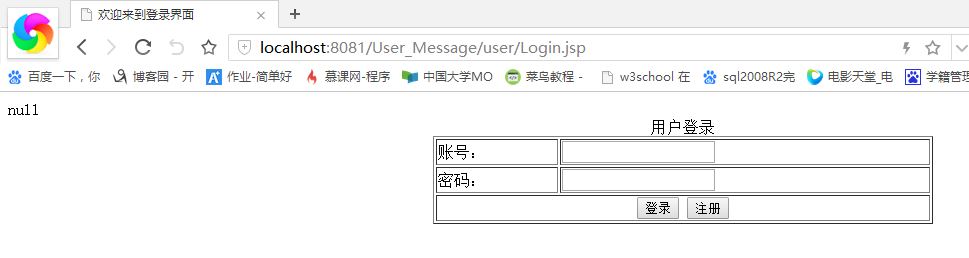
(1)登录界面
<%@ page language="java" contentType="text/html; charset=UTF-8"
    pageEncoding="UTF-8"%>
<!DOCTYPE html PUBLIC "-//W3C//DTD HTML 4.01 Transitional//EN" "http://www.w3.org/TR/html4/loose.dtd">
<html>
<head>
<meta http-equiv="Content-Type" content="text/html; charset=UTF-8">
<title>欢迎来到登录界面</title>
</head>
<body>
<%=request.getAttribute("error") %>
<form action="LoginCheck.jsp" method="post">
    <table align="center" border="1" width="500">
    <caption>用户登录</caption>
        <tr>
            <td>账号:</td>
            <td>
            <input type="text" name="username"/>
            </td>
        </tr>
        <tr>
            <td>密码:</td>
            <td>
            <input type="password" name="password">
            </td>
        </tr>
        <tr align="center">
            <td colspan="2">
            <input type="submit" value="登录"/>
            <input type="button" value="注册" onClick="window.location.href='addInput.jsp'"/>
            </td>
        </tr>
    </table>
</form>
</body>
</html>
(2)登录验证界面
<%@page import="com.jaovo.msg.Util.UserException"%>
<%@page import="com.jaovo.msg.dao.UserDaoImpl"%>
<%@page import="com.jaovo.msg.model.User"%>
<%@ page language="java" contentType="text/html; charset=UTF-8"
    pageEncoding="UTF-8"%>
<!DOCTYPE html PUBLIC "-//W3C//DTD HTML 4.01 Transitional//EN" "http://www.w3.org/TR/html4/loose.dtd">
<html>
<head>
<title>用户身份验证</title>
</head>
<body>
<%
    //接收客户端传递过来的参数
    String username = request.getParameter("username");
    String password = request.getParameter("password");
    if(username == null || "".equals(username.trim())||password == null || "".equals(password.trim()))
    {
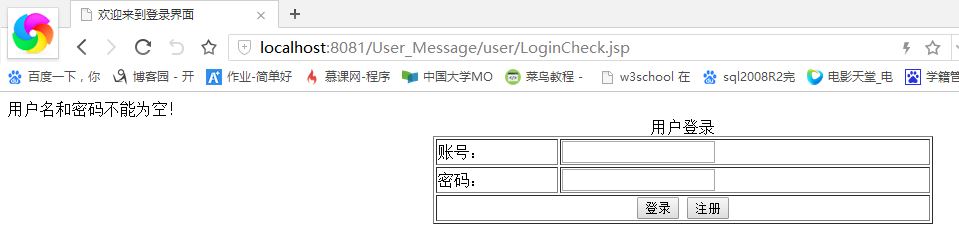
        request.setAttribute("error", "用户名和密码不能为空!");
%>
    <jsp:forward page="Login.jsp"></jsp:forward>
<%
    }
%>
<%
    User user = new User();
    user.setUsername(username);
    user.setPassword(password);
    UserDaoImpl userDao = new UserDaoImpl();
    try
    {
        if(userDao.load(username)==null)
        {
            throw new UserException();
        }
        if(userDao.check(user)==true)
        {
%>
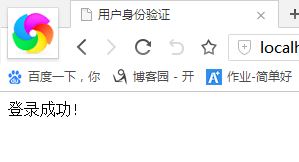
    登录成功!<br>
<%
        }
        else
        {
%>
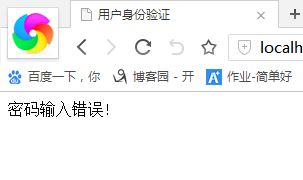
    密码输入错误!<br>
<%
        }
    }
    catch(UserException e)
    {
%>
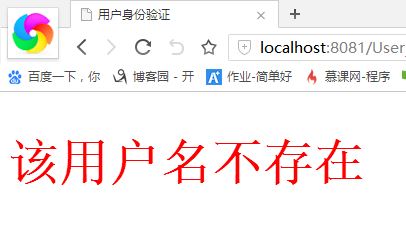
    <h2 style="color:red ; font-size:50px">该用户名不存在</h2>
    <%
    }
    %>
    </body>
</html>
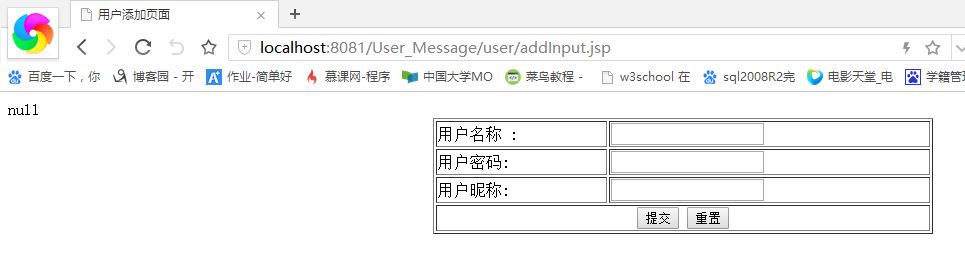
(3)用户注册界面
<%@ page language="java" contentType="text/html; charset=UTF-8"
    pageEncoding="UTF-8"%>
<!DOCTYPE html PUBLIC "-//W3C//DTD HTML 4.01 Transitional//EN" "http://www.w3.org/TR/html4/loose.dtd">
<html>
<head>
    <title>用户添加页面</title>
</head>
<body>
    <form action="add.jsp" method="get">
        <table align="center" border="1" width="500">
            <tr>
                <td>用户名称 : </td>
                <td>
                    <input type="text" name="username" />
                </td>
            </tr>
                <tr>
                <td>用户密码:</td>
                <td>
                    <input type="password" name="password" />
                </td>
            </tr>
            <tr>
                <td>用户昵称:</td>
                <td>
                    <input type="text" name="nickname" />
                </td>
            </tr>
            <%=request.getAttribute("error") %>
            <tr align="center">
                <td colspan="2">
                    <input type="submit" value="提交" />
                    <input type="reset" value="重置" />
                </td>
            </tr>
        </table>
    </form>
</body>
</html>
(4)注册结果界面
<%@page import="com.jaovo.msg.Util.UserException"%>
<%@page import="com.jaovo.msg.dao.UserDaoImpl"%>
<%@page import="com.jaovo.msg.model.User"%>
<%@ page language="java" contentType="text/html; charset=UTF-8" pageEncoding="UTF-8"%>
<!DOCTYPE html PUBLIC "-//W3C//DTD HTML 4.01 Transitional//EN" "http://www.w3.org/TR/html4/loose.dtd">
<html>
<head>
<title>用户添加页面</title>
</head>
<body>
<%
    //接收客户端传递过来的参数
    String username = request.getParameter("username");
    String password = request.getParameter("password");
    String nickname = request.getParameter("nickname");
    if(username == null || "".equals(username.trim())||password == null || "".equals(password.trim())){
        request.setAttribute("error", "用户名和密码不能为空!");
%>
    <jsp:forward page="addInput.jsp"></jsp:forward>
<%
    }
%>
<%
    User user = new User();
    user.setUsername(username);
    user.setPassword(password);
    user.setNickname(nickname);

    UserDaoImpl userDao = new UserDaoImpl();
    try{
    userDao.add(user);
%>
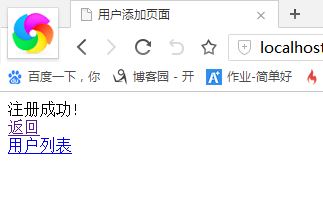
    注册成功!<br>
    <a href="addInput.jsp">返回</a><br>
    <a href="#">用户列表</a>
<%
    }catch(UserException e){
%>
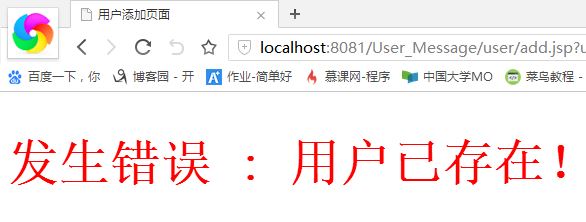
    <h2 style="color:red ; font-size:50px">发生错误 : <%=e.getMessage() %></h2>
    <%
    }
    %>
    </body>
</html>
7.运行结果界面截图:
(1)登录界面
(2)登录成功
(3)用户名或密码为空
(4)用户名不存在
(5)密码错误
(6)注册界面
(7)注册成功
(8)注册重复